Quart d'heure insolite #31 : Paradoxes de l'astronautique
Unusual Quarter Hour #31: Paradoxes of Astronautics
Keywords
Summary
154 words
Critical Evaluation
Value of the Information & Strength of the Argument
The information presented is highly valuable for understanding the counterintuitive nature of orbital mechanics. Taillet effectively uses animations to illustrate complex concepts, making them accessible. The argumentation is solid, grounded in Newtonian mechanics and clearly explained step by step. He anticipates common misconceptions and addresses them directly, such as the idea that accelerating brings you closer to a target ahead. The use of real-world examples, like the McDivitt rendezvous attempt, strengthens the argument by showing how even astronauts initially struggled with these concepts. The distinction between inertial and rotating reference frames is explained with precision, and the introduction of fictitious forces is justified as a mathematical tool rather than a physical reality. The overall argument is coherent and persuasive, building from simple qualitative demonstrations to more nuanced discussions of forces.
Scientific Rigor, Source Quality, Title Accuracy
The scientific rigor is high, as the content is based on well-established physics. Taillet references a specific textbook, ‘Understanding Space: An Introduction to Astronautics’, which he recommends for further study. He also mentions historical accounts, such as the McDivitt incident, though the exact source is not fully cited in the transcript. The title ‘Paradoxes of astronautics’ accurately reflects the content, as the entire talk is structured around counterintuitive phenomena in spaceflight. The ad-equation between title and content is excellent. No comments were provided for analysis.
230 words
Title / Content Match
The title accurately reflects the content: the video explores several counterintuitive aspects of spaceflight mechanics, framed as paradoxes. The presentation stays focused on these themes throughout.
Quality & Reliability
9/10
Content delivered by a university physics professor, based on established Newtonian mechanics and orbital dynamics. The explanations are rigorous, with clear distinctions between intuitive misconceptions and physical reality. The speaker acknowledges the counterintuitive nature of the subject and provides accurate descriptions of phenomena such as the rendezvous paradox, the role of fictitious forces, and the importance of reference frames. No factual errors detected.
Key Moments
Markers derived by PSI from the transcript: the creator did not define chapters.
- Introduction and definition of paradoxes.
- Examples of paradoxes: logical, trickery, and counterintuitive.
- Transition to astronautics and Newtonian mechanics.
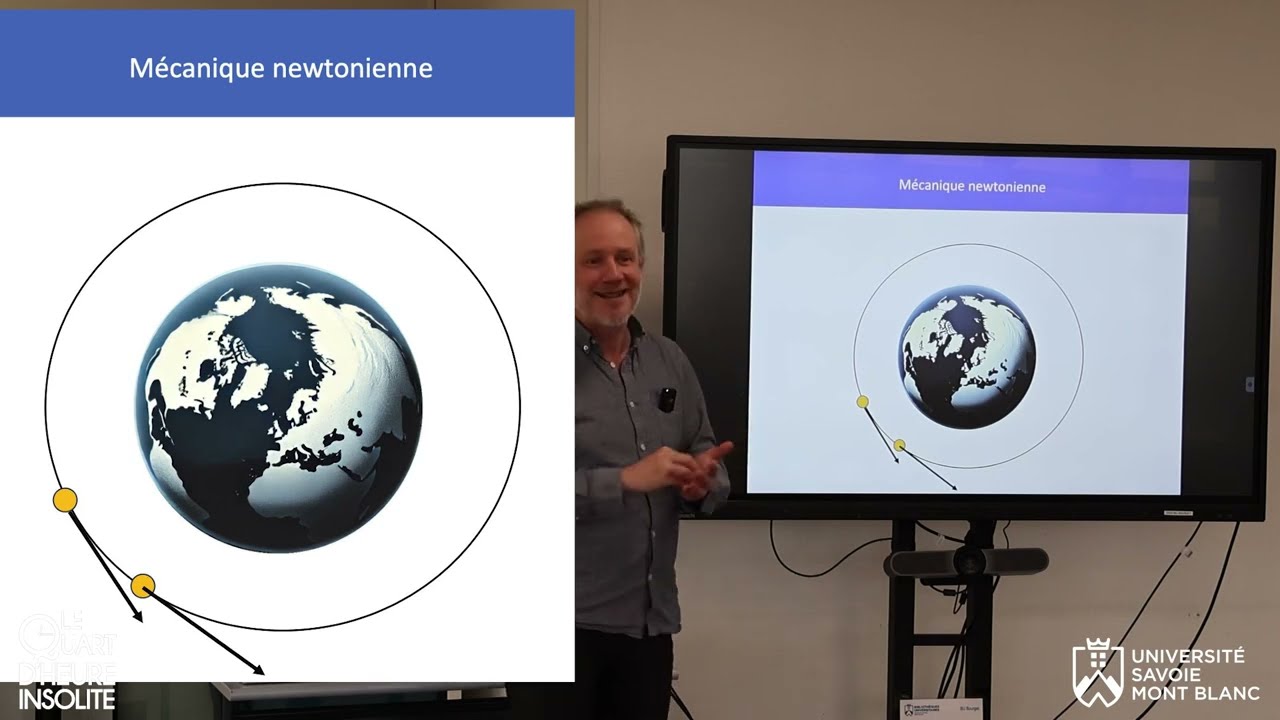
- The rendezvous problem: why accelerating doesn't work.
- Animation showing the counterintuitive maneuver: decelerate to catch up.
- Reference frames and fictitious forces.
- Explanation of centrifugal and Coriolis forces.
- Historical example: McDivitt's rendezvous attempts.
- Conclusion and Q&A.
Cited Sources
- Understanding Space: An Introduction to Astronautics — Recommended textbook for further study on astronautics.
Contribution & Novelties
The video’s original contribution lies in its clear, accessible explanation of the counterintuitive aspects of orbital mechanics, using animations and real-world examples. It bridges the gap between basic physics and practical spaceflight, highlighting why our intuition fails in space. The presentation of the rendezvous paradox and the role of fictitious forces is particularly enlightening for non-experts.
Pour aller plus loin :
- Orbital mechanics — Wikipedia article covering the fundamentals of orbital motion.
- Space rendezvous — Wikipedia article explaining the rendezvous maneuver and its challenges.
- Coriolis force — Wikipedia article on the Coriolis effect and its applications.
- Centrifugal force — Wikipedia article discussing the concept and its use in rotating frames.
110 words
Radar Profile
The radar shows a strong emphasis on information quality and reliability, with high scores in those areas. The technical level is moderately high, suitable for an informed audience. The quantity of information is substantial, covering multiple paradoxes and their explanations. Overall, the profile indicates a well-structured, scientifically accurate presentation.