Introduction à la mécanique en L1 : étude d'une subtilité
Introduction to mechanics in the first year of university: a study of a subtlety
Keywords
Summary
204 words
Critical Evaluation
Value of the Information & Strength of the Argument
The value of the video lies in its pedagogical approach: it presents an intuitive but incorrect solution, exposes its flaw through extreme case reasoning, and then builds the correct solution step by step. The argumentation is rigorous, with clear free-body diagrams and explicit application of Newton’s second law. The instructor carefully distinguishes the assumptions (non-extensible massless string) and highlights the common mistake of equating tension to weight. The use of energy conservation as a cross-check further strengthens the explanation. The reasoning is logical and easily followed, making it an effective teaching tool.
Scientific Rigor, Source Quality, Title Accuracy
The video is scientifically rigorous: the physics is correct, the derivations are accurate, and the pedagogical method is sound. The title ‘Introduction à la mécanique en L1 : étude d’une subtilité’ fairly describes the content, as it is an introduction to a subtle point in mechanics suitable for first-year students. No external sources are cited, but the content is self-contained and relies on standard principles of classical mechanics. The description provides no further links, so the video stands on its own merit. The adequacy between title and content is high, as the video indeed studies a subtlety that commonly confuses students.
208 words
Title / Content Match
The title accurately reflects the content: an introduction to a subtle mechanics problem often encountered in first-year university physics.
Quality & Reliability
9/10
The video is produced by a physics professor, the reasoning is rigorous, and the demonstration is correct. It addresses a common misconception with clear counterexamples and a full correct solution.
Key Moments
Markers derived by PSI from the transcript: the creator did not define chapters.
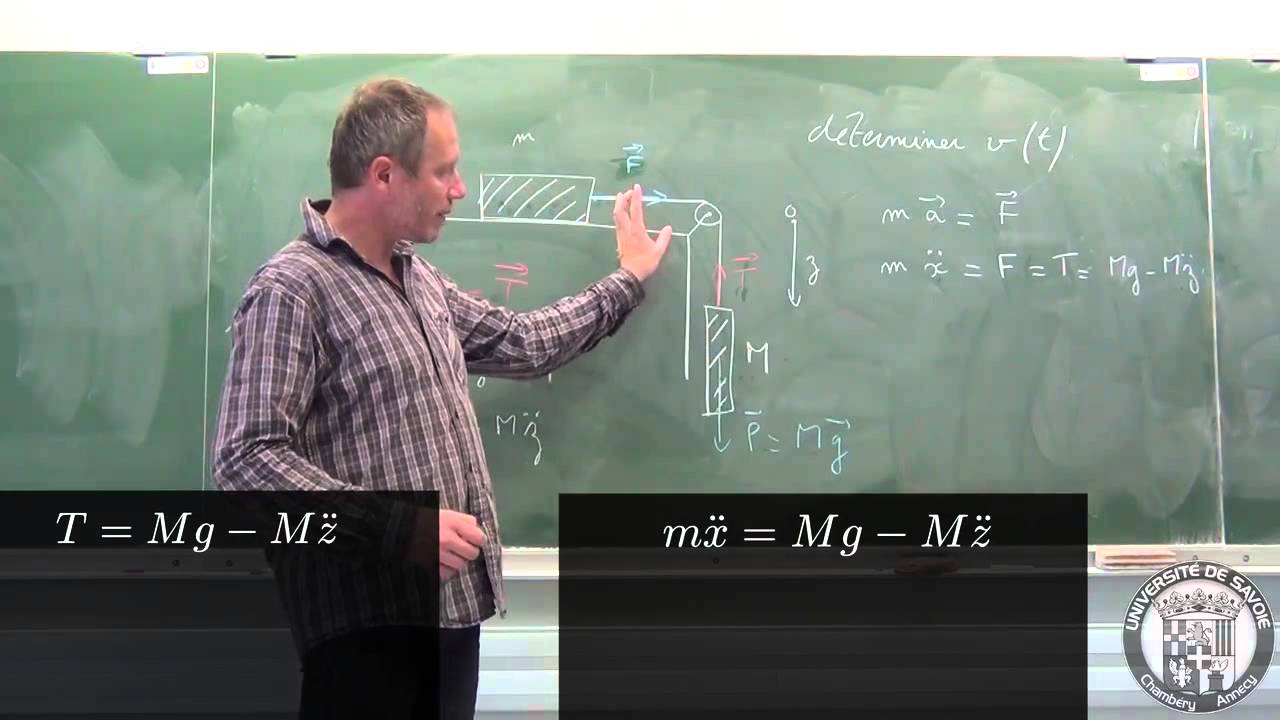
- Introduction of the problem: a mass on a frictionless table attached via a pulley to a hanging mass, asking for the velocity as a function of time.
- Presentation of the erroneous solution assuming the tension equals the weight of the hanging mass, leading to an overestimated acceleration.
- Physical counterexample with an elephant and a mouse to show that the erroneous result is implausible.
- Correct free-body analysis of the hanging mass, deriving the tension as not equal to the weight.
- Applying Newton's second law to both masses and obtaining the correct acceleration a = M/(M+m)g.
- Deriving velocity and position from the acceleration, and comparing with the limiting cases.
- Using energy conservation to find the velocity in terms of displacement, and concluding with the general lesson about tension and support reactions.
Contribution & Novelties
This video offers a clear and rigorous explanation of a common misconception in mechanics: the assumption that the tension in a rope equals the weight of the hanging mass when a mass is pulled over a pulley. It demonstrates the correct application of Newton’s second law and energy conservation, and highlights the importance of drawing free-body diagrams. The novel aspect is the pedagogical approach of first presenting a flawed solution and then identifying the exact error, which helps students internalize the correct methodology.
Pour aller plus loin :
- Newton’s laws of motion — Foundational principles used in the resolution.
- Atwood machine — A related classic problem involving pulleys and masses.
- Mechanical energy — The conservation principle applied to solve the velocity in terms of displacement.
- Tension (physics) — The concept of tension in a string and its analysis.
138 words
Radar Profile
The radar profile shows high scores in quality, reliability, and quantity of information, with a moderate technical level appropriate for first-year physics. The video is strong in scientific rigor and clarity, making it an excellent educational resource.