Quart d'Heure Insolite #04 : jouer au morpion avec des chats de Schrödinger
Unusual Quarter Hour #04: Playing tic-tac-toe with Schrödinger's cats
Keywords
Summary
156 words
Critical Evaluation
Value of the Information & Strength of the Argument
The value of the information lies in its accessible presentation of a core quantum concept (superposition) and a concrete, interactive tool to grasp it. The argumentation is coherent: Taillet builds step-by-step from atomic decay to the paradox and then to the game, using analogies and a lexicon (‘plouf’) to bridge the linguistic gap. He acknowledges the counterintuitive nature and does not oversimplify the ongoing debate, while maintaining a clear thread. The live demonstration of the game reinforces the pedagogical value, though the games themselves are not fully analyzed, limiting the depth of the explanation.
Scientific Rigor, Source Quality, Title Accuracy
The scientific content is accurate as far as it goes: the description of superposition and measurement aligns with standard quantum mechanics. However, the talk is deliberately non-rigorous, with Taillet saying ‘I ask you to trust me’ for certain claims, and he avoids discussing interpretations of the measurement problem. No scientific sources are cited on screen, but the description provides a Facebook page for the series, not a bibliography. The title is appropriate and matches the playful tone, contributing positively to the overall coherence.
192 words
Title / Content Match
The title accurately reflects the video's content: it introduces Schrödinger's cat and a quantum version of tic-tac-toe, with a playful tone that matches the 'insolite' (unusual) series.
Quality & Reliability
7/10
The presenter is a physics professor at the University of Savoy, providing reliable background. The explanation of quantum superposition and the Schrödinger's cat thought experiment is accurate but simplified for a general audience. The video does not cite specific scientific sources, relying on the presenter's authority and the description's link to a Facebook page for updates.
Key Moments
Markers derived by PSI from the transcript: the creator did not define chapters.
- Introduction: purpose of the 'Quart d'Heure Insolite' and practical announcements.
- Explanation of radioactive decay and the concept of superposition ('plouf').
- Presentation of Schrödinger's cat thought experiment and the measurement problem.
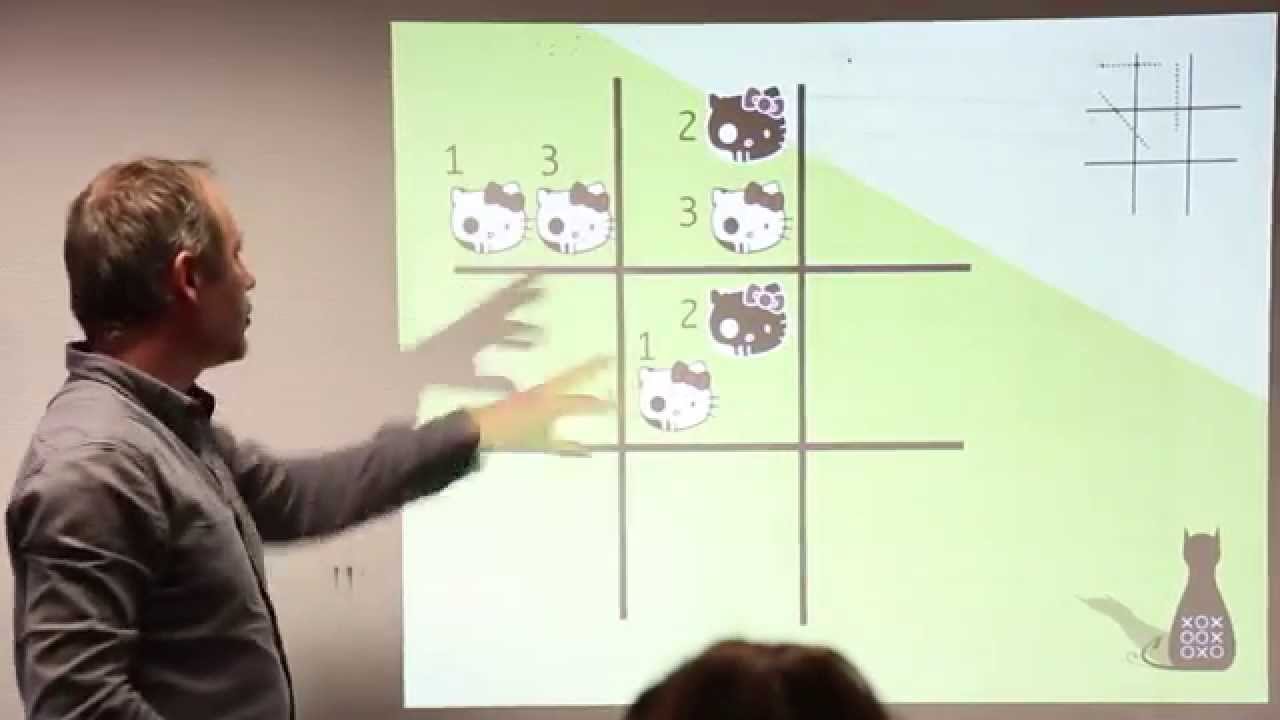
- Introduction to quantum tic-tac-toe: rules and how it uses superposition.
- Demonstration of example games and a live online match.
- Conclusion, acknowledgments, and teaser for the next session on Interstellar.
Cited Sources
- Le Quart d'Heure Insolite official Facebook page — The description provides this link for updates on the conference series and extra content.
Concurring Sources
- Schrödinger's cat - Wikipedia — Concords with the video's description of the thought experiment.
- Quantum superposition - Wikipedia — Supports the concept of 'plouf' that the video introduces.
- Quantum tic-tac-toe - Wikipedia — Validates the game's existence and rules, as presented in the video.
Contribution & Novelties
The video contributes a creative pedagogical approach by connecting the abstract concept of quantum superposition to a familiar game, making it tangible for a non-expert audience. The original contribution is the live presentation of the quantum tic-tac-toe game, which was invented by physicist Elay Shech in 2006 (though the name is not mentioned in the video), and Taillet effectively uses it to illustrate the idea of multiple possible states before measurement. This bridges theoretical physics and recreational learning.
Pour aller plus loin :
- Schrödinger’s cat on Wikipedia — A comprehensive overview of the thought experiment, its historical context, and interpretations.
- Quantum superposition on Wikipedia — The fundamental principle that allows a quantum system to be in multiple states simultaneously, central to the video’s explanation.
- Quantum tic-tac-toe — The specific game presented, with rules and strategies, confirming its existence and inventor.
- Measurement problem on Wikipedia — Discusses the unresolved theoretical issues about what constitutes a measurement, relevant to the video’s discussion of the cat paradox.
164 words
Radar Profile
The radar profile shows a moderate quantity of information (6/10) but high qualitative accuracy (8/10), reflecting that the video is concise yet precise. The technical level is low (4/10) as expected for a general audience. Global reliability is decent (7/10) due to the expert presenter, but the lack of explicit sources reduces the score.