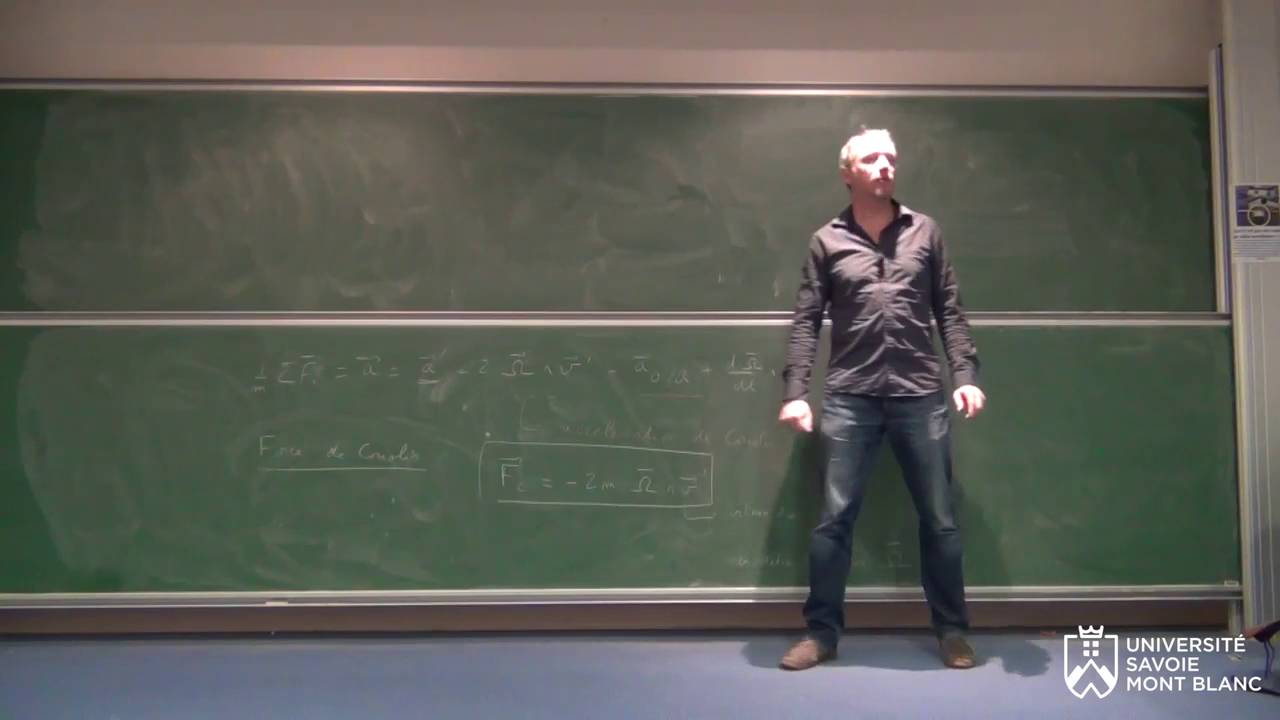
Mécanique, semestre 2, cours 7 : force de Coriolis
Mechanics, semester 2, lesson 7: Coriolis force
Keywords
Summary
158 words
Critical Evaluation
Value of the Information & Strength of the Argument
The value of this lecture lies in its clear pedagogical approach, breaking down a complex physical concept into digestible steps. The argumentation is solid: it starts from first principles (the acceleration transformation), derives the Coriolis force, and then applies it to concrete examples. The professor emphasizes intuition and practical estimation, which helps students grasp the abstract concept. The reasoning is logical and consistent throughout, with careful attention to sign conventions and vector operations.
Scientific Rigor, Source Quality, Title Accuracy
The lecture is scientifically rigorous, adhering to standard textbook treatments of the Coriolis force. The professor provides links to his course materials (podcast.grenet.fr) for further reference, which adds credibility. The title matches the content precisely, and no misleading claims are made. The only minor point is that the video does not cite external scientific papers, but for a lecture this is acceptable as it relies on established physics.
156 words
Title / Content Match
The title accurately describes the content: a lecture on the Coriolis force within a mechanics course.
Quality & Reliability
8/10
The lecture is presented by a professor of physics, based on established principles of mechanics. The content is clear, rigorous, and includes derivation of the Coriolis force. No major errors detected, but it is a single lecture without external verification.
Key Moments
Markers derived by PSI from the transcript: the creator did not define chapters.
- Introduction and review of acceleration transformation between frames
- Definition and motivation of the Coriolis force
- First example: train on rails, qualitative discussion of rail wear
- Quantitative estimation of Coriolis force on a high-speed train
- Application to atmospheric phenomena (hurricanes, winds) and ocean currents
- Summary and conclusion, reminders about the scope of the force
Cited Sources
- Mécanique du point (PHYS 111) - podcast.grenet.fr — Description de la vidéo : lien vers la version à jour du cours complet.
- Cours de cosmologie (M1) - podcast.grenet.fr — Autre cours de l'université de Savoie mentionné en description.
- Introduction à la relativité générale (M1) - podcast.grenet.fr — Autre cours de physique avancée proposé par l'auteur.
Contribution & Novelties
The lecture provides a pedagogical treatment of the Coriolis force, emphasizing conceptual understanding and practical calculation. While not original research, it effectively explains a subtle concept to undergraduate students. The use of a TGV example makes the abstract force tangible, and the step-by-step derivation aids retention.
Pour aller plus loin :
- Coriolis force (Wikipedia) — Approximation détaillée de la force de Coriolis, historique et applications.
- Foucault pendulum (Wikipedia) — Expérience classique illustrant la rotation de la Terre via la force de Coriolis.
- Rotating reference frame (Wikipedia) — Concepts de forces fictives dans les référentiels en rotation.
96 words
Radar Profile
The scores indicate a well-rounded lecture: high information density, solid quality, appropriate technical level, and reliable content. The radar profile is balanced with no major weaknesses, reflecting a comprehensive physics lecture.
💬 Sur les 13 commentaires analysés, le climat est positif : les téléspectateurs expriment leur gratitude et leur admiration pour la clarté des explications, bien que certains évoquent des critiques sur le système éducatif.