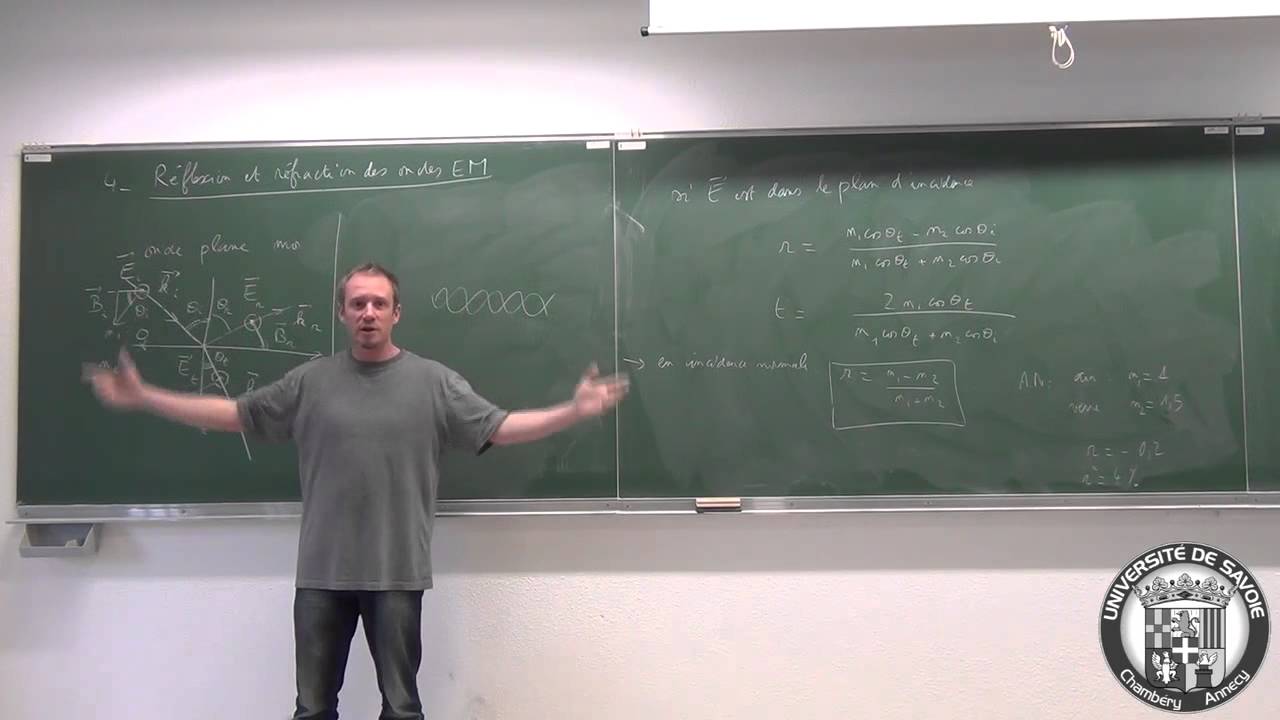
cours #9 d'introduction à l'électromagnétisme
course #9 introduction to electromagnetism
Keywords
Summary
139 words
Critical Evaluation
Value of the Information & Strength of the Argument
The lecture provides a solid pedagogical exposition of classical electromagnetism. The argumentation is rigorous: starting from Maxwell’s equations and boundary conditions, the lecturer derives the reflection and refraction laws without skipping essential steps. The treatment of the two principal polarizations (TE and TM) and the derivation of Fresnel coefficients are clear and logically structured. The transition to conducting media is handled with appropriate approximations, introducing the complex permittivity and the resulting attenuation. The value lies in the coherent progression from fundamental equations to practical results, which is highly instructive for students. The lecturer frequently emphasizes physical interpretations, connecting mathematical results to intuitive behaviors. The reasoning is deductive and consistent, with no unsupported claims.
Scientific Rigor, Source Quality, Title Accuracy
The lecture adheres to the standard framework of classical electrodynamics. No external sources are cited within the video, but the pedagogical content follows established textbooks (e.g., Griffiths, Jackson). The only link provided is a podcast repository hosting the complete course. The title accurately reflects the content: it is indeed the ninth lecture in an electromagnetism series, covering reflection/refraction and conductors. The alignment between title and content is exact. Given that this is a recorded university lecture, the scientific rigor is inherent in the teaching context. No contradictions or questionable aspects were identified. The transcript quality is poor due to speech transcription errors, but the underlying mathematical structure remains discernible.
237 words
Title / Content Match
The title accurately describes the content: it is the ninth lecture of an electromagnetism course, consistent with the topics discussed.
Quality & Reliability
7/10
The content is a university lecture on electromagnetism, covering reflection and refraction of electromagnetic waves at dielectric interfaces and propagation in conductors. The reasoning is based on standard Maxwell equations and boundary conditions. However, the provided transcript is heavily garbled due to automatic speech recognition errors, making it impossible to verify every detail. The pedagogical approach appears rigorous and methodical.
Key Moments
Markers derived by PSI from the transcript: the creator did not define chapters.
- Introduction and announcement of the lecture topic: reflection and refraction at a dielectric interface.
- Review of Maxwell's equations and boundary conditions for electric and magnetic fields at an interface.
- Derivation of Fresnel coefficients for perpendicular polarization (TE mode).
- Derivation for parallel polarization (TM mode) and discussion of Brewster angle.
- Transition to propagation in a conductor, introducing complex permittivity and skin depth.
- Summary and final remarks on the course, including energy considerations.
Cited Sources
- Podcast Grenet – Cours d'électromagnétisme — Link provided in the video description to download the full course in HD.
Contribution & Novelties
This lecture offers a thorough derivation of reflection and refraction from first principles, reinforcing the connection between Maxwell’s equations and macroscopic optical phenomena. The treatment of conducting media extends the analysis to real-world applications such as shielding and wave absorption. The pedagogical value is high for students seeking to consolidate their understanding of wave-particle interactions at boundaries.
Pour aller plus loin :
- Snell’s law - Wikipedia — Directly relates to the reflection/refraction law derived in the lecture.
- Fresnel equations - Wikipedia — The specific coefficients for reflected and transmitted amplitudes are derived here.
- Skin effect - Wikipedia — The concept of skin depth in conductors is explained, matching the second part of the lecture.
114 words
Radar Profile
The profile shows a strong emphasis on technical depth and methodological clarity, with high scores in 'niveau_technique' and 'fiabilite_globale'. The information quantity and quality are adequate for a university lecture, though the presentation is not particularly data-dense. The overall balance indicates a solid, reliable educational resource for advanced undergraduate physics.