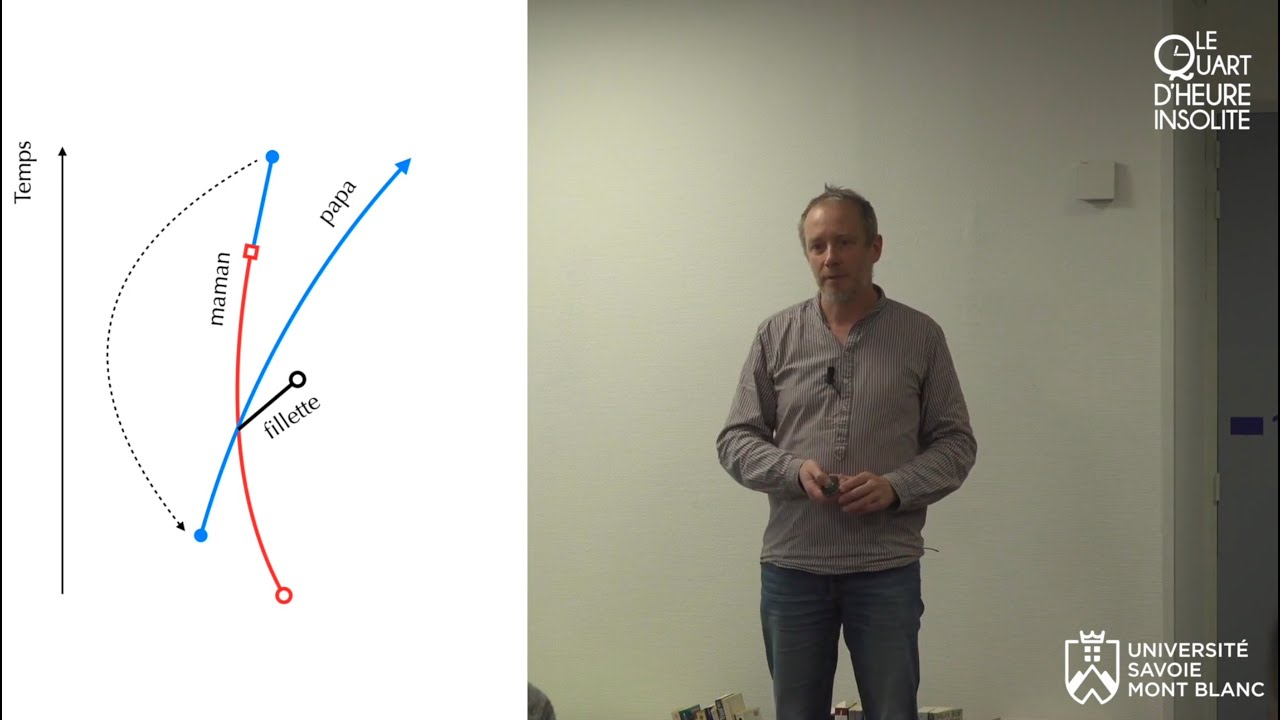
Quart d'Heure Insolite #21 : le voyage dans le temps
Quarter of an Hour Unusual #21: time travel
Keywords
Summary
175 words
Critical Evaluation
Value of the Information & Strength of the Argument
The lecture offers substantial value through its interdisciplinary approach, merging physics with philosophy and literature. Taillet’s argumentation is solid: he builds from intuitive everyday analogies to the rigorous deterministic framework of classical physics, culminating in the block universe model. He effectively uses Laplace’s demon to demonstrate the logical consequence of determinism—that the future is as fixed as the past—and connects this to H.G. Wells’ literary vision. The reasoning is clear and supported by historical sources and examples, making complex ideas accessible without oversimplifying. The presentation is well-structured, moving from definitions to physical implications, and encourages the audience to reflect on the nature of time.
Scientific Rigor, Source Quality, Title Accuracy
The scientific rigor is high: Taillet is a physicist and references well-known works (Laplace’s ‘Essai philosophique sur les probabilités’, Wells’ ‘The Time Machine’, Gleick’s ‘Time Travel’) and concepts (block universe, determinism). He correctly attributes the idea of time travel as a modern invention to H.G. Wells and distinguishes between physical determinism and philosophical implications. The title ‘Le voyage dans le temps’ accurately encapsulates the content, as the lecture centers on time travel and its theoretical foundations. The sources mentioned are credible and historically relevant, though no live links are provided in the description; the citations are based on the spoken transcript. Overall, the content demonstrates thorough scholarship and clarity.
228 words
Title / Content Match
The title accurately reflects the central theme of time travel, and the video discusses the scientific and philosophical aspects of time travel and the concept of time.
Quality & Reliability
8/10
The speaker is a physics researcher and professor at the University of Savoie Mont Blanc. The presentation is based on well-established scientific concepts (Laplace's demon, block universe, determinism) and references historical works (H.G. Wells, James Gleick). The reasoning is clear, structured, and grounded in physical theory, with appropriate citations to literature and historical context.
Key Moments
Markers derived by PSI from the transcript: the creator did not define chapters.
- Introduction to the theme and context of the lecture, thanking the MMI students.
- Discussion on how we perceive time through analogies: river, quantity, circle, and cultural differences.
- Examination of the existence of time, breaking it into past, present, and future.
- Explanation of Laplace's demon and the deterministic universe, leading to the block universe concept.
- Introduction of H.G. Wells' 'The Time Machine' and the invention of the idea of time travel.
- Cultural variations in representing time direction, including the Aymara and Mandarin examples.
Cited Sources
- Time Travel — Book by James Gleick, which inspired the speaker to give this lecture.
- The Time Machine — Novel by H.G. Wells, discussed as the first explicit time travel story.
- A Philosophical Essay on Probabilities — Work by Pierre-Simon Laplace, quoted to introduce the concept of a deterministic universe.
- L'analogie, cœur de la pensée — Book by Douglas Hofstadter and Emmanuel Sander, mentioned to discuss the role of analogy in reasoning.
- Gödel, Escher, Bach — Book by Douglas Hofstadter, referenced as a prior discovery of the speaker.
Contribution & Novelties
This lecture provides a unique interdisciplinary perspective on time travel, connecting classical physics, philosophy, and literature. It clarifies common misunderstandings about the block universe and determinism, and traces the cultural origins of the time travel concept to H.G. Wells. The speaker’s background as a physicist adds authority, and the use of everyday analogies makes the abstract ideas relatable. The lecture also highlights how language and culture shape our perception of time, a often-overlooked angle.
Pour aller plus loin :
- Eternalism (philosophy of time) — The view that past, present, and future are all equally real, related to the block universe concept.
- Laplace’s demon — Thought experiment central to determinism, discussed in the lecture.
- The Time Machine — H.G. Wells’ novel that popularized the idea of time travel.
127 words
Radar Profile
The radar profile shows balanced scores across information quantity, quality, and reliability, with a slightly lower technical level, indicating content that is rich and accurate but accessible to a general audience.