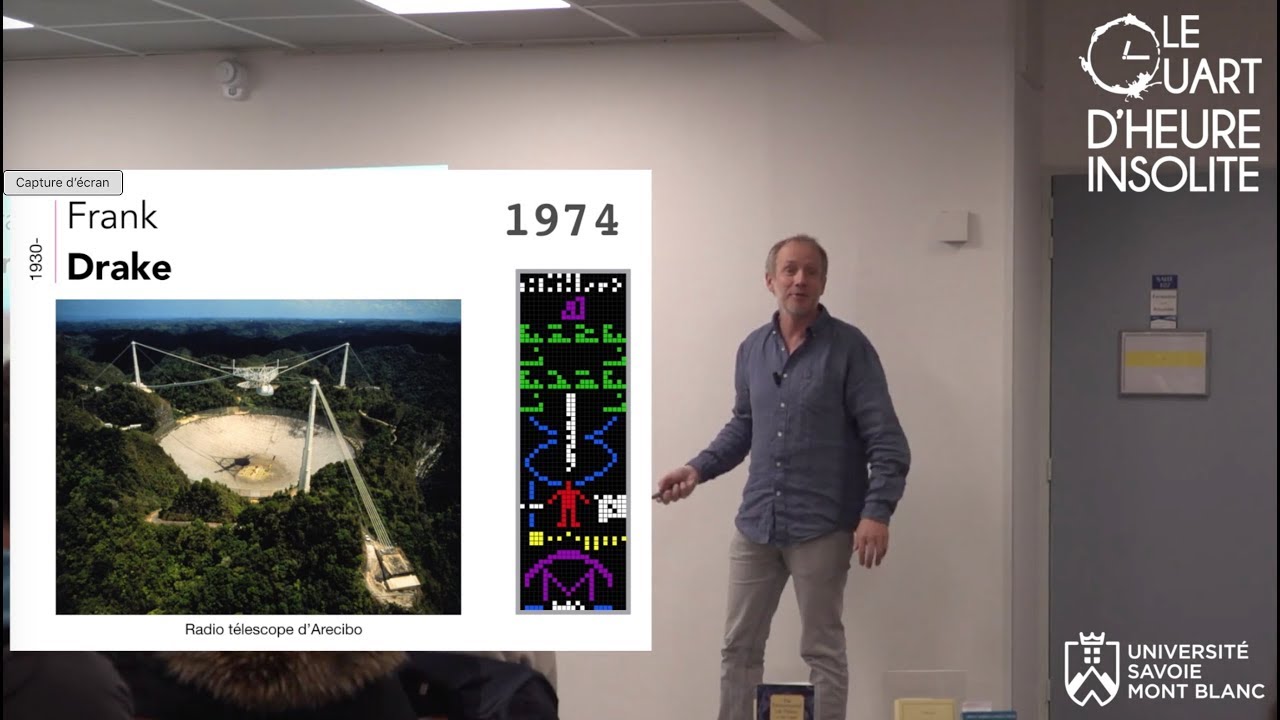
Quart d'Heure Insolite #19 : la vie extraterrestre
Unusual Quarter Hour #19: extraterrestrial life
Keywords
Summary
171 words
Critical Evaluation
Value of the Information & Strength of the Argument
The value of this talk lies in its clear historical narrative that connects philosophical, theological, and scientific threads. Taillet skillfully argues that the question of extraterrestrial life has always been intertwined with human self-perception and theology, as shown by the religious objections in the 17th century and even in 1854. The argumentation is logical and well-structured, progressing chronologically and highlighting each thinker’s contribution. However, the talk is more descriptive than analytical; it does not critically evaluate the strength of past claims or the plausibility of extraterrestrial life based on modern exoplanet research. The points are supported by anecdotes and quotations, but a deeper engagement with current astrobiological evidence would strengthen the argument.
Scientific Rigor, Source Quality, Title Accuracy
The scientific rigor is moderate: Taillet references several historical works, but he does not provide detailed citations or primary sources. He mentions books by Meunier and others, yet the talk serves as a broad overview rather than a rigorous review. The title ‘Quart d’Heure Insolite #19: la vie extraterrestre’ accurately describes the content, though it lasts 48 minutes, exceeding the typical quarter-hour format. The sources used are credible but not exhaustive; the presenter’s expertise adds authority, but the lack of weblinks and exact references limits verifiability. The title is faithful, and the content aligns well with it, though the ‘unusual quarter hour’ branding suggests a lighter tone than the fairly dense historical exposition.
240 words
Title / Content Match
The title accurately reflects the content, which explores the concept of extraterrestrial life through historical and scientific perspectives.
Quality & Reliability
8/10
The talk is given by a physicist with deep knowledge of the historical and scientific aspects, but it relies on secondary sources and popular books rather than original research. The content is accurate but not exhaustively referenced.
Key Moments
Markers derived by PSI from the transcript: the creator did not define chapters.
- Introduction to the series and announcement of upcoming topics
- Citation from Kepler via Burton, opening of War of the Worlds
- Giordano Bruno's execution for his belief in plural worlds
- William Herschel's telescopes and belief in lunar inhabitants
- 19th-century developments: astrophysics, Darwin, and Mars canals
- Discussion on animal intelligence and conclusion
Cited Sources
- Des extraterrestres: l'âge du débat (1750-1900) — Historical book on the debate about extraterrestrial life
- La dernière frontière: imaginer d'autres mondes — Modern history of imagining other worlds
- Robert Burton, The Anatomy of Melancholy (1621) — Cited for quoting Kepler
- H.G. Wells, War of the Worlds (1898) — Novel opening cited
Contribution & Novelties
The talk’s originality lies in its synthesis of historical and philosophical perspectives on extraterrestrial life, showing how early debates were shaped by religious and cultural contexts rather than empirical evidence. Taillet brings a physicist’s perspective to historical material, making connections between Laplace’s nebular hypothesis and modern planetary formation. The talk fills a gap in popular content by focusing on the pre-modern history of the idea, which is often overlooked.
Pour aller plus loin :
- Plurality of worlds (Wikipedia) — Historical overview of the concept.
- Drake equation (Wikipedia) — A modern probabilistic attempt to estimate intelligent civilizations.
- Fermi paradox (Wikipedia) — The argument about the apparent absence of extraterrestrial civilizations.
- Exoplanets (Wikipedia) — The empirical hunt for habitable worlds today.
119 words
Radar Profile
The radar profile shows a strong overall quality with high scores in quantity of information and reliability, but slightly lower scores in technical level and information quality. This indicates a broad, accessible talk that is well-sourced and informative, though not deeply technical or original in its data.
💬 Très positif : Sur les 30 commentaires analysés, la grande majorité sont chaleureux et exprime une grande appréciation pour le retour de la série et la qualité de l'exposé, avec un seul commentaire négatif. Le public semble fidèle et enthousiaste.