Quart d'Heure Insolite #27 : l'arc-en-ciel
Unusual Quarter Hour #27: The Rainbow
Keywords
Summary
145 words
Critical Evaluation
Value of the Information & Strength of the Argument
The video provides a novel and intuitive explanation of rainbows by focusing on the geometrical optics of a single water droplet and the concept of caustics. The argumentation is solid: the presenter uses simple demonstrations and derives the key results qualitatively. He carefully explains why the rainbow appears as an arc and why different colors separate. The analogy with a glass of water makes the phenomenon relatable. The discussion about the historical aspect of color counting adds interest.
Scientific Rigor, Source Quality, Title Accuracy
The scientific rigor is high: the presenter is a physicist and the explanation aligns with standard optics. He mentions a source (the book by Lévy-Leblond) and uses a Wikipedia image (though not explicitly cited). The title is appropriate. No other external sources are cited, but the talk is self-contained. The presentation is well-structured and engaging.
148 words
Title / Content Match
The title 'Quart d'Heure Insolite #27 : l'arc-en-ciel' accurately reflects the content: a quirky 15-minute talk (actually longer) about the rainbow. The video indeed covers various surprising aspects of rainbows.
Quality & Reliability
8/10
The presenter is a research physicist at Université Savoie Mont Blanc. The explanation is based on well-established optical principles (refraction, reflection, caustics, dispersion). The talk includes live demonstrations and refers to a book by Jean-Marc Lévy-Leblond. Minor simplifications are made for pedagogical purposes, but the core science is accurate.
Key Moments
Markers derived by PSI from the transcript: the creator did not define chapters.
- Experiment with a water glass: observing reflections and colors on the rear surface.
- Demonstration with water droplets on a hydrophobic surface, showing colors on individual droplets.
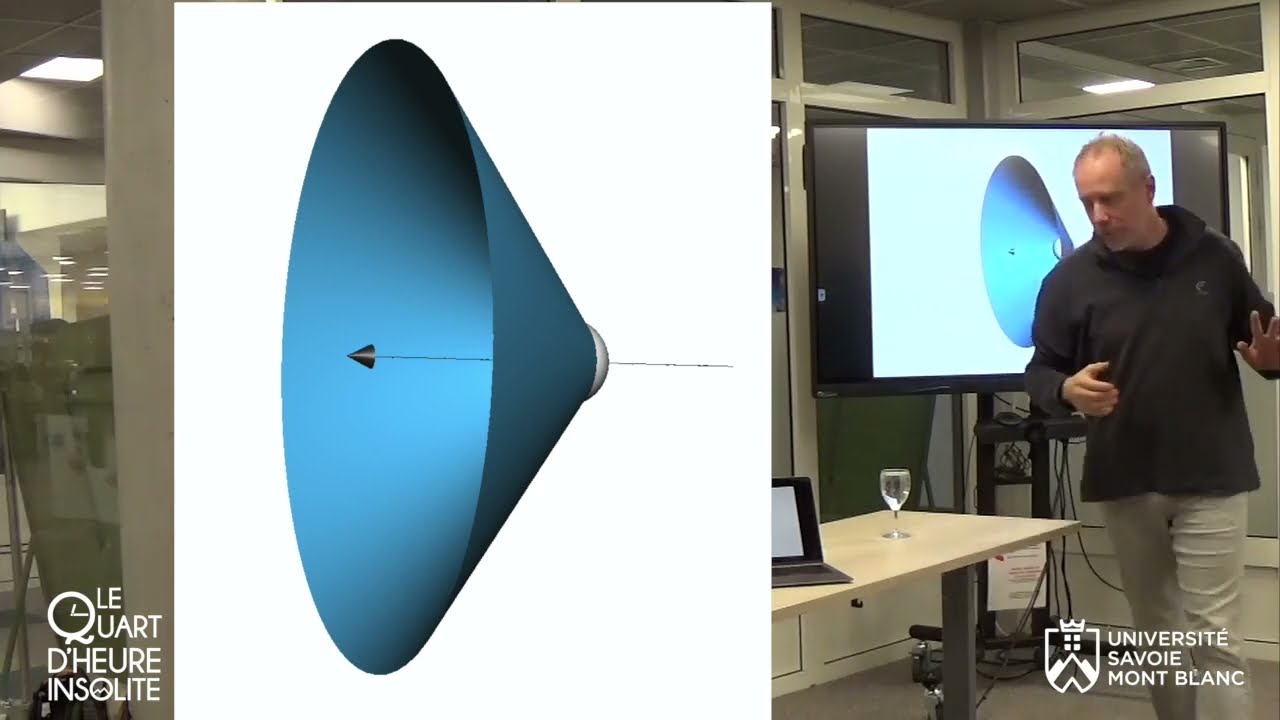
- Explanation of light path in a droplet: refraction, internal reflection, and formation of a caustic.
- Introduction of the cone of emission and the origin of the rainbow arc; explanation of Alexander's dark band.
- Discussion of dispersion and why colors separate due to wavelength-dependent refractive index.
- Historical note on the number of colors in a rainbow and Newton's introduction of indigo.
Cited Sources
- La vitesse de l'ombre — Mentioned in the video as a reference for the discussion of rainbow colors and epistemology.
- Quart d'Heure Insolite Facebook page — Link provided in the video description for following news about the series.
Contribution & Novelties
The video offers a fresh pedagogical approach to rainbows by emphasizing the role of caustics and the cone of emission, making the explanation visual and intuitive. It also highlights the often-overlooked distinction between rainbow colors and prism colors, and discusses the cultural history of color naming, particularly Newton’s role in establishing the seven-color convention. The demonstrations with everyday materials are valuable for teachers and curious learners.
Pour aller plus loin :
- Rainbow (Wikipedia) — A comprehensive overview of the physical and perceptual aspects of rainbows.
- Caustic (optics) (Wikipedia) — Explains the concentration of light behind a curved surface, key to understanding the rainbow’s intensity.
- Refractive index (Wikipedia) — The fundamental property that causes wavelength-dependent bending and hence color separation in droplets.
121 words
Radar Profile
The profile shows high scores across all dimensions, especially in information quantity and reliability, indicating a well-balanced and trustworthy popular science talk. The technical level is moderate, suitable for a general audience.