Optique ondulatoire - cours 4 (remix)
Wave Optics - Lecture 4 (Remix)
Keywords
Summary
152 words
Critical Evaluation
Value of the Information & Strength of the Argument
The value of this video lies in its clear, step-by-step pedagogical explanation of fundamental principles in optics. The argumentation is solid: the instructor starts from known laws, introduces the concept of optical path, and then derives the laws from Fermat’s principle, showing the deep connection between geometry and physics. He stresses the subtlety of the stationary condition, correcting common misconceptions (e.g., that the path is always the shortest). The use of concrete examples (reflection on a mirror, total internal reflection) strengthens the understanding. The mathematical derivations are kept accessible, avoiding excessive formalism while retaining rigor.
Scientific Rigor, Source Quality, Title Accuracy
The scientific rigor is high; the content is accurate and based on well-established physics. The instructor is a physicist at the University of Savoie, and the lecture is part of a structured course. The video is a ‘remix’ (improved version) of an earlier recording, indicating attention to quality. The title matches the content exactly. Sources are provided in the description, linking to additional course podcasts from the same author, which are reliable academic resources. No external scientific claims are made beyond standard textbook material, so no specific research papers are cited, but the educational value is solid.
207 words
Title / Content Match
The title accurately describes the content: it is the fourth lesson in a wave optics series, and the video indeed covers Fermat's principle and the laws of refraction and reflection.
Quality & Reliability
9/10
Lecture by a university physics professor, based on standard, well-established physics content (Fermat's principle, Snell-Descartes laws). The explanation is clear, rigorous, and includes both mathematical derivations and physical interpretations.
Key Moments
Markers derived by PSI from the transcript: the creator did not define chapters.
- Introduction and review of reflection and refraction laws
- Explanation of total internal reflection and critical angle
- Introduction to Fermat's principle and optical path length
- Formal statement of Fermat's principle: stationary path
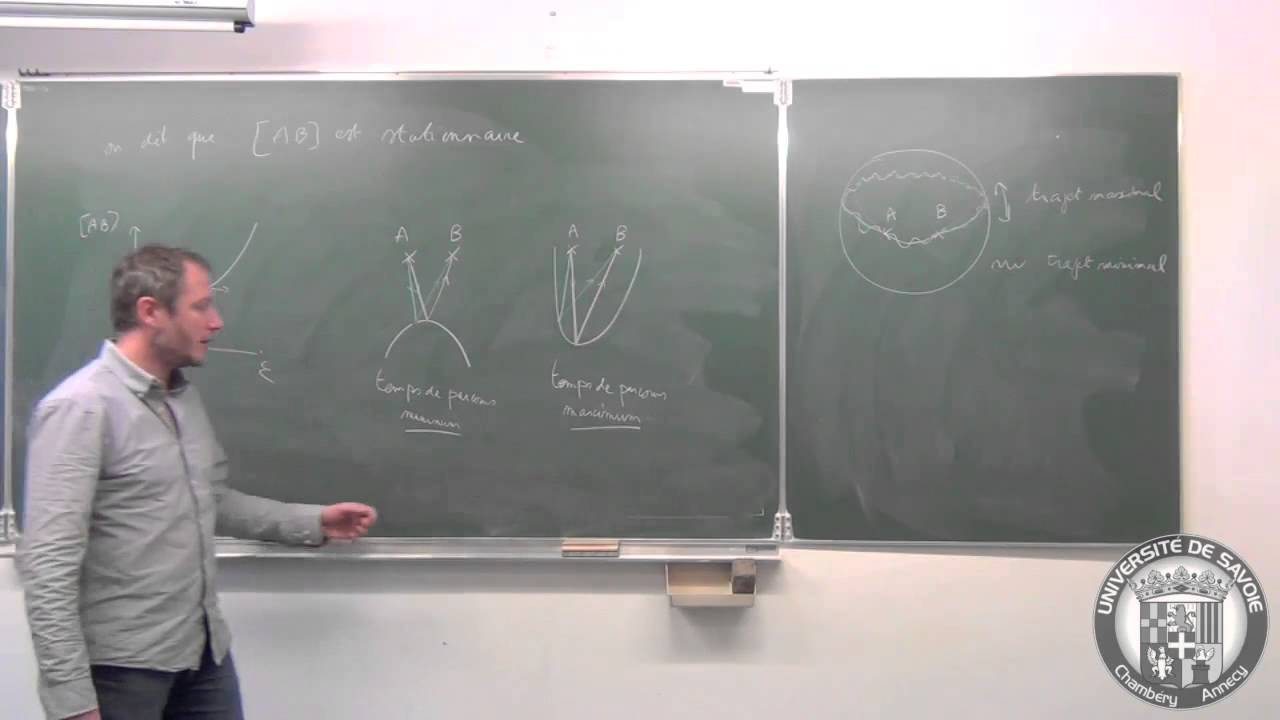
- Illustration of stationary paths with examples (minimum, maximum, saddle)
- Derivation of Snell's law using Fermat's principle
- Discussion on stigmatism and image formation
Cited Sources
- Cours d'optique ondulatoire (full series) — Description of the course; this is the source of the full series in better quality
- Cours de thermodynamique L2 — Mentioned as another course by the same author
- Cours d'électromagnétisme — Mentioned as another course by the same author
- Cours d'introduction à la relativité générale — Mentioned as another course by the same author
- Mécanique du point (PHYS 111) — Mentioned as another course by the same author
- Optique géométrique (PHYS 112) — Mentioned as another course by the same author
Concurring Sources
- Cours d'optique ondulatoire (full series) — The full course series, which this video is part of, corroborates the content and provides additional context.
Contribution & Novelties
This lecture provides a thorough and pedagogically effective treatment of Fermat’s principle, clarifying common misconceptions and linking it to the laws of reflection and refraction. The originality lies in the explicit presentation of the stationary condition and the use of diverse examples (including a sphere) to illustrate that the optical path is not always minimal. This prepares students for deeper topics like interference and diffraction.
Pour aller plus loin :
- Fermat’s principle (Wikipedia) — Background on the principle and its historical context.
- Snell’s law (Wikipedia) — Derivation and applications.
- Total internal reflection (Wikipedia) — Physical explanation and uses (e.g., fiber optics).
- Optical path length (Wikipedia) — Definition and relation to phase.
111 words
Radar Profile
The radar scores indicate a very high quantity and quality of information, with strong technical depth and excellent reliability. The video is a solid academic lecture, particularly strong in explanatory detail and pedagogical clarity.