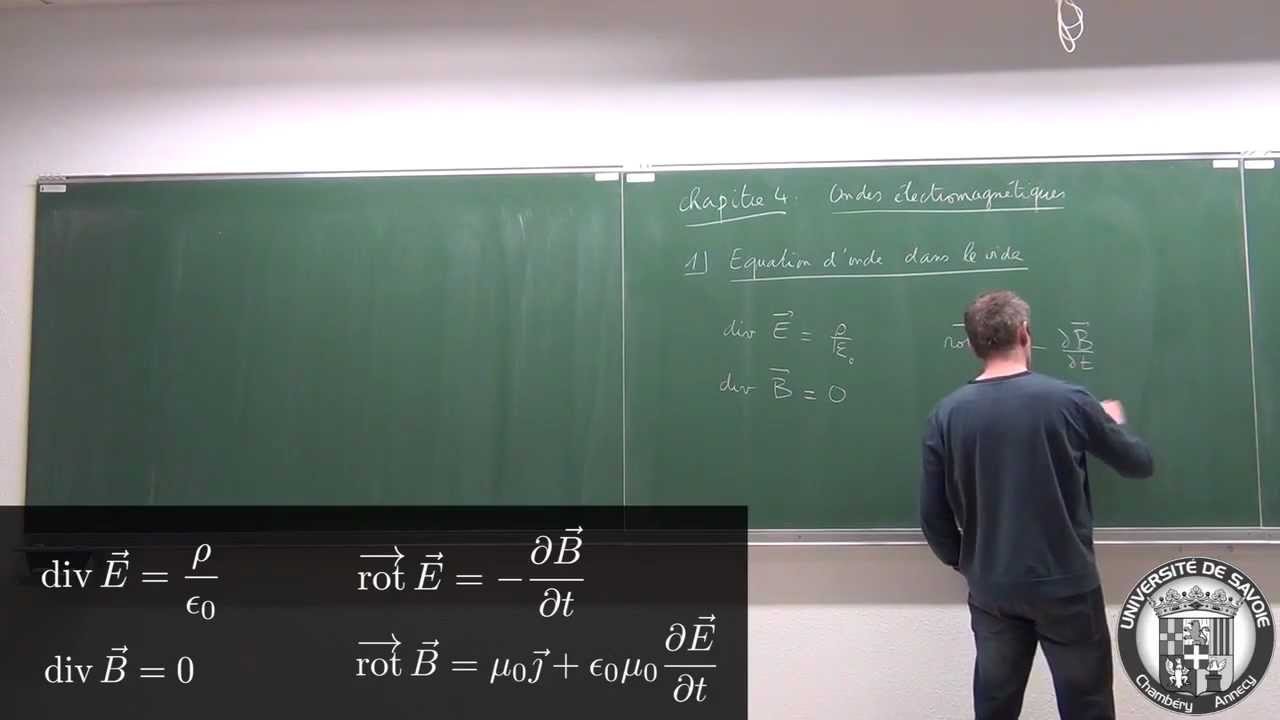
cours #5 d'introduction à l'électromagnétisme
course #5 introduction to electromagnetism
Keywords
Summary
158 words
Critical Evaluation
Value of the Information & Strength of the Argument
The lecture offers substantial value by deriving the wave equation from the fundamental Maxwell equations, connecting electromagnetic theory to optics. The argumentation is logically structured: from the vacuum simplification, to the vector calculus identity, to the identification of the wave speed. The professor carefully addresses a common student misconception about divergence of the electric field, reinforcing the physical meaning. The derivation is transparent, with each step justified, making it suitable for learners at an advanced undergraduate level.
Scientific Rigor, Source Quality, Title Accuracy
The scientific rigor is high: the lecture relies on standard vector calculus and well-established physics. The historical note about Heaviside adds context without compromising accuracy. The only external source provided is the course podcast link, which hosts the full series. The title, though generic, accurately reflects the lecture’s place in an electromagnetism sequence; it does not oversell or mislead. The content matches the title, covering wave equations in vacuum.
161 words
Title / Content Match
Title accurately describes a lecture in an electromagnetism series; generic but matches content.
Quality & Reliability
9/10
Lecture by a university professor, rigorous derivation and historical context, accurate and well-structured.
Key Moments
Markers derived by PSI from the transcript: the creator did not define chapters.
Cited Sources
- Cours d'électromagnétisme - Podcast Grenet — Official course page hosting the full lecture series.
Contribution & Novelties
This lecture provides a clear pedagogical derivation of the wave equation from Maxwell’s equations, highlighting the historical context and common student misconceptions. Its originality lies in the explicit step-by-step demonstration of the vector calculus identity and the numerical calculation identifying the speed of light.
Pour aller plus loin :
- Maxwell’s equations — Fundamental equations governing electromagnetism.
- Wave equation — General form of the equation derived in the lecture.
- Speed of light — The constant c obtained from epsilon0 and mu0.
- Oliver Heaviside — Physicist who developed vector calculus notation.
89 words
Radar Profile
The radar profile shows high scores across all dimensions, reflecting a technically deep and well-structured lecture with substantial content, strong mathematical rigor, and reliable scientific accuracy.