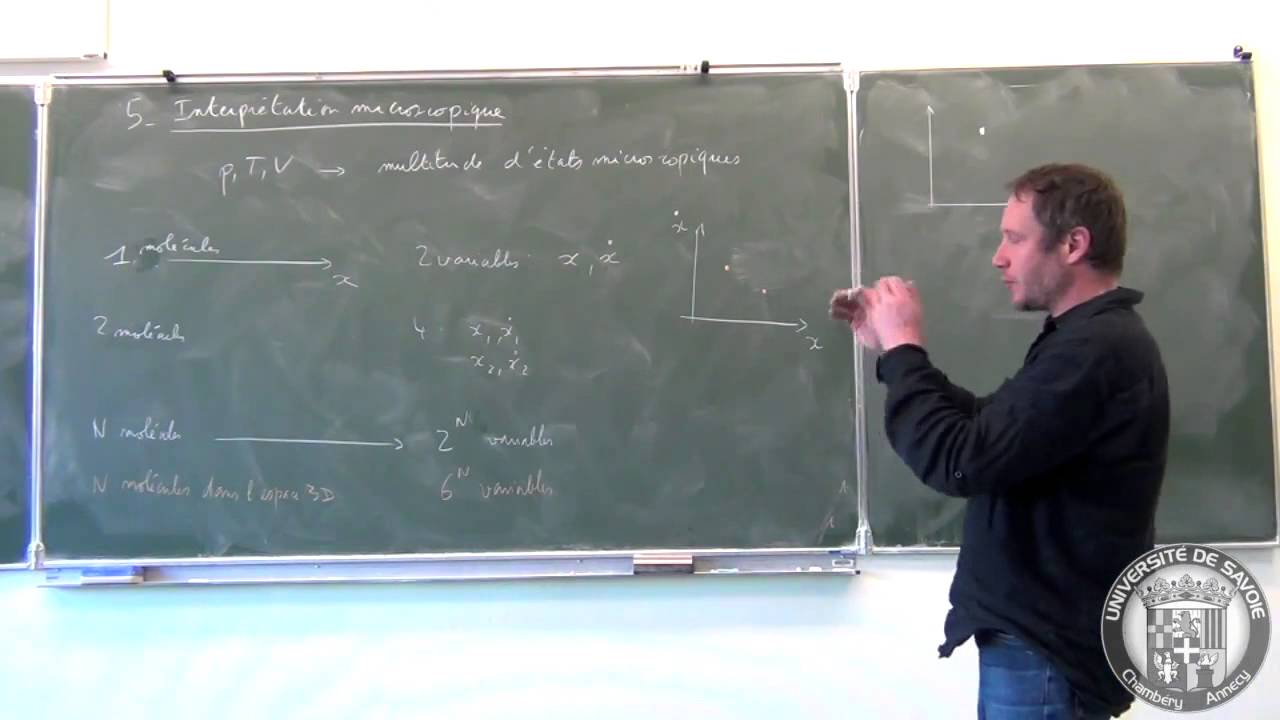
Introduction à la thermodynamique - cours 9
Introduction to thermodynamics - lesson 9
Keywords
Summary
148 words
Critical Evaluation
Value of the Information & Strength of the Argument
The value of the information is high because it presents a core concept of thermodynamics—entropy and the second law—with careful mathematical derivations and physical interpretations. The argumentation is solid: the lecturer starts with intuitive motivations (perpetual motion) and then builds a formal framework using state functions, cyclic processes, and inequalities. The step-by-step derivation of the Carnot efficiency from the second law is particularly convincing, and the explanations of potential pitfalls (e.g., signs of heat exchange, the distinction between reversible and irreversible transformations) reinforce the rigor. The lecture avoids oversimplification while remaining accessible to a motivated undergraduate audience.
Scientific Rigor, Source Quality, Title Accuracy
The scientific rigor is exemplary: the content aligns with established thermodynamics literature, and the professor’s expertise is evident in the precise use of definitions and careful handling of limiting cases. The sources cited in the video description consist of other courses from the same institution and a link to the physics department, which are appropriate for further study but do not constitute external research references. The title accurately reflects the content, as the lecture is indeed an introduction to thermodynamics focusing on the second principle and entropy. No inconsistencies were found between the title and the actual material covered.
211 words
Title / Content Match
The title accurately reflects the content: it is the ninth lecture of an introductory thermodynamics course, focusing on the second principle and entropy.
Quality & Reliability
9/10
The lecture is delivered by a physics professor from Université de Savoie and presents a rigorous, mathematically precise treatment of the second law of thermodynamics and entropy. The explanations are accurate, well-structured, and consistent with canonical textbook presentations.
Key Moments
Markers derived by PSI from the transcript: the creator did not define chapters.
- Introduction: perpetual motion machines and the motivation for the second law
- Discussion of first and second kind perpetual motion machines; energy extraction from the sea
- Statement of the second principle: existence of entropy and its increase in isolated systems
- Derivation of consequences: entropy of a thermostat and impossibility of monothermal cycles
- Derivation of the Carnot efficiency bound from the second law
- Discussion of entropy measurement and two-thermostat contact example
Cited Sources
- Cours de thermodynamique L2 (series page) — The complete course series, including lecture #9, is hosted here.
- Physics at Université de Savoie — Information about the physics programs at the university.
- Introduction to General Relativity — A related advanced course in the same institution.
External References
Contribution & Novelties
This lecture provides a clear and rigorous introduction to the second law of thermodynamics, distinguishing it from the first law and illustrating its profound consequences for energy conversion. The original contribution is primarily pedagogical: it demystifies the concept of entropy and its role in limiting machine efficiencies, using accessible examples like perpetual motion attempts and a boat extracting heat from the sea. The derivation of the Carnot bound starting from the simple entropy increase postulate is especially instructive.
Pour aller plus loin :
- Second law of thermodynamics — Overview and formulations of the law.
- Entropy — Statistical and thermodynamic interpretations.
- Carnot cycle — The idealized cycle that achieves maximum efficiency.
- Clausius theorem — A statement equivalent to the second law, used in the lecture.
124 words
Radar Profile
The high scores on quality, technical level, and reliability, combined with a slightly lower score on information quantity, suggest a focused in-depth treatment rather than a broad overview. The lecture excels in explaining a single core topic with rigor and clarity, which is typical of an advanced didactic presentation.