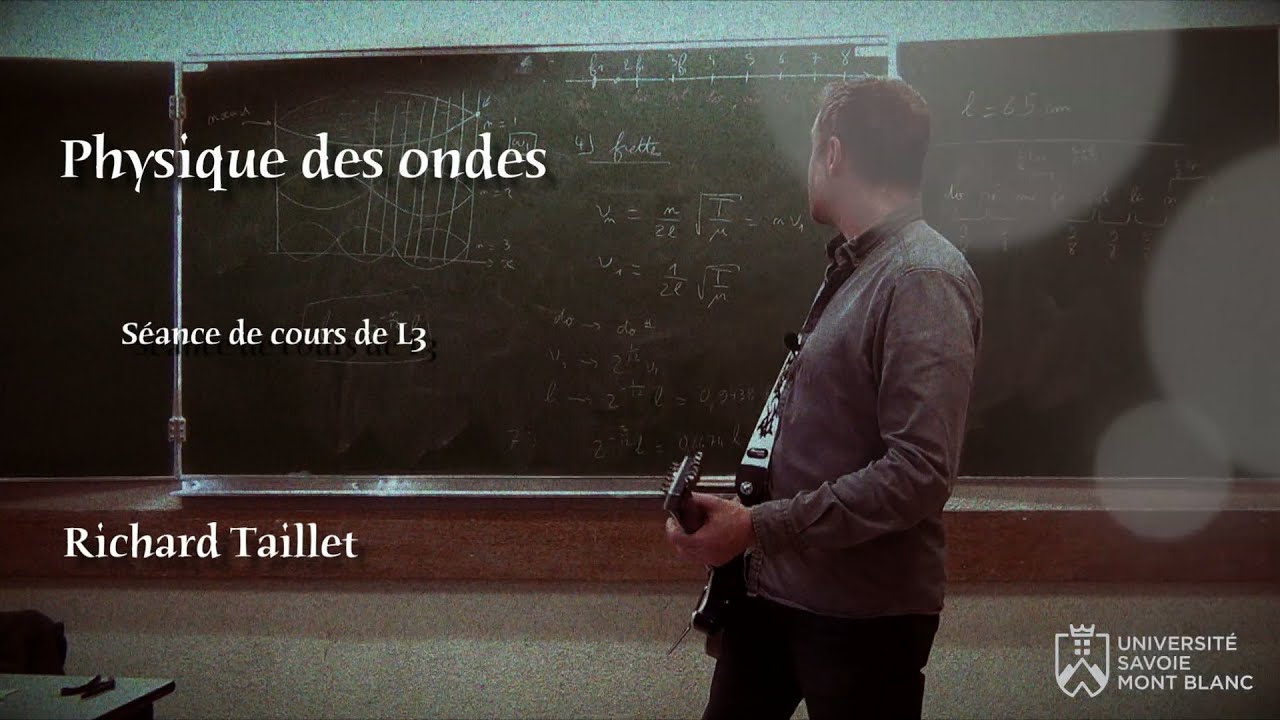
Quelques liens entre physique et musique (cours de L3)
Some links between physics and music (L3 course)
Keywords
Summary
This L3 lecture by Richard Taillet uses guitars as a concrete support to teach wave physics. Beginning with the vibrating string equation, he derives the wave velocity as √(T/μ) and applies boundary conditions for a fixed string to obtain quantized wavelengths λn = 2L/n and frequencies ωn = nω1. He introduces fundamental modes and harmonics. Experimental demonstrations show how tension affects pitch and how string mass affects frequency. The lecture also explains why a guitar needs a resonance box to transfer energy to the air, comparing acoustic and electric guitars. The role of the bridge and table resonances is discussed, as well as the compromise between power and note duration. The session covers both theoretical derivations and live experiments, making abstract concepts tangible.
Pour aller plus loin :
- Standing waves — Explains the fundamental concept of standing waves on a string with fixed ends.
- Harmonic series (music) — Musical relevance of the integer multiples of the fundamental frequency.
- Acoustic resonance — Resonant behavior of the guitar body, relating to the energy transfer discussion.
- String vibration — Dedicated page on the physics of vibrating strings, including the wave equation and modes.
190 words
Critical Evaluation
Value of the Information & Strength of the Argument
The lecture provides a solid, mathematically grounded introduction to vibrating strings, connecting directly to musical phenomena. The step-by-step derivation from the wave equation to the quantized modes is clear and rigorous. The experimental demonstrations (changing tension, comparing different strings) effectively illustrate the theoretical predictions. The discussion on energy transfer and resonance shows a good grasp of practical implications, and the pedagogical approach of using a guitar makes abstract physics intuitive. The argumentation is coherent and well-structured, moving from basic equations to real-world applications.
Scientific Rigor, Source Quality, Title Accuracy
The scientific rigor is high: the derivations follow standard wave theory, and the experiments are consistent with theoretical expectations. The ties to known results (e.g., frequency = n×(1/2L)√(T/μ)) are correct. The description provides multiple links to other university courses, but no specific external references are cited during the lecture. The titre accurately reflects the content—both physics and music are precisely covered, with guitars serving as the central theme. The source of the content (a university professor) lends credibility, though the lack of named references in the talk limits external verification.
188 words
Title / Content Match
The title correctly reflects the content: the lecture explicitly explores connections between physics (wave physics) and music (guitar playing), with both theoretical and experimental parts.
Quality & Reliability
9/10
Lecture by a university professor in physics, presented with rigorous mathematical derivation and experimental demonstrations. The content is consistent with standard wave physics, and the presentation is clear and pedagogically sound.
Key Moments
Markers derived by PSI from the transcript: the creator did not define chapters.
- Introduction: lecture structure, guitars as experimental tools.
- Presentation of guitars, explanation of how a resonance box works in acoustic vs electric guitars.
- Wave equation recalled, velocity from tension and linear mass density.
- Boundary conditions 0 and L lead to quantization of wavelengths, derivation of modes.
- Experimental demonstration: changing string tension raises the pitch, verifying frequency increase.
- Discussion of harmonics, fundamental frequency and overtones, and why thick strings sound lower.
- Superposition of modes, explanation of how plucking excites multiple harmonics.
Cited Sources
- Cours de thermodynamique L2 — Linked in the description as another physics course at the university.
- Cours d'électromagnétisme L2 — Linked in the description as another physics course at the university.
- Cours d'introduction à la relativité générale M1 — Linked in the description as another physics course at the university.
- Cours d'optique ondulatoire L3 — Linked in the description as another physics course at the university.
- Informations sur la physique à l'université de Savoie — Link to the physics department website.
Concurring Sources
- Cours d'optique ondulatoire L3 — The description includes this and other wave-related courses, consistent with the lecture's topic.
Contribution & Novelties
This lecture offers an original pedagogical approach by using a guitar as a live experimental setup to teach wave physics. The direct coupling of theoretical derivations with immediate demonstrations (e.g., changing tension and hearing pitch change) helps bridge abstract mathematics and physical intuition. The discussion on the role of the resonance box and the compromise between energy transfer and sustain adds depth beyond standard textbook treatments, making the content particularly valuable for physics students.
Pour aller plus loin :
- Standing waves — Explains the fundamental concept of standing waves on a string with fixed ends.
- Harmonic series (music) — Musical relevance of the integer multiples of the fundamental frequency.
- Acoustic resonance — Resonant behavior of the guitar body, relating to the energy transfer discussion.
- String vibration — Dedicated page on the physics of vibrating strings, including the wave equation and modes.
141 words
Radar Profile
The radar profile shows strong scores in quality, technical level, and reliability, with a slightly lower but still high quantity of information. This indicates a well-rounded, in-depth, and trustworthy educational video.