Quart d'Heure Insolite #14 : induction et falsification
Unusual Quarter-Hour #14: Induction and Falsification
Keywords
Summary
224 words
Critical Evaluation
Value of the Information & Strength of the Argument
The value of the information lies in its clear, concrete treatment of a paradox that is usually confined to philosophical textbooks. Taillet does not merely state the logical equivalence between ‘all ravens are black’ and ‘all non-black things are non-ravens’; he quantifies the evidential weight using simple probabilities, showing why a red car does not feel confirmatory even though it is logically equivalent. This is a strong pedagogical move. The argumentation is solid: he identifies the fallacy of affirming the consequent, introduces contraposition rigorously, and then uses a statistical model to explain the asymmetry between testing ravens and testing non-black objects. He also makes an important epistemological point about induction: it relies on prior theoretical commitments, as illustrated by the boiling-point example, where purity, pressure, and container size must be assumed. The talk would be strengthened by a more explicit discussion of possible objections to the Bayesian/statistical resolution, but as a popular-science lecture it is coherent and persuasive.
Scientific Rigor, Source Quality, Title Accuracy
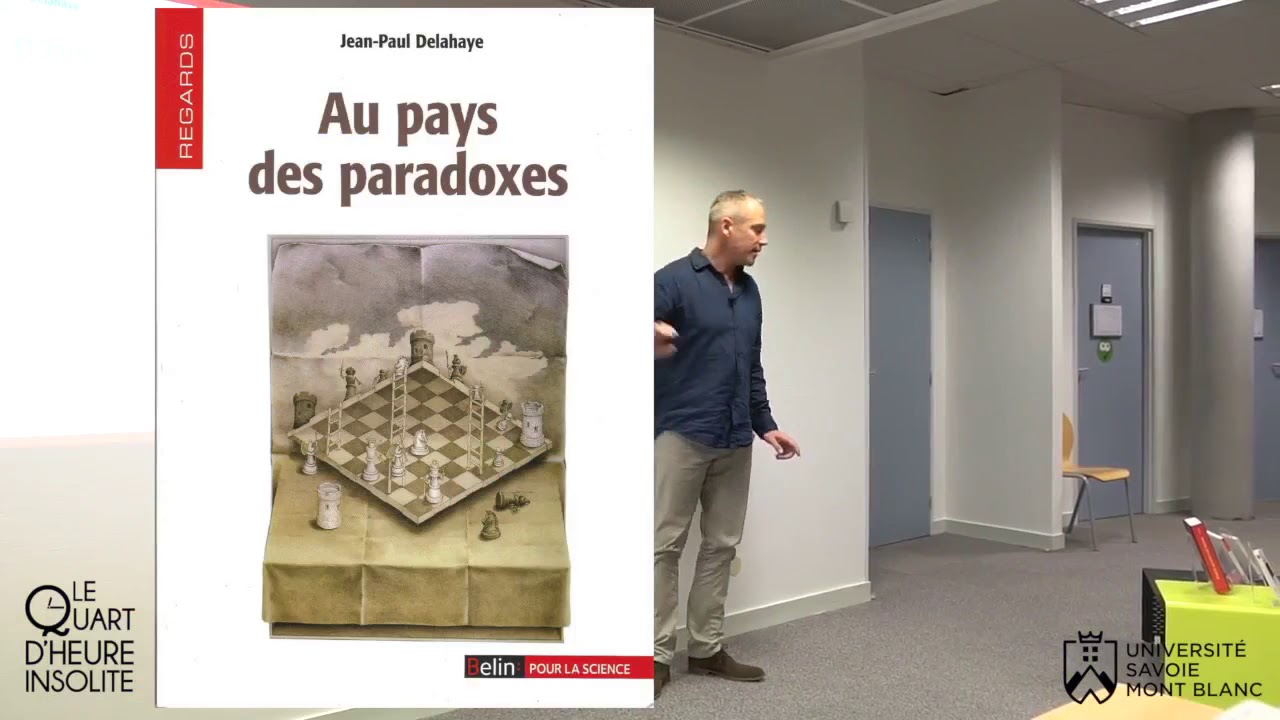
SCIENTIFIC RIGOR, QUALITY OF SOURCES, ADEQUATION OF TITLE/CONTENT: The speaker is an academic physicist, and his presentation of the logical and probabilistic material is accurate. He explicitly draws on three books: Jean-Paul Delahaye’s ‘Au pays des paradoxes’ for the resolution of the raven paradox, David Hume’s ‘An Enquiry Concerning Human Understanding’ for the problem of induction, and Alan Chalmers’s ‘What Is This Thing Called Science?’ for the inductivist view of science. These are appropriate, recognized works, though no primary research articles or formal citations are given. The title mentions both induction and falsification, but the provided transcript develops induction in detail and only alludes to falsification; this partial mismatch should be mitigated by the fact that the talk likely continues after the transcript cutoff.
297 words
Title / Content Match
The title promises both induction and falsification, but the provided transcript covers induction in depth and only briefly alludes to challenges; falsification is not developed in the available footage, so the match is partial.
Quality & Reliability
8/10
Presentation by a university physicist with good grasp of the philosophical literature; uses classical paradoxes and simple probabilistic arguments accurately. However, the talk is a popularization and relies on selected books rather than a systematic review, and the transcript is truncated before the promised falsification part.
Key Moments
Markers derived by PSI from the transcript: the creator did not define chapters.
- Introduction and thanks to the organizing team.
- Frame of the talk: epistemology, the nature of knowledge, and a warning that apparent trivialities will become subtle.
- Introduces 'all ravens are black' and explains the fallacy of affirming the consequent.
- Presents contraposition and Hempel's raven paradox with the red car example.
- Statistical resolution: probability of observing only black ravens versus checking non-black objects.
- Defines induction as generalization from observations to laws, using the boiling point of water.
- Discusses problems of induction: no logical justification and the need for theoretical assumptions.
Cited Sources
- Au pays des paradoxes (Jean-Paul Delahaye) — Book used for the discussion of Hempel's raven paradox and its statistical resolution.
- An Enquiry Concerning Human Understanding (David Hume) — Recommended for understanding induction and habitual expectation.
- What Is This Thing Called Science? (Alan Chalmers) — Book presented for the inductivist view of science and its limits.
- Le Quart d'Heure Insolite Facebook page — Official page for announcements mentioned in the video description.
Concurring Sources
- Problem of induction — Classical philosophical problem underlying the talk's central claim about induction.
- Raven paradox (Hempel) — The paradox discussed in the video with examples of black ravens and red cars.
- New riddle of induction — Goodman's paradox, mentioned in the video through the 'emeralds' example.
- Falsifiability — Popper's criterion, likely relevant to the falsification promised in the title.
Contribution & Novelties
The original contribution lies in making a fairly abstract philosophical paradox concrete through a worked probabilistic example: Taillet quantifies how many observations are needed to support ‘all ravens are black’ versus checking non-black objects, explaining why the two logically equivalent statements are not equally informative in practice. He also emphasizes that induction is impossible without a theoretical framework, using the boiling point of water as a practical illustration. This is a didactic, not a research-level, contribution, but it helps viewers appreciate the gap between logical confirmation and statistical confidence.
Pour aller plus loin :
- Problem of induction — The Humean challenge that Taillet refers to when he says induction is not logically justified.
- Raven paradox — A concise description of Hempel’s paradox and its Bayesian resolutions.
- New riddle of induction — Goodman’s ‘grue’ example, a more recent twist on the same theme.
- Falsifiability — Popper’s proposed answer to the problem of induction, useful for the second half of the title.
160 words
Radar Profile
The radar profile is strong on information quantity and quality, moderate in rigor, and lower on technical complexity, matching an accessible popular-science lecture. The high reliability score reflects the speaker's academic background and clear didactic structure.