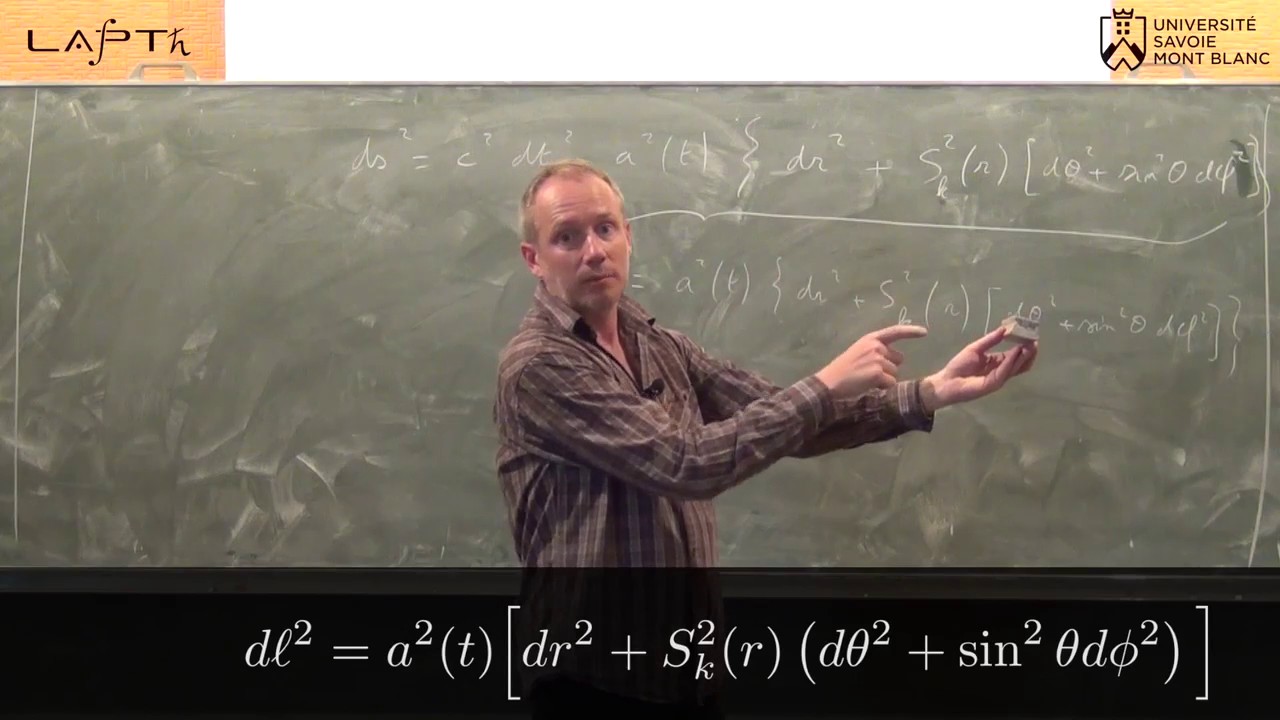
Cours de cosmologie - épisode 11 : taille apparente et distance angulaire
Cosmology course - episode 11: apparent size and angular distance
Keywords
Summary
123 words
Critical Evaluation
Value of the Information & Strength of the Argument
The video provides a thorough and original pedagogical approach to a subtle concept in observational cosmology. The argumentation is solid: the lecturer starts from the FLRW metric, carefully explains each step, and connects the mathematical formalism to observable quantities (redshift). He also distinguishes between analytical and numerical methods, showing both can be used. The value lies in making advanced material accessible while maintaining scientific rigor, and in explicitly linking theory with observational tests.
Scientific Rigor, Source Quality, Title Accuracy
The scientific rigor is high: the derivation follows standard cosmological formalism, and the lecturer references the FLRW metric and Friedmann equations correctly. The sources cited are limited to his own course materials (podcasts) and the university website, but the content is self-contained and based on established physics. The title is fully adequate—it precisely describes the topic without exaggeration. No external references are explicitly cited in the video, but the description provides links to related courses and resources.
165 words
Title / Content Match
The title accurately describes the content: it covers apparent size and angular distance in cosmology.
Quality & Reliability
8/10
The content is delivered by a university professor, based on standard cosmology, with clear derivations. The numerical computation is reproducible, but the video is a lecture, not a peer-reviewed publication.
Key Moments
Markers derived by PSI from the transcript: the creator did not define chapters.
- Introduction: linking apparent size and redshift
- Definition of angular size in flat space
- Derivation of angular distance in FLRW metric
- Analytical solution for flat universe with no cosmological constant
- Numerical computation with SageMath/CoCalc
- Comparison with observations and constraints on cosmological parameters
Cited Sources
- Cours de cosmologie (podcast) — The full course with updated versions of the lecture videos.
- Introduction à la relativité générale (M1) — Related course at master's level that may provide background on general relativity.
Contribution & Novelties
The video offers a clear, step-by-step derivation of the angular diameter distance in cosmology, which is often presented abruptly in textbooks. It explicitly shows how to compute the integral numerically with free software (SageMath/CoCalc), making the method reproducible. The pedagogical contribution is to bridge theoretical formalism and observational practice, emphasizing how measurements of apparent sizes can constrain the universe’s parameters.
Pour aller plus loin :
- Angular diameter distance — Wikipedia overview of the concept, including its formula and physical interpretation.
- Friedmann–Lemaître–Robertson–Walker metric — Background on the metric used in the derivation.
- Redshift — Definition and physical meaning, central to the formulation.
- SageMath — The open-source software used for symbolic and numerical computation.
112 words
Radar Profile
The radar profile is balanced with high scores in all dimensions: quantity, quality, technical level, and reliability. This reflects a dense, advanced lecture with solid scientific foundations. The technical level and quality dominate, while the quantity is slightly lower due to the focused topic.