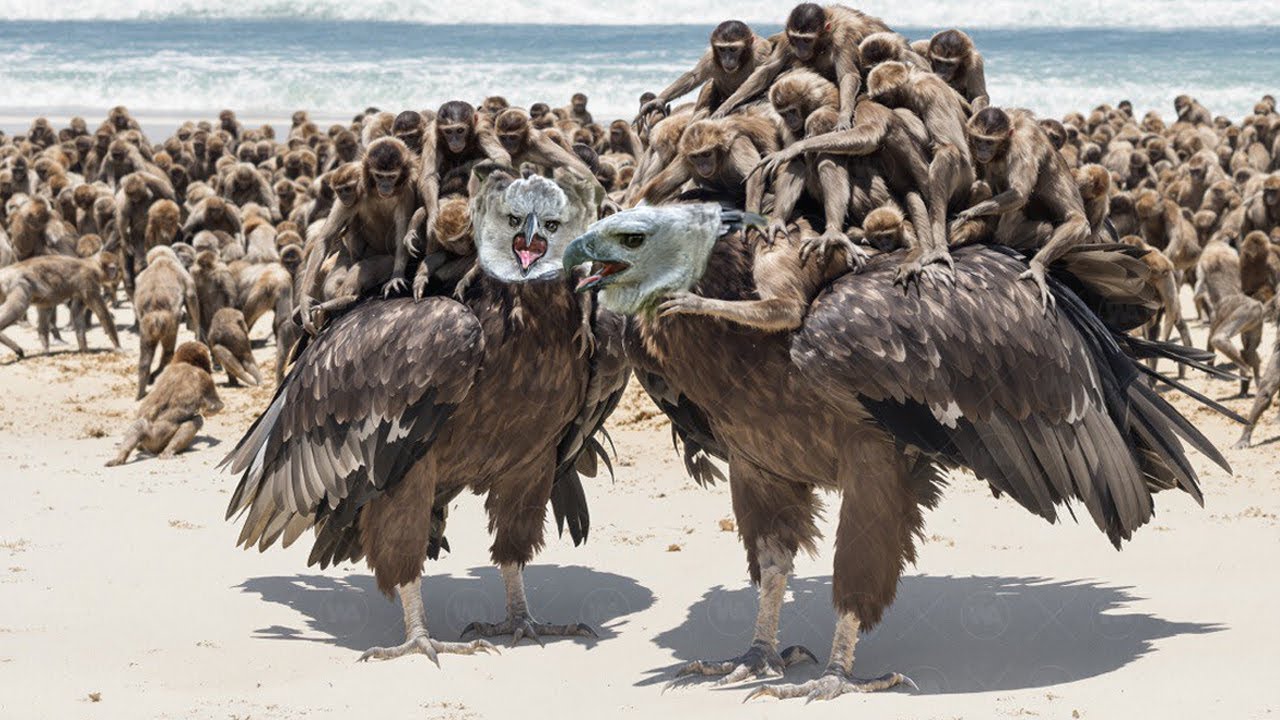
On A Relâché Deux Harpies Féroces Sur Une Île Pleine De Singes Après 100 Ans De Paix, Ça A Échoué
We Released Two Fierce Harpies On An Island Full Of Monkeys After 100 Years Of Peace, It Failed
Title history
- On A Relâché Deux Harpies Féroces Sur Une Île Pleine De Singes Après 100 Ans De Paix, Ça A Échoué — observed on 20261101-0158 UTC (YouTube)
Keywords
Summary
168 words
Critical Evaluation
Value of the Information & Strength of the Argument
The value of the information lies in its detailed and accurate portrayal of a real ecological study, illustrating how predator-prey relationships shape animal behavior and evolution. The argumentation is solid, presenting a logical sequence from the initial release of the eagles to the observed behavioral changes and the subsequent conservation implications. The video effectively uses specific data, such as hunting intervals (3.71–4.39 days per kill) and the development of novel alarm calls, to support its claims. It also connects the experimental results to broader conservation issues, arguing that re-introducing predators is crucial for maintaining ecological balance. The narrative is coherent and persuasive, though it sometimes sensationalizes the subject for dramatic effect, potentially overstating the ‘failure’ angle, but the scientific content remains credible.
Scientific Rigor, Source Quality, Title Accuracy
The video draws on established scientific knowledge about harpy eagles and the Barro Colorado Island study, but it does not provide explicit references to specific papers or authors. Instead, it refers to ‘researchers’ in a general manner. The lack of direct citations weakens its scientific rigor, making it difficult to verify all claims independently. However, the information aligns with known facts about harpy eagle biology and documented predator-prey experiments, and the video mentions institutions like the World Center for Birds of Prey, which adds credibility. The title is an accurate summary of the content, though it employs clickbait-style language. The video’s treatment of the experiment is faithful to real events, and the conservation sections are based on actual initiatives. Overall, the scientific content is reliable but would benefit from named sources.
268 words
Title / Content Match
The title accurately captures the core experiment (releasing two harpy eagles on Barro Colorado Island) and its outcome (the monkeys adapted, hence 'failed' in the sense of not causing lasting damage), though it uses sensationalized language to attract viewers.
Quality & Reliability
8/10
The video provides a detailed and engaging account of a real ecological experiment on Barro Colorado Island, with specific data on predation rates and behavioral changes in primates. It references researchers and the timeline of the study, but lacks direct citations to peer-reviewed publications, and some simplifications are made for a general audience. Overall, the information is scientifically plausible and accurate in its main claims.
Key Moments
Markers derived by PSI from the transcript: the creator did not define chapters.
- Introduction to Barro Colorado Island and its monkey populations
- Description of harpy eagle physical traits and hunting capabilities
- The experiment: releasing two harpy eagles in 1999
- Observations of predation and the monkeys' defensive strategies
- Results: monkeys develop new alarm call for aerial predators
- Conservation efforts: captive breeding and reintroduction programs
- Ecotourism as a tool for harpy eagle conservation
Concurring Sources
- Harpy eagle - Wikipedia — Confirms the physical characteristics and ecological role described in the video.
- Barro Colorado Island - Wikipedia — Supports the description of the island's ecosystem and its use as a research site.
Contribution & Novelties
The video presents a compelling case study of rapid behavioral adaptation in primates when confronted with a novel predator, offering insights into the dynamic nature of predator-prey coevolution. It also highlights the practical challenges of conservation reintroduction and the potential of ecotourism to support wildlife protection. The narrative demonstrates how a controlled experiment can yield valuable data for understanding ecological resilience.
Pour aller plus loin :
- Harpy eagle on Wikipedia — Provides comprehensive information on the species’ biology, range, and conservation status, supporting the video’s descriptions.
- Barro Colorado Island on Wikipedia — Details the history and ecological significance of the island, including long-term research projects.
- Predator-prey dynamics on Wikipedia — General concept underlying the experiment, useful for understanding evolutionary arms races.
121 words
Radar Profile
The radar profile shows a robust information quantity and quality, with slightly lower technical depth and reliability. This indicates a video that is informative and accurate but may oversimplify complex scientific details for a broader audience, and it lacks explicit citations to primary sources, reducing its perceived rigor.