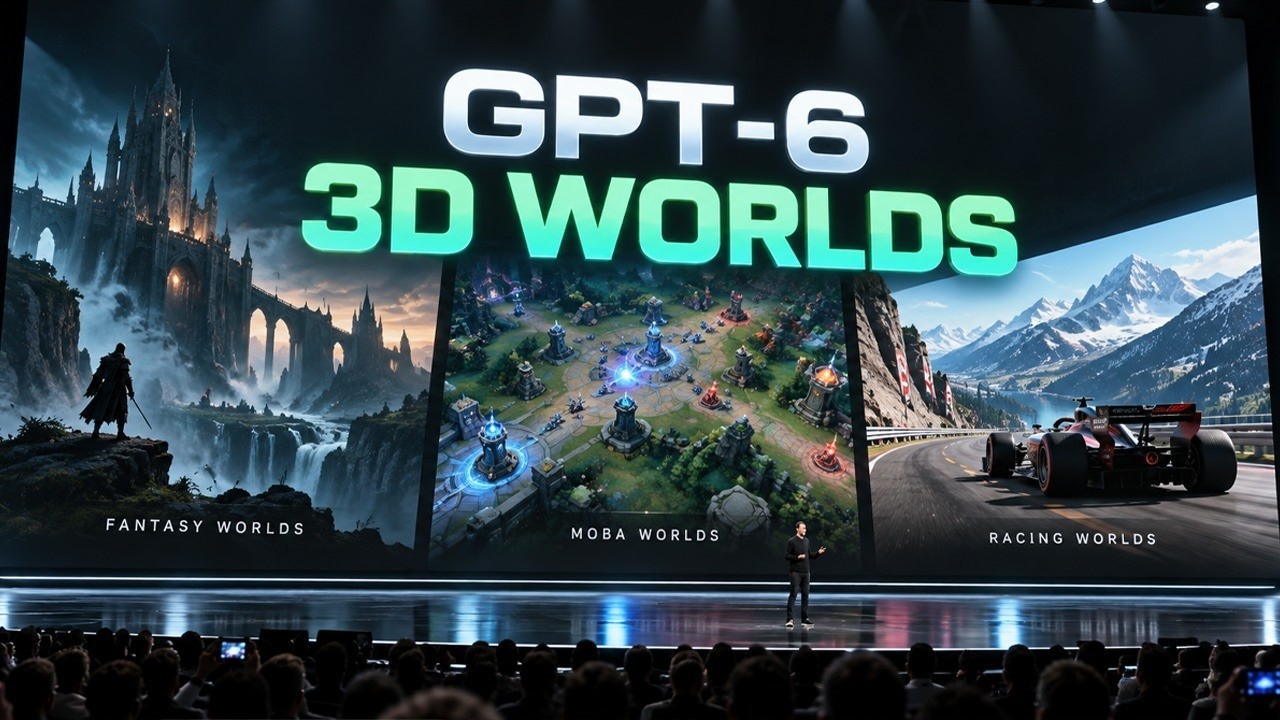
This New GPT 6 System Builds Entire 3D Worlds Insanely Well
Keywords
Summary
139 words
Critical Evaluation
Value of the Information & Strength of the Argument
The video provides substantial insight into the technical capabilities of GPT6 Astra, explaining the multi-stage workflow from concept to deployment. It offers concrete examples of problems encountered and solved, such as optimizing vegetation, fixing geometry flicker, and correcting control mappings. The argumentation is consistent and supports the claim that AI can now handle a broader game development pipeline. However, the evidence relies on demos generated by Abacus AI, which may be curated to showcase strengths. The video does not critically evaluate potential weaknesses beyond mentioning that the games are not commercial grade. Overall, the information is valuable for understanding current AI game generation, but the argumentation would be stronger with independent testing or third-party assessment.
Scientific Rigor, Source Quality, Title Accuracy
The sources cited in the description are official documentation for Blender, Three.js, Rapier, Poly Haven, and Abacus AI’s supercomputer, which corroborate the technical mechanics described. No external studies or peer-reviewed references are provided, limiting scientific rigor. The title accurately represents the content, focusing on GPT6’s ability to build 3D worlds. The video does not misuse or misrepresent sources; they are appropriately used to explain the underlying technologies. The lack of independent verification and potential bias from showcasing a product is a notable weakness. The title’s sensationalism (“Insanely Well”) is somewhat justified by the impressive demos, though it remains a subjective evaluation.
231 words
Title / Content Match
The title accurately reflects the content, as the video thoroughly showcases the AI's ability to construct complete 3D game worlds.
Quality & Reliability
6/10
The video focuses on demonstrating Abacus AI's GPT6 Astra capability. It relies heavily on supplied materials and proprietary demos, with no independent verification. Technical details are plausible and reference documented tools, but overall reliability is moderate due to promotional elements.
Key Moments
Markers derived by PSI from the transcript: the creator did not define chapters.
- Introduction: Overview of three AI-built games and the claim that GPT6 Astra goes deeper into production.
- Workflow description: Concept shots as targets, Blender for assets, Three.js for browser rendering, Rapier for physics, and the inspection loop.
- Emberfall MOBA details: Complex systems, original champions, vegetation optimization, and iterative fixes.
- Eye of the Fallen God RPG: Atmosphere, architecture, combat mechanics, and visual refinements.
- Racing game: Vehicle model, suspension physics, track geometry, and post-deployment bug fix.
- Limitations and conclusion: Not commercial grade, requires supercomputer, but a significant prototyping step.
Cited Sources
- Blender Command Line Rendering — Used to explain how Astra runs Blender headlessly to generate 3D assets
- Poly Haven API — Source for realistic materials and textures used by the workflow
- Rapier JavaScript Documentation — Physics engine used for collisions, vehicles, and characters in the games
- Abacus AI Supercomputer — The platform where the GPT6 Astra workflow runs, providing persistent environment and compute
- Three.js Loading 3D Models — Explains how glTF/GLB assets are loaded into browser-based 3D games
Contribution & Novelties
This video highlights a significant advancement in AI-driven game development: the system not only writes code but also generates original assets, manages complex systems, and runs iterative quality checks, effectively covering a large portion of the production pipeline. It demonstrates that AI can handle diverse genres (MOBA, RPG, racing) with technical depth, including physics, optimization, and deployment. The main novelty lies in the integration of capabilities—concept art, Blender scripting, WebGL, and automated testing—into a single autonomous workflow.
Pour aller plus loin :
- Procedural content generation in games — Explains foundational techniques that AI-based generation builds upon.
- WebGL — The underlying technology for browser-based 3D rendering used by Three.js.
- Automated game testing — Discusses software testing methods applicable to games, which Astra’s workflow partially automates.
124 words
Radar Profile
The radar profile shows moderate to high scores across all dimensions, with quantity and technique scoring highest, reflecting the video's rich technical content. Reliability and quality are slightly lower due to reliance on vendor-provided materials and lack of independent verification, but the consistency of the presentation maintains a credible overall profile.