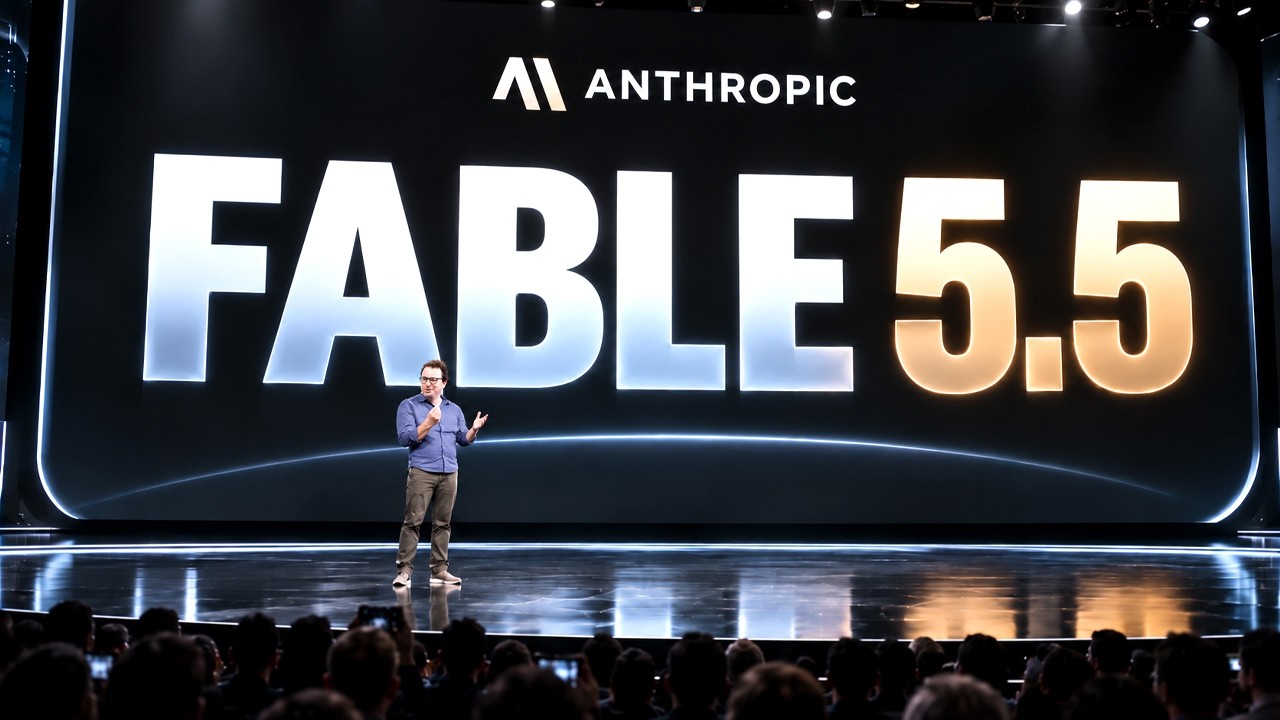
Fable 5.5 Is Blowing Up With Some Crazy Early Demos
Keywords
Summary
176 words
Critical Evaluation
Value of the Information & Strength of the Argument
The video’s value lies in its balanced treatment of breaking AI news. For Fable 5.5, it does not jump to conclusions but systematically debunks the evidence, explaining why placeholder documentation and user anecdotes are insufficient. It provides a thorough analysis of Anthropic’s official releases (Opus 5.5, Sonnet 5.5) and clarifies how model versioning actually works. The argumentation is solid, particularly in pointing out that a self-reported prompt test cannot reliably identify a model and that OpenAI-like leaks typically include checkable identifiers. The Astra segment benefits from a concrete external source (Euronews) and technical detail about the decryption method. Griffin is explained with clear analogies (relay race vs. phone call) and backed by quantitative metrics. While some claims rely on company statements, the video maintains a skeptical tone and highlights limitations of the studies, such as the small sample size. Overall, the reasoning is coherent and avoids hyperbolic speculation.
Scientific Rigor, Source Quality, Title Accuracy
The video uses four sources from its description: Anthropic’s official Sonnet 5.5 page, a Euronews article on the cipher, a Reddit thread on Fable 5.5, and Tavus’s Griffin page. It directly references these and quotes specific details, which is a good practice. However, the Reddit source is user-generated and the video itself criticizes its reliability, which is honest but limits the strength of that section. The title is catchy but misleading as it only mentions Fable 5.5, yet the content equally covers Astra and Griffin. The video’s critical approach, including checking the leaked documentation and comparing versioning docs, demonstrates rigor. It also points out that some claims are unverifiable, which enhances credibility. Overall, the sourcing is transparent given the nature of rumor reporting, and the title inadequacy is a minor detractor.
294 words
Title / Content Match
The title focuses exclusively on the Fable 5.5 rumor, while the video also covers GPT-6 Astra and Tavus Griffin, making it partially misleading.
Quality & Reliability
6/10
The video critically examines unverified claims about Fable 5.5, provides concrete details on GPT-6 Astra's cipher breakthrough, and explains technical aspects of Tavus Griffin. It uses multiple sources from the description, but some claims remain unconfirmed.
Key Moments
Markers derived by PSI from the transcript: the creator did not define chapters.
- Introduction to the three main topics: Fable 5.5 rumors, GPT-6 Astra cipher, and Tavus Griffin.
- Detailed discussion of Fable 5.5 rumor origins, including user claims and the leaked documentation page investigation.
- Analysis of Anthropic's official releases and versioning policies, explaining why silent model serving is unlikely.
- Story of GPT-6 Astra decoding the 217-year-old Napoleon cipher using simulated annealing.
- Tavus Griffin's real-time video interaction capabilities, including benchmark scores and the 48% human detection rate.
- Safety concerns and the need for AI identity disclosure, wrapping up the video.
Cited Sources
- Claude Sonnet 5.5 - Anthropic — Official Anthropic page describing Sonnet 5.5, used to confirm actual model releases and counter Fable 5.5 claims.
- AI decodes 217-year-old Napoleonic letter in 6 hours — News article about GPT-6 Astra's cipher breakthrough, providing an external verification.
- Fable 5.5 is being secretly tested similar to how Opus 5.5 was pre-release — Reddit thread that initiated the Fable 5.5 rumor, included to show original claims and community reactions.
- Tavus Griffin — Tavus's official product page for Griffin, detailing the real-time video interaction model and its capabilities.
Concurring Sources
- AI decodes 217-year-old Napoleonic letter in 6 hours — Provides independent confirmation of GPT-6 Astra's achievement, matching the video's report.
- Tavus Griffin — Official source for the Griffin model's capabilities and benchmark claims, used as a primary reference by the video.
Contribution & Novelties
This video synthesizes recent AI news with a critical eye, offering a valuable counterpoint to the hype around unverified model leaks. It provides a clear explanation of Anthropic’s versioning policy and why the Fable 5.5 evidence is weak. The technical breakdown of Tavus Griffin’s full-duplex architecture and its performance metrics is particularly informative. The coverage of GPT-6 Astra’s cipher decoding adds a fascinating historical application.
Pour aller plus loin :
- Simulated annealing — Core algorithm used by GPT-6 Astra to crack the cipher; explains the probabilistic optimization technique.
- Turing test — Relevant to Tavus Griffin’s claim of passing a real-time video Turing test; background on the classic test for machine intelligence.
- Deepfake — Context for concerns about AI-generated human likeness and implications for identity verification.
- Full-duplex — Technical term used to describe Griffin’s simultaneous input/output capability; clarifies network communication principles.
140 words
Radar Profile
The radar profile shows balanced strengths across quantity and technical detail, with slightly lower scores in reliability due to the speculative nature of the Fable 5.5 segment. The video excels in providing a comprehensive overview of diverse AI topics while maintaining a critical stance, but the reliance on unverified rumors for one section keeps the overall reliability in check.