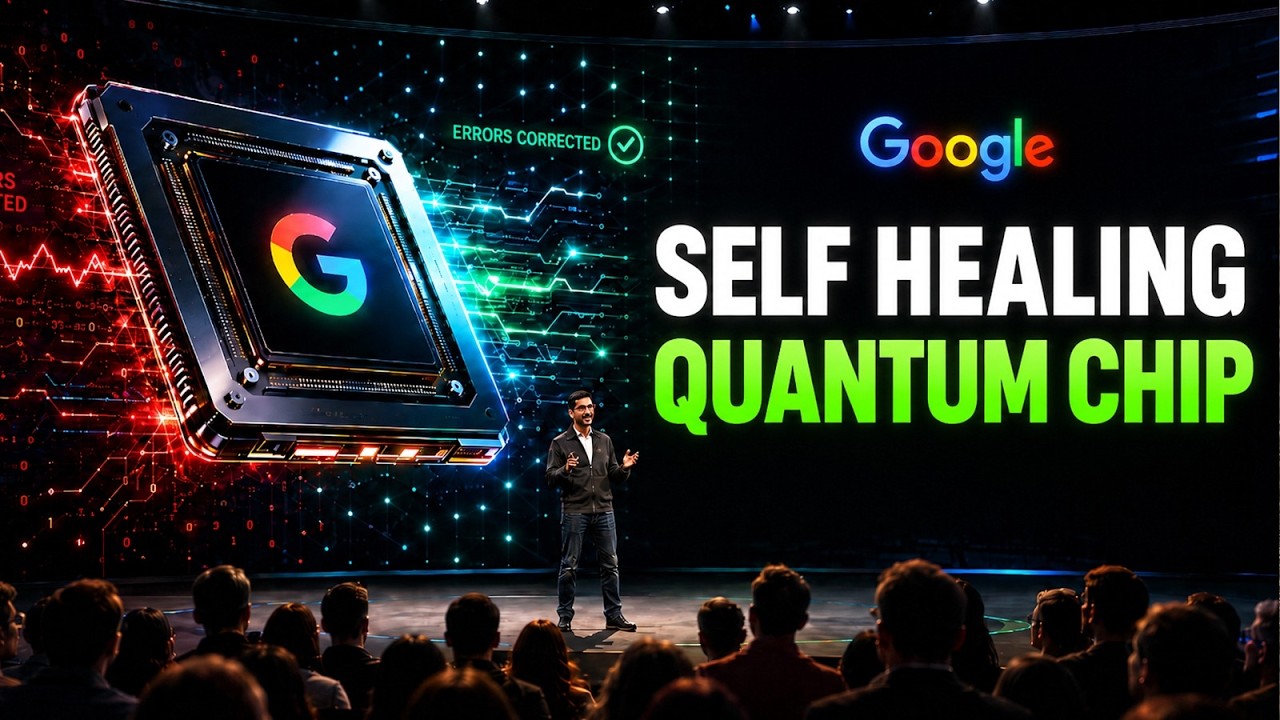
Google Just Made a Massive Quantum Breakthrough
Keywords
Summary
162 words
Critical Evaluation
Value of the Information & Strength of the Argument
The video provides substantial insight into an overlooked aspect of quantum computing: calibration drift. It clearly explains the problem (analog nature, parameter drift, incompatibility with long computations) and the solution (using error detection data as a learning signal). The argumentation is solid, well-structured, and backed by concrete numbers from the paper (20% error reduction, 2.4× stability, etc.). The speaker acknowledges limitations (exploration noise, drift frequency cutoff, data rate) and avoids overclaiming. The explanation of the technical mechanism (policy gradient, proxy optimization, sparsity) is coherent and accessible without oversimplification.
Scientific Rigor, Source Quality, Title Accuracy
The video cites the original Nature paper (s41586-026-10759-2), Google’s research blog, and reputable outlets (Ars Technica, Phys.org, The Quantum Insider). These sources are directly relevant and credible. The title is slightly hyperbolic but does not mislead; the content indeed covers a major breakthrough. There is a short promotional segment (about 40 seconds) for a downloadable guide, which is clearly separate from the scientific content. No obvious errors or misrepresentations were found in the technical description.
178 words
Title / Content Match
The title is somewhat sensationalist but accurately reflects the described breakthrough: Google's quantum processor can self-tune during computation, a significant advance.
Quality & Reliability
8/10
The video relies on a peer-reviewed Nature paper, Google's official research blog, and reputable science news outlets. Claims are presented with details and limitations, though some rhetorical amplification is used.
Key Moments
Markers derived by PSI from the transcript: the creator did not define chapters.
- Introduction of the calibration drift problem
- Explanation of why calibration is needed during computation
- How quantum error correction works and provides detection signals
- Reinforcement learning agent uses detection events as reward
- Results on Willow: 20% additional error suppression and record logical error rates
- Limitations, scalability, and future implications for quantum control
Cited Sources
- Nature: Towards a quantum computer that learns from its errors — Original peer-reviewed study
- Google Research Blog: Towards a quantum computer that learns from its errors — Official Google announcement and technical explanation
- Ars Technica: Quantum error correction can constantly recalibrate a processor — Independent science news coverage
- Phys.org: Faster, more stable quantum computing — Science news outlet reporting the findings
- The Quantum Insider: Google study shows quantum computer can learn from its own errors while it computes — Quantum industry news site covering the breakthrough
Concurring Sources
- Ars Technica: Quantum error correction can constantly recalibrate a processor — Agrees with the video's claims about the breakthrough.
- Phys.org: Faster, more stable quantum computing — Corroborates the stability improvements and error-rate results.
- The Quantum Insider: Google study shows quantum computer can learn from its own errors while it computes — Reports the same study and findings.
External References
Contribution & Novelties
The video highlights a novel approach to quantum control: using error detection data as a reward signal for reinforcement learning, allowing the processor to retune itself in real time. This moves beyond traditional physics-based calibration models and could enable long-duration quantum computations without interruption. The presented results (record logical error rates, robustness to drift) constitute a significant step toward practical fault-tolerant quantum computers. The concept is platform-agnostic and may be generalized to other qubit technologies.
Pour aller plus loin :
- Quantum error correction — Context for the detection mechanisms used.
- Reinforcement learning — The method used for the self-tuning agent.
- Quantum computing — Background on qubits and hardware challenges.
109 words
Radar Profile
The profile shows high scores in information quantity and quality, with a slightly lower technical level (still high) and good reliability. This indicates a dense, well-sourced presentation that is fairly technical but accessible to a general audience. The reliability score is consistent with the use of primary and reputable sources.