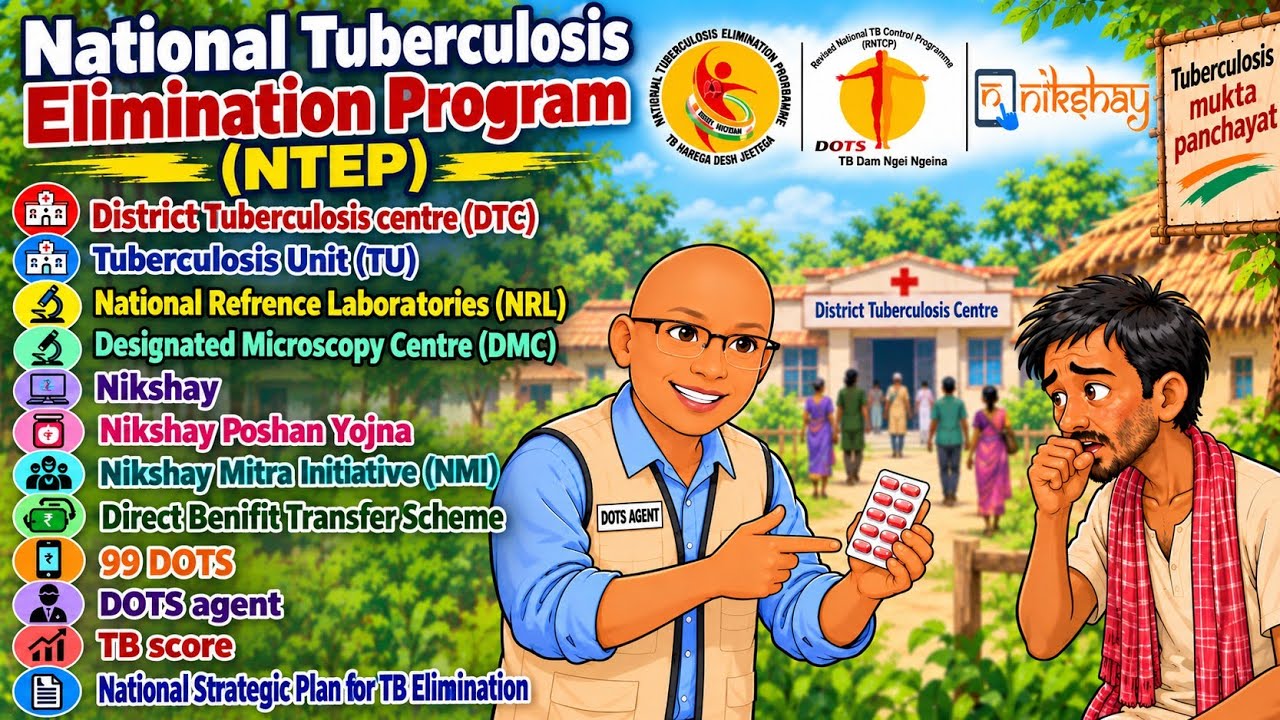
National Tuberculosis Elimination Program | NTEP |
Keywords
Summary
165 words
Critical Evaluation
Value of the Information & Strength of the Argument
The lecture’s value lies in its pedagogical approach, structuring a complex national health program into digestible segments with clear mnemonic supports for medical students. The argumentation is systematically built around historical progression, organizational frameworks, and operational roles, using simple analogies (control vs elimination vs eradication) to clarify conceptual distinctions. The speaker integrates practical examples, such as referencing his own medical college as a nodal DR-TB center, which enhances relatability but does not detract from the core instructional content. The reasoning is coherent and aligns with standard public health teaching in India.
Scientific Rigor, Source Quality, Title Accuracy
The lecture is rigorous in its adherence to established facts about NTEP, citing official milestones and organizational structures accurately. The primary source mentioned is the drive link with notes, which serves as supplemental material. No external references are explicitly cited within the video, but the content matches known program details. The title ‘National Tuberculosis Elimination Program | NTEP |’ exactly matches the content, offering no discrepancy. The lecture appears suitable for its intended audience of medical students, but no comment analysis is possible as no comments were provided.
194 words
Title / Content Match
Title accurately reflects the content; the video comprehensively covers the NTEP program.
Quality & Reliability
8/10
Lecture provides structured overview of NTEP, its history, organization, and objectives. Information appears accurate and well-organized, based on standard knowledge for medical education. Some personal anecdotes but overall reliable.
Key Moments
Markers derived by PSI from the transcript: the creator did not define chapters.
- Introduction to NTEP and lecture objectives
- Definition of control, elimination, eradication and timeline milestones (1951 BCG, 1962 NTP, 1993 RNTCP, DOTS, 2006 Stop TB, 2014 End TB, 2020 NTEP)
- Detailed discussion of RNTCP objectives and DOTS components
- Overview of NTEP organization at national, state, district, sub-district and peripheral levels
- Lab network explanation: national reference labs, intermediate reference labs, culture and DST labs, designated microscopy centers
- Drug resistance surveillance: nodal and district DR-TB centers, case management and roles
- Financial resources, National Strategic Plan for TB elimination, and conclusion
Cited Sources
- Program Notes (Google Drive) — Notes provided in video description for detailed study.
Contribution & Novelties
The lecture provides an original synthesis of NTEP, merging disease epidemiology with program implementation details, which is particularly useful for Indian medical students. It clarifies common confusions about program names and timelines, and offers mnemonics and visual cues (logos) that enhance retention. The inclusion of local examples (e.g., a specific medical college) personalizes the content without compromising accuracy.
Pour aller plus loin :
- WHO Tuberculosis overview — Essential global context and strategies.
- The End TB Strategy — Official document outlining global targets and pillars.
- DOTS (Directly Observed Therapy Short-course) - Wikipedia — Background on the DOTS component of TB control.
100 words
Radar Profile
The radar profile shows high scores in quantity and quality of information due to the comprehensive coverage and structured delivery. Technical level is moderate-high, appropriate for medical students. Overall reliability is strong, though a slight caution is warranted because no external sources are directly cited, and some details may rely on lecturer's personal knowledge.