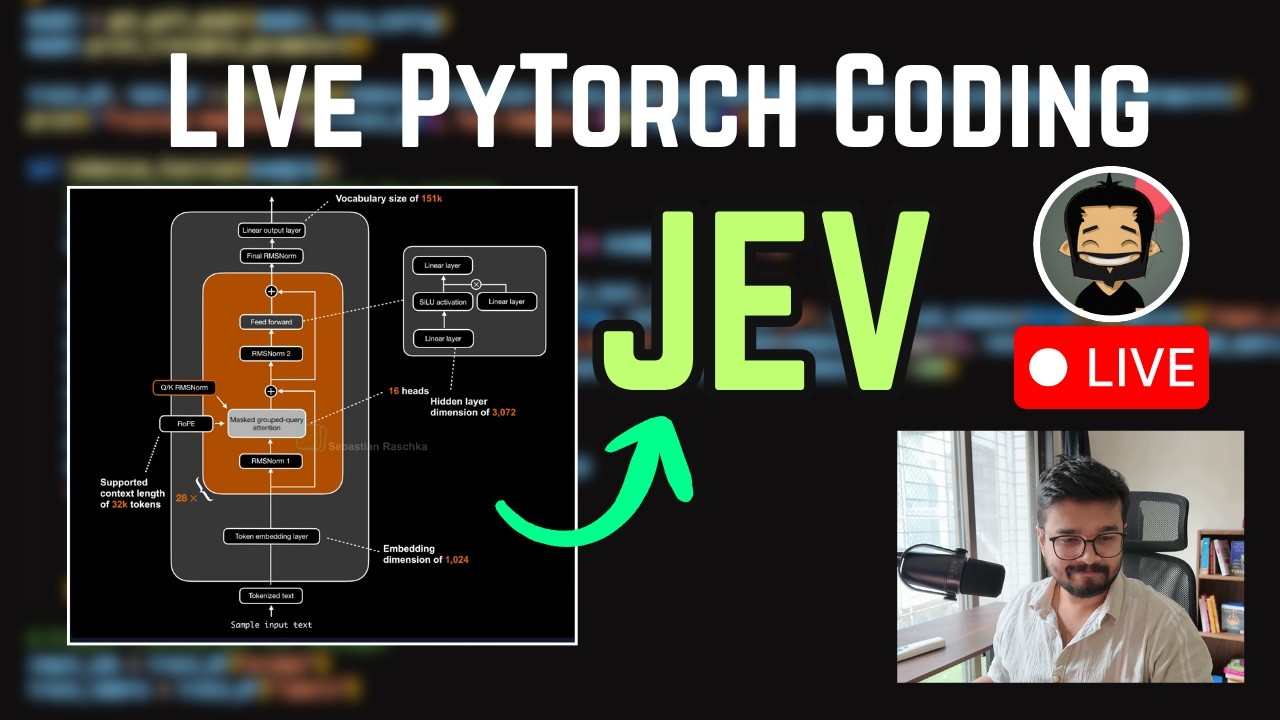
Live coding Jev from Scratch | Understanding Qwen architecture
Keywords
Summary
137 words
Critical Evaluation
Value of the Information & Strength of the Argument
The video offers significant value by demonstrating a concrete approach to repurposing an existing language model for a novel decision-making task. The argumentation is based on hands-on code and iterative debugging, which is illustrative and practical, though not formally structured. The creator justifies architectural choices (e.g., using causal vs. bidirectional attention) with clear reasoning, grounded in how transformers operate. The discussion on dataset creation is particularly useful, as it outlines reproducible methods for generating training data. Overall, the content is educational and pragmatic, appealing to practitioners, with arguments supported by practical examples rather than academic citations.
Scientific Rigor, Source Quality, Title Accuracy
The video does not cite any external scientific sources, relying entirely on the creator’s expertise and live experimentation. This limits its verifiability, but the methods shown are consistent with established deep learning practices. The title exactly reflects the content: it is a live coding session focused on adapting a Qwen model to a JEV architecture, with explanations of the underlying architecture. The lack of external references is partially mitigated by the transparency of the live coding process, which allows viewers to see and replicate the steps.
197 words
Title / Content Match
The title accurately describes the live coding session adapting a Qwen model to a JEV architecture, and the content matches.
Quality & Reliability
7/10
The author demonstrates deep technical expertise through live coding and explanations, but does not provide external references or citations. The content is exploratory and based on personal experience, so reliability is moderate.
Key Moments
Markers derived by PSI from the transcript: the creator did not define chapters.
- Discussion on open-source models and career advice
- Introduction to decision model datasets and their creation methods
- Conceptual explanation of JEV as a classification language model with attention types
- Start of live coding: adapting Qwen architecture
- Hacking attention mask and positional-IDs for choice-order invariance
- Debugging and testing the modified model
- Wrap-up and next steps for training the model
Contribution & Novelties
The video contributes a practical, hands-on approach to adapting a modern LLM (Qwen) to a decision-making architecture (JEV), highlighting the importance of attention mask modification for order invariance. It provides actionable insights into dataset creation for such models, emphasizing the use of trusted sources with LLM-based augmentation. The live coding format offers transparency into the adaptation process.
Pour aller plus loin :
- Hugging Face Transformers documentation — Essential library for loading and modifying models.
- PyTorch official site — Deep learning framework used in the video.
- Qwen models on Hugging Face — Access to Qwen checkpoints and documentation.
- BERT (bidirectional attention) — Relevant to the discussion of bidirectional attention in decision models.
111 words
Radar Profile
The radar profile shows high scores for technical level and information quantity, indicating a content-rich video, while reliability is moderate due to lack of external citations. The balance suggests a practically oriented tutorial with strong technical depth but limited formal rigor.