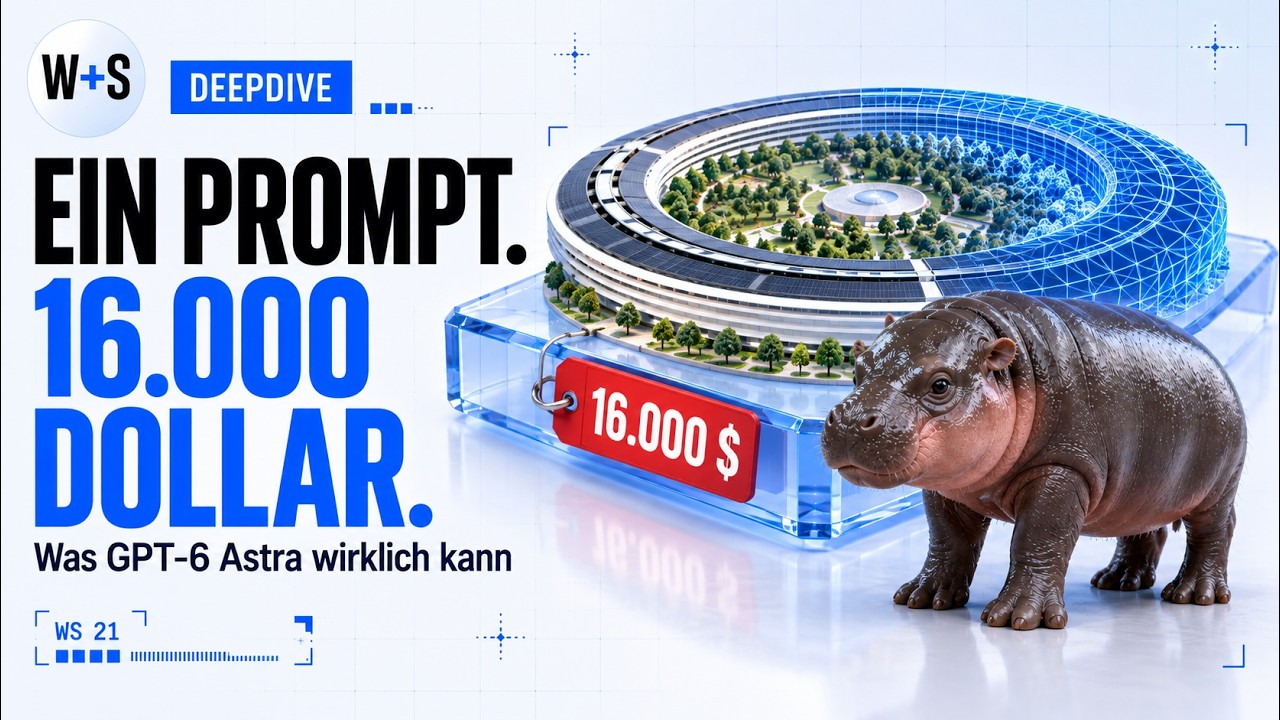
Ein Prompt, 16.000 Dollar: Was GPT-6 Astra wirklich kann
One Prompt, $16,000: What GPT-6 Astra can really do
Keywords
Summary
141 words
Critical Evaluation
Value of the Information & Strength of the Argument
The value of the information is moderate: the hosts provide concrete examples of GPT-6’s abilities, such as the Apple Park project and the video game creation, which are impressive and illustrative. However, the argumentation relies heavily on personal anecdotes and opinions rather than systematic testing. The comparison between GPT-6 and Claude is informal and based on a single prompt, making it anecdotal. The hosts do acknowledge limitations and ambiguities, such as the lack of a clear AGI definition and the variability of benchmarks. The discussion of Artificial Analysis’s recalibration is insightful, showing how benchmark changes can affect rankings. Overall, the argumentation is reasonable but not backed by rigorous data.
Scientific Rigor, Source Quality, Title Accuracy
The scientific rigor is low: the hosts do not cite peer-reviewed studies or official documentation, instead referencing community examples and their own tests. They mention sources like Artificial Analysis and Max Weinbach, but do not provide links or detailed data. The title accurately reflects the content, focusing on the $16,000 project and the model’s capabilities. The discussion is more of a review and opinion piece than a scientific evaluation. No comments are provided for analysis.
199 words
Title / Content Match
The title accurately reflects the content: the hosts discuss a single prompt that generated a 3D Apple Park model costing $16,000, and evaluate GPT-6 Astra's capabilities broadly.
Quality & Reliability
6/10
The discussion is based on hands-on experiences and anecdotal evidence rather than systematic evaluation. The hosts openly acknowledge the subjectivity of their comparisons and the fluid nature of benchmark rankings. While they reference credible sources like Artificial Analysis, they do not provide verifiable data or citations. The tone is critical and balanced, but the lack of rigorous methodology limits reliability.
Chapters
Cited Sources
- Artificial Analysis Intelligence Index — Referenced as the benchmark source that ranked GPT-6 5th initially, then 2nd after recalibration, and finally tied 1st after a second update.
- Max Weinbach's Apple Park 3D reconstruction project — Mentioned as the source of the $16,000 single-prompt project that recreated Apple Park in 3D using GPT-6 Astra, consuming 6.3 billion tokens.
Concurring Sources
- OpenAI's official product pages — General reference to OpenAI's product information, aligning with claims about GPT-6 Astra's features.
Dissenting Sources
Contribution & Novelties
The episode provides a practical, hands-on look at GPT-6 Astra’s capabilities, particularly in creative tasks like 3D visualization and image generation. It highlights the enormous scale of resources that can be leveraged with a single prompt, exemplified by the Apple Park project. The hosts also offer a candid comparison with Claude, noting that OpenAI has closed the gap in many areas. The discussion of benchmark recalibration adds a critical perspective on how rankings can be influenced by methodology changes.
Pour aller plus loin :
- Artificial general intelligence (AGI) — Relevant to the opening debate on whether GPT-6 marks the start of an AGI era.
- Vibe coding — The hosts discuss vibe coding extensively, contrasting generic outputs with more tailored results.
- Artificial Analysis — The benchmark provider mentioned throughout the episode, whose methodology changes affected GPT-6’s ranking.
136 words
Radar Profile
The radar profile shows moderate scores across all dimensions, indicating a balanced but not exceptional episode. The information quantity is slightly higher than quality, reflecting the hosts' broad but shallow coverage. Technical level is average, accessible to a general audience with some technical background. Reliability is limited by anecdotal evidence.