Quantum Mechanics for Semiconductor Devices: Tunneling, Wave Functions, and Energy Bands | 2026 L3
Keywords
Summary
173 words
Critical Evaluation
Value of the Information & Strength of the Argument
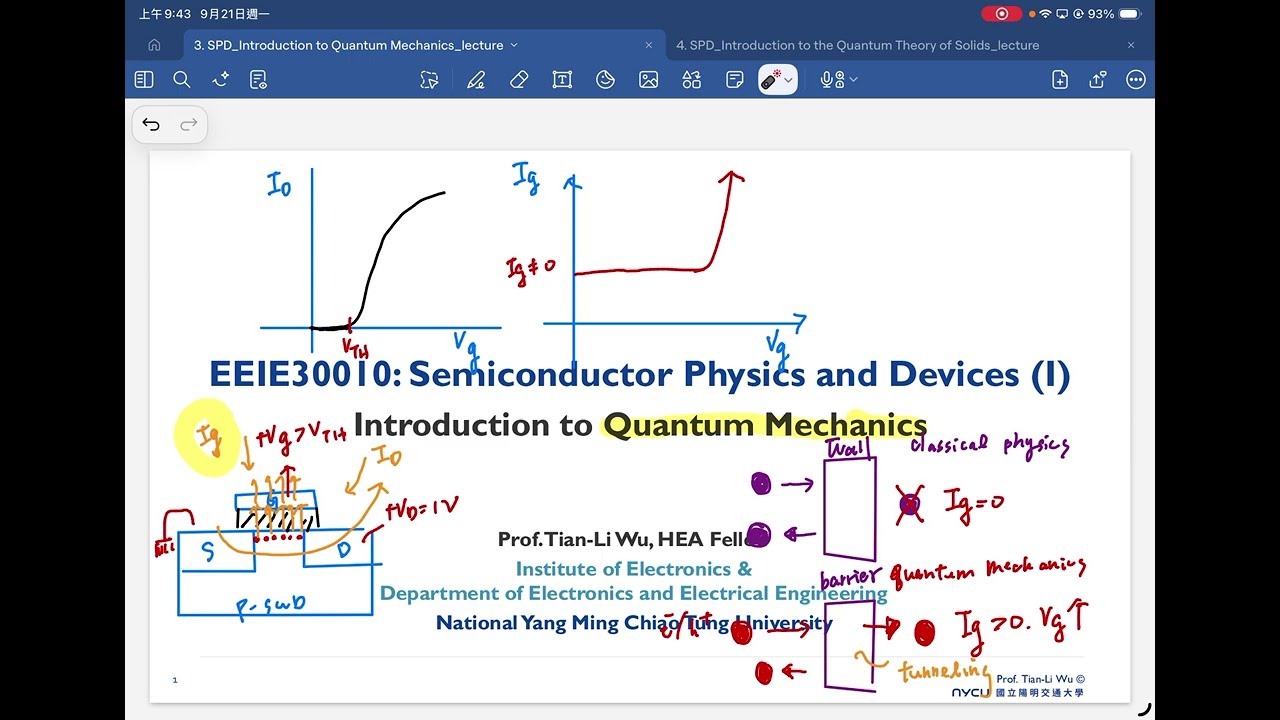
The value of this lecture lies in its ability to make abstract quantum mechanics tangible for engineering students by anchoring each concept to a real device problem, specifically gate leakage in MOSFETs. The professor uses clear analogies (e.g., a ball against a wall vs. electron tunneling) and emphasizes physical intuition over mathematical derivation, which strengthens the argumentation. The logical progression from classical failure to quantum explanation is well-structured, and each solution of the Schrödinger equation is connected back to device behavior. The argumentation is solid because it relies on fundamental, well-established physics and clearly demonstrates how these principles resolve the discrepancies between classical predictions and experimental observations.
Scientific Rigor, Source Quality, Title Accuracy
The scientific rigor is high; the lecture presents standard, widely accepted quantum mechanics concepts without introducing unverified claims. However, the lecture does not cite specific external sources or papers; it relies on general textbook knowledge. The title is perfectly aligned with the content, as the lecture systematically covers tunneling, wave functions, and energy bands, all within the context of semiconductor devices. The explanation of gate leakage and its relationship to tunneling is accurate and provides a compelling rationale for studying quantum mechanics. No sources are explicitly mentioned, which is expected for a pedagogical lecture; the information is consistent with established literature.
223 words
Title / Content Match
The title accurately describes the lecture content, which covers tunneling, wave functions, and energy bands in the context of semiconductor devices.
Quality & Reliability
8/10
The lecture presents standard quantum mechanics concepts with clear pedagogical explanations, connecting theoretical principles to practical semiconductor device issues. The material is accurate and reliable, though it does not introduce new research findings.
Key Moments
Markers derived by PSI from the transcript: the creator did not define chapters.
- Introduction to MOSFET operation and gate leakage problem.
- Why classical physics fails and need for quantum mechanics.
- Review of quantum principles: photoelectric effect, energy quantization, wave-particle duality, uncertainty.
- Schrödinger equation and separation of variables, wave function interpretation.
- Potential step and barrier, tunneling effect and application to gate leakage.
- Formation of energy bands in crystals and band diagrams.
Contribution & Novelties
The lecture’s original contribution lies in its pedagogical approach: it systematically bridges fundamental quantum mechanics with real semiconductor device issues, particularly gate leakage, by presenting theoretical concepts in direct response to a practical engineering problem. Each quantum principle is introduced as necessary to explain a device phenomenon, making the material highly relevant for engineering students. The clear progression from motivation to theory to application enhances comprehension.
Pour aller plus loin :
- Quantum tunnelling — Directly related to gate leakage and barrier penetration.
- Schrödinger equation — Fundamental equation used to describe wave functions and energy quantization.
- Energy band — Explains the formation of conduction and valence bands in crystals.
- MOSFET — The device context for the explained quantum phenomena.
118 words
Radar Profile
The radar profile shows high quantity of information and good quality, with a strong technical level. Reliability is average but consistent. The lecture excels in delivering comprehensive coverage of quantum mechanics for semiconductor applications.