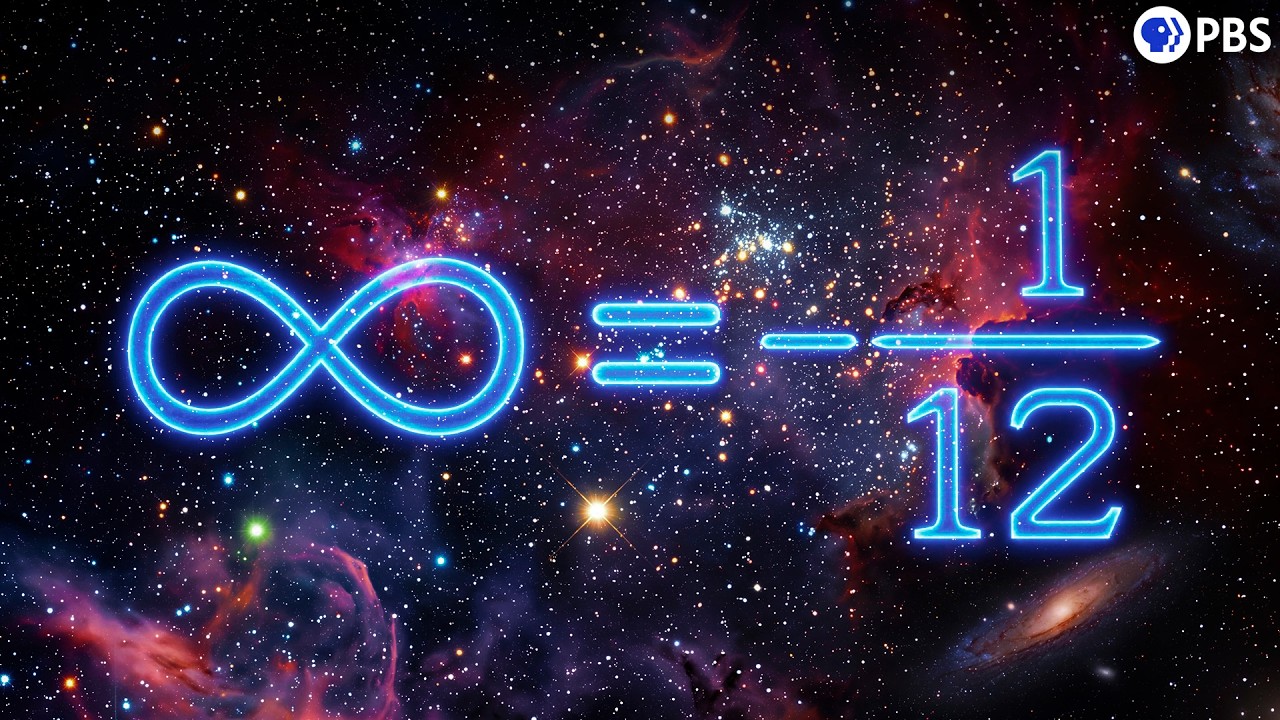
The Impossible Equation Behind String Theory's 26 Dimensions
Keywords
Summary
193 words
Critical Evaluation
Value of the Information & Strength of the Argument
The video provides a clear and accurate explanation of a subtle topic. It correctly distinguishes between the naive divergent sum and the zeta-regularized value, and it explains the physical motivation for regularization in the Casimir effect and string theory. The argumentation is logical and builds step by step: from the mathematical trick to its physical applications. The host acknowledges where the derivation becomes hand-wavy, particularly in the string theory section, which maintains transparency. The value of the information is high because it connects a seemingly abstract mathematical curiosity to measurable physical phenomena (Casimir effect) and to a fundamental result in string theory (D=26). The explanation of how the infinite sum arises from mode counting and how a cutoff or zeta regularization isolates the finite part is pedagogically effective. The video also correctly notes that the -1/12 is not a literal sum but a regularized finite part, which is a crucial conceptual point often misunderstood in popular discussions.
Scientific Rigor, Source Quality, Title Accuracy
The video is scientifically rigorous and cites relevant sources: the Numberphile video that popularized the -1/12 result, a debunking video, and a 3Blue1Brown video on analytic continuation. These are mentioned in the description and linked. The title accurately reflects the content, as the video indeed explains how the -1/12 result leads to the 26 dimensions of bosonic string theory. The content is consistent with established physics and mathematics. The only minor issue is that the video does not provide direct citations to primary literature, but it references well-known educational sources. The comments show a mix of appreciation for the mathematical depth and some criticism regarding the treatment of the Navier-Stokes AI claim, but that is not central to the video’s topic. Overall, the sourcing and rigor are strong for a science communication piece.
305 words
Title / Content Match
The title accurately reflects the content: the video explains how the -1/12 result from zeta regularization leads to the requirement of 26 dimensions in bosonic string theory. The title is engaging and not misleading.
Quality & Reliability
9/10
The content is presented by a professional physicist (Matt O'Dowd) and the channel is a well-established PBS science outlet. The mathematical and physical claims are accurate: the divergent nature of the sum of natural numbers, the role of analytic continuation of the Riemann zeta function, the Casimir effect and its measurement, and the critical dimension of bosonic string theory (D=26) are all standard results in theoretical physics. The video carefully distinguishes between the naive sum and zeta-regularized values, and it correctly notes that the -1/12 is not a literal sum but a regularized finite part. The only minor weakness is the admitted hand-waving in the string theory derivation, but this is transparently flagged.
Key Moments
Markers derived by PSI from the transcript: the creator did not define chapters.
- Introduction: the sum of all positive integers and the -1/12 result.
- Explanation of convergent and divergent series, and the Numberphile video.
- Introduction to the Riemann zeta function and analytic continuation.
- The Casimir effect: setting up the plates and mode exclusion.
- Derivation of the Casimir energy and the appearance of -1/12.
- Transition to string theory: vibrational modes and divergent sums.
- Regularization of the string's zero-point energy and the (D-2)/2 factor.
- Requirement of Lorentz symmetry leading to D=26.
- Summary of regularization and renormalization, and the meaning of -1/12.
- Sponsor message and closing credits.
Cited Sources
- Numberphile video on 1+2+3+... = -1/12 — Mentioned as the original viral video that popularized the result, but no direct URL provided in the description.
- Debunking video of the Numberphile proof — Mentioned as the host's favorite debunking video, but no URL provided.
- 3Blue1Brown video on analytic continuation — Mentioned as an excellent resource on the Riemann zeta function and analytic continuation, but no URL provided.
Concurring Sources
- Riemann zeta function — Confirms the analytic continuation and the value ζ(-1) = -1/12.
- Casimir effect — Confirms the derivation and experimental measurement of the Casimir force.
- Bosonic string theory — Confirms the critical dimension D=26 and the role of the normal-ordering constant.
External References
Contribution & Novelties
The video’s original contribution is its clear and integrated explanation of how the -1/12 result from zeta regularization appears in two distinct physical contexts: the Casimir effect and bosonic string theory. It connects the mathematical technique to measurable phenomena and to the derivation of the critical dimension D=26, providing a coherent narrative that is accessible yet technically accurate. It also emphasizes the conceptual distinction between the literal divergent sum and the regularized finite part, which is often glossed over in popular accounts.
Pour aller plus loin :
- Riemann zeta function — For the mathematical foundation of analytic continuation and the value at -1.
- Casimir effect — For the physical setup and experimental verification of the attractive force.
- Bosonic string theory — For the critical dimension D=26 and the role of the Virasoro algebra.
- Zeta function regularization — For the technique used to assign finite values to divergent sums in physics.
150 words
Radar Profile
The radar shows high scores in information quantity, quality, and reliability, with a slightly lower technical level due to the hand-wavy string theory section. The overall profile indicates a well-researched, accurate, and informative science communication piece.
💬 Sur les 30 commentaires analysés, le climat est majoritairement positif, avec des remerciements pour l'explication claire et des demandes de vidéos plus mathématiques. Quelques commentaires expriment une certaine confusion ou critiquent le traitement de sujets connexes, mais l'orientation générale reste favorable.