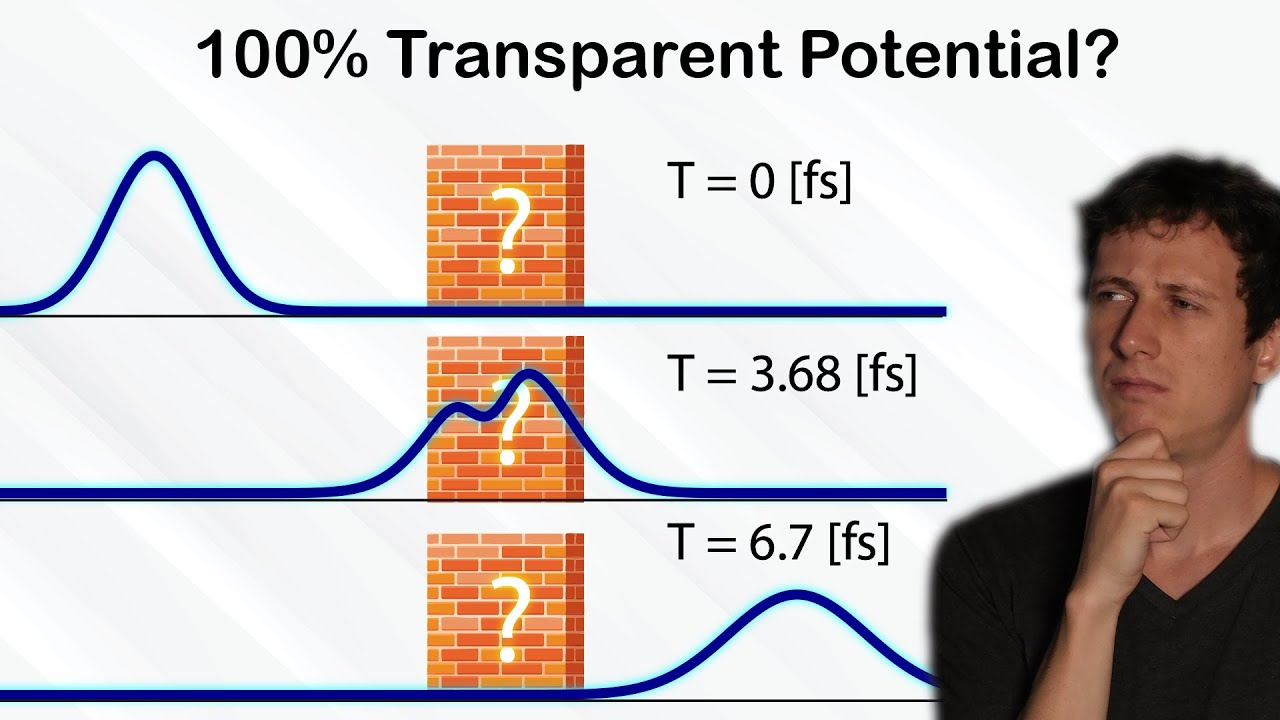
How Electrons Tunnel Through a Barrier (Numerical Simulations)
Title history
- How Electrons Tunnel Through a Barrier (Numerical Simulations) — observed on 20261101-0203 UTC (YouTube)
Keywords
Summary
152 words
Critical Evaluation
Value of the Information & Strength of the Argument
The video provides valuable intuitive insights into quantum tunneling through clear visual simulations. It effectively uses momentum-space representation to explain why certain wave components transmit or reflect, and it challenges naive reasoning by comparing different potential shapes. The argumentation is systematic: each scenario is introduced with a physical question, simulated, and then interpreted. The explanation of the Pöschl-Teller potential as a reflectionless potential is a highlight, showing a deeper mathematical understanding. However, the video does not provide rigorous derivations or cite external literature, relying on simulation outcomes and qualitative reasoning. The presenter’s narrative makes complex topics accessible without oversimplifying the underlying physics.
Scientific Rigor, Source Quality, Title Accuracy
The video demonstrates high rigor in its numerical methods, with careful attention to normalization and convergence (e.g., reducing reflection errors to 10^-10 for Pöschl-Teller). The physics is accurately presented, and the simulations match theoretical expectations. No external scientific sources are cited; the only links are support pages and graphic attributions, which are not relevant to the content. The title is accurate and does not overpromise. The lack of citations is a minor weakness, but the content is self-contained and aligns with established quantum mechanics principles.
202 words
Title / Content Match
The title accurately describes the content, focusing on numerical simulations of electron tunneling through barriers, as demonstrated throughout the video.
Quality & Reliability
9/10
The video presents standard quantum mechanics, numerically solving the Schrödinger equation with high accuracy. The explanations align with established physics, and the simulations are consistent with theoretical predictions. Some nuances like Pöschl-Teller potentials are correctly identified, indicating a solid understanding of the subject.
Key Moments
Markers derived by PSI from the transcript: the creator did not define chapters.
- Introduction of Gaussian wave packets and unit scaling for electron simulation
- Demonstration of wave packet spreading and its relation to Heisenberg uncertainty
- Momentum space representation and its time invariance
- Simulation of wave packet hitting a potential barrier, showing transmission and reflection
- Analysis of momentum space splitting during barrier interaction
- Comparison of step potentials, showing reflection even for attractive steps
- Introduction of Pöschl-Teller potential and its reflectionless properties for integer λ
Contribution & Novelties
The video’s original contribution lies in its clear visual demonstration of quantum tunneling using numerical simulations, particularly the momentum-space interpretation and the comparison of different potential shapes. It challenges common intuitions and shows that tunneling is a fundamental phenomenon that cannot be fully suppressed by any finite potential. The use of Pöschl-Teller potential as a reflectionless example adds depth, though it is not new research. The video serves as an excellent educational tool, providing intuition that is often missing in textbooks.
Pour aller plus loin :
- Pöschl-Teller potential — A known exactly solvable potential with reflectionless properties for integer quantum numbers, relevant to the video’s final example.
- Quantum tunnelling — The core phenomenon discussed, with theoretical background and applications.
- Heisenberg uncertainty principle — The principle that explains wave packet spreading and momentum-position limitations, central to the early part of the video.
141 words
Radar Profile
The radar profile shows very high scores across all dimensions, indicating a technically sound, well-explained, and reliable educational video. The only slight weakness could be the lack of external citations, but the internal consistency and accuracy are excellent.