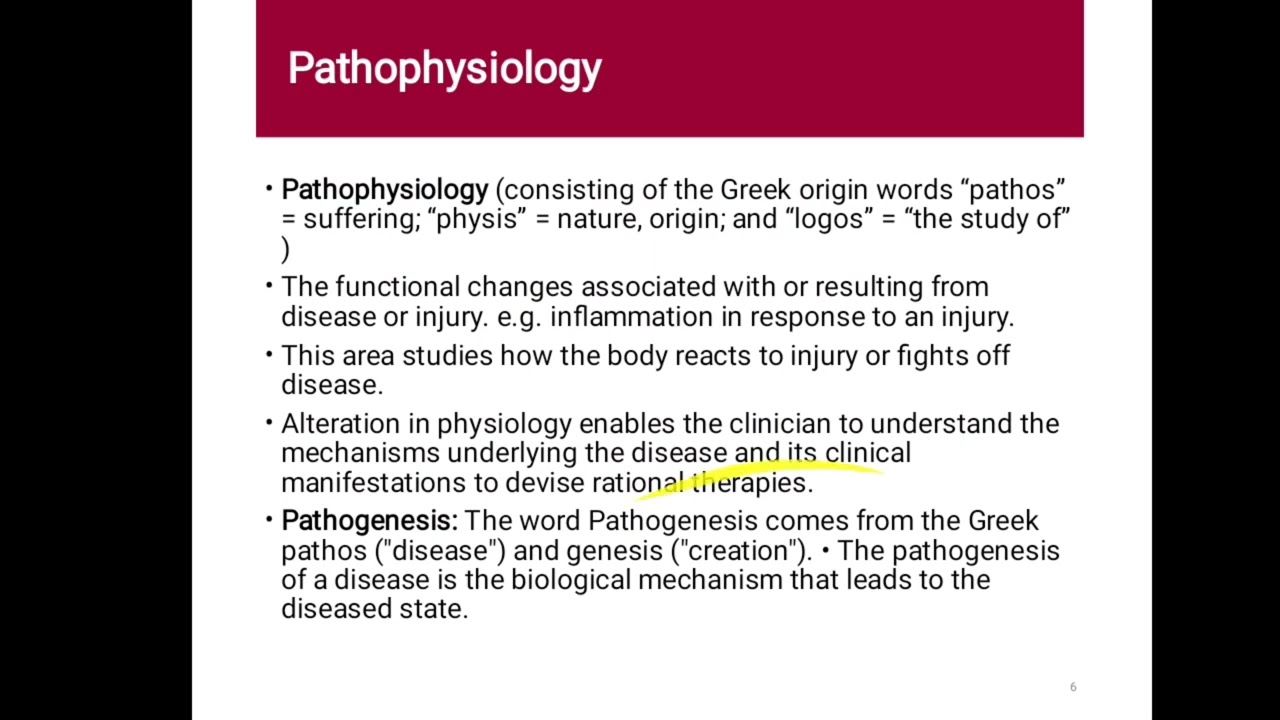
Introduction to pathophysiology chapter 1 BSN 3rd semester kmu slides in pashto #kmupdates
Keywords
Summary
162 words
Critical Evaluation
Value of the Information & Strength of the Argument
The value of the video lies in its clear and straightforward definitions of key terms in pathophysiology, which could serve as a memorization aid for beginners. The argumentation is mostly descriptive, presenting established concepts without critical analysis or supporting data. The lecturer relies on simple explanations and analogies, but does not engage with controversial or evolving aspects of the field. The argumentation lacks a structured framework and jumps between topics, yet the core ideas are accurately conveyed. The inclusion of visual aids is assumed but not verifiable from the transcript. Overall, the video provides a starting point for learners but offers limited intellectual depth.
Scientific Rigor, Source Quality, Title Accuracy
The scientific rigor is moderate: the information aligns with standard medical textbooks, but the video does not cite any external sources, studies, or clinical evidence. The quality of sources is therefore not applicable, as no sources are referenced. The title adheres to the content, but the ‘in pashto’ label is partially inaccurate, as the lecture is overwhelmingly in English. The video appears to be a straightforward reproduction of educational slides without critical evaluation. The lack of citations weakens the overall reliability, leaving viewers to trust the instructor’s authority without corroborating material.
210 words
Title / Content Match
The title accurately reflects the video's content as an introduction to pathophysiology, but the claim of 'in pashto' is partially misleading since the lecture is predominantly in English with only occasional Pashto interjections.
Quality & Reliability
6/10
Content is fundamentally correct and aligns with standard biomedical knowledge, but it is presented at an introductory level without citations or references, and the transcript contains frequent spelling errors and occasional unclear phrasing. The absence of external sources limits its scientific depth, though the core definitions and concepts are accurate.
Key Moments
Markers derived by PSI from the transcript: the creator did not define chapters.
- Introduction and welcome, stating the purpose of the video.
- Definition of pathology and its role as a bridge between basic science and medicine.
- Explanation of pathophysiology, focusing on how the body reacts to injury.
- Discussion of the concept of disease and its components, including the natural history of disease.
- Categorization of disease causes into intrinsic and extrinsic, with examples like radiation and poor sanitation.
Contribution & Novelties
This video does not introduce novel research or original insights; it serves as a didactic summary of foundational concepts in pathophysiology. Its contribution is limited to educational revisualization, potentially helping beginners recall definitions. For those seeking deeper understanding, the following resources provide comprehensive and authoritative information:
Pour aller plus loin :
- Pathophysiology - Wikipedia — Offers a detailed overview of the discipline, its relation to pathology, and examples.
- Pathology - Wikipedia — Explains the breadth of pathology, including clinical and anatomical aspects, and its diagnostic relevance.
- Natural history of disease - Wikipedia — Discusses the progression of disease from onset to resolution, providing context for the video’s explanation.
108 words
Radar Profile
The radar profile shows relatively balanced scores across dimensions, with a slightly higher score in information quality (7) compared to technical level (4) and reliability (6). This suggests the video is more about conveying established knowledge accurately than delving into technical depth, and the lack of citations reduces its credibility.