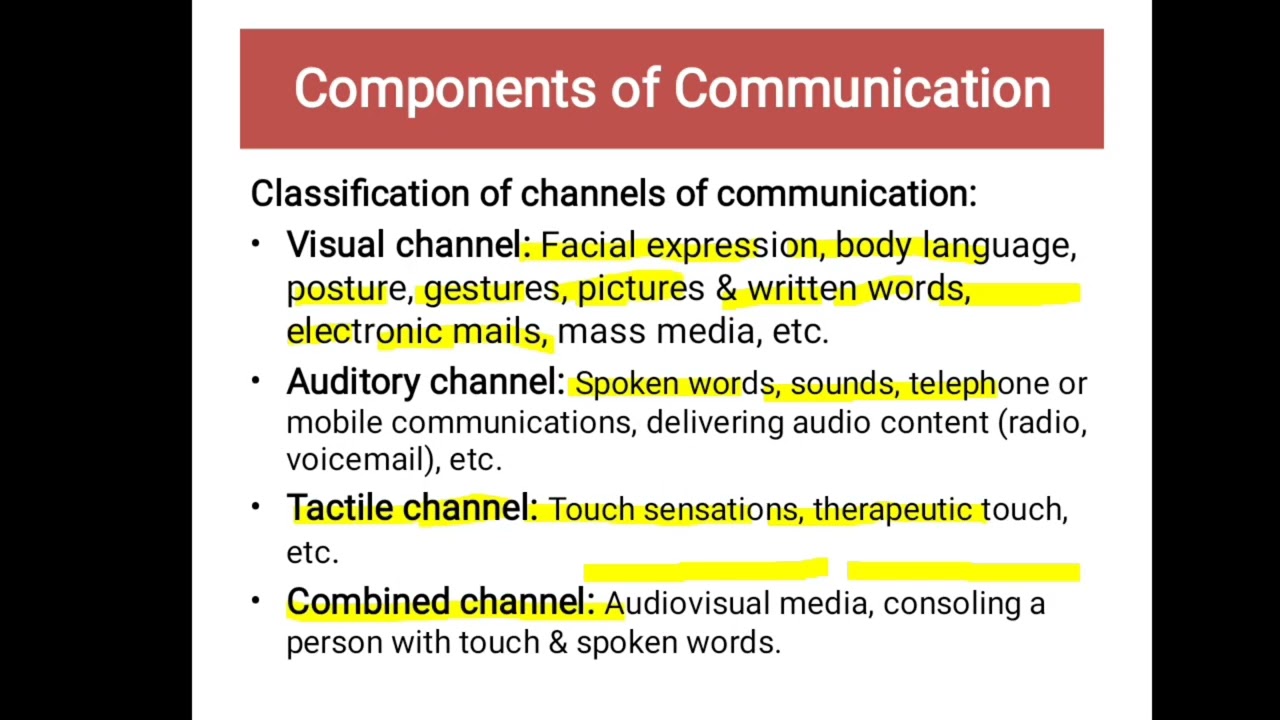
communication chapter : 3 part:1 BSN Ist semester kmu slides in pashto #kmupdates #nursingschool
Keywords
Summary
136 words
Critical Evaluation
Value of the Information & Strength of the Argument
The value of the information lies in its clarity and accessibility for nursing students, providing a structured introduction to communication concepts essential for clinical practice. However, the argumentation is limited: the instructor presents definitions and classifications without evidence, examples, or critical discussion. The reliance on slides suggests a superficial treatment, with no exploration of real-life scenarios, potential barriers, or empirical research. The two-way process model is presented as a given, but the video does not elaborate on its significance or practical applications beyond basic feedback. The lack of depth and absence of references undermine the scientific value, though the content is not misleading.
Scientific Rigor, Source Quality, Title Accuracy
The video demonstrates low scientific rigor: no sources, citations, or references are mentioned, relying solely on the lecturer’s knowledge. The slides appear to be from a standard nursing textbook, but without verification, the accuracy cannot be confirmed. The title is precise and matches the content, indicating the specific chapter and course context. However, the subtitle ‘slides in pashto’ may refer to the language of the slides, while the spoken language is primarily Pashto, which is consistent. Overall, the presentation is pedagogically oriented but lacks scholarly rigor, making it more suitable for rote learning than critical understanding. No comment analysis is possible as no comments were provided.
224 words
Title / Content Match
The title accurately reflects the content: a communication chapter lecture for first-semester BSN students, using slides in Pashto, with hashtags indicating the university and nursing school context.
Quality & Reliability
4/10
The video presents standard communication concepts for nursing students, but relies on a slide presentation with no external citations or scientific sources. The content is accurate but elementary, and the lecture format lacks depth or critical evaluation.
Key Moments
Markers derived by PSI from the transcript: the creator did not define chapters.
- Introduction and identification of effective verbal communication
- Definition of communication as a two-way process
- Roles of sender, receiver, message, and channel
- Classification of channels including visual and body language
- Importance of feedback and completion of communication process
- Nonverbal communication and silence as powerful message
- Visual communication using electromagnetic instruments
- Intrapersonal communication, self-talk, and meditation
Contribution & Novelties
This video offers a basic educational overview of communication concepts for nursing students. Its novelty is limited to the specific combination of Pashto language and nursing curriculum, but the content itself is not original. It serves as a primer rather than advancing new ideas.
Pour aller plus loin :
- Communication - Wikipedia — Provides a comprehensive overview of communication models and theories, complementing the video’s basics.
- Shannon–Weaver model - Wikipedia — A classic model of communication that illustrates the sender-receiver process, useful for deeper understanding.
- Nonverbal communication - Wikipedia — Expands on the video’s brief mention of nonverbal elements, with research-based insights.
102 words
Radar Profile
The radar profile shows low technical level and reliability, with moderate information quantity and quality. This indicates a beginner-level lecture that covers basic concepts but lacks depth and rigorous sourcing, typical of a classroom tutorial.