Intelligent Systems: Machine Learning seminars
Keywords
Summary
136 words
Critical Evaluation
Value of the Information & Strength of the Argument
The video provides a solid conceptual foundation for understanding sequence processing in NLP. The explanation of RNNs, LSTMs, and attention is clear and well-structured, building from simple ideas to complex architectures. The interactive quiz serves as an effective review, and the lecturer uses concrete examples (e.g., ‘Шла Маша по шоссе’) to illustrate abstract concepts. The argumentation for why non-linearities are necessary is mathematically grounded. The discussion of practical applications like candidate generation for product matching adds valuable context. However, the presentation is somewhat verbose, and some explanations could be more concise.
Scientific Rigor, Source Quality, Title Accuracy
The lecture is academically rigorous, referencing standard concepts and architectures (RNN, LSTM, attention, Transformer) without citing specific external papers. The title accurately represents the content: it is a seminar on machine learning for intelligent systems. The quiz questions reinforce prior knowledge, and the lecturer clarifies misunderstandings. The video does not include a bibliography, but the absence of direct citations is typical for an educational lecture. The content aligns with established deep learning literature, and the lecturer’s technical explanations are consistent with common knowledge in the field. No public comments were available for analysis.
199 words
Title / Content Match
Title matches content: the video is indeed a seminar on machine learning, specifically on intelligent systems for NLP.
Quality & Reliability
8/10
The lecture is a structured academic presentation covering fundamental NLP concepts (RNN, LSTM, GRU, attention, Transformers) with interactive quiz and explanations. The content is technically accurate and aligns with established deep learning literature, though it is a teaching session rather than original research.
Key Moments
Markers derived by PSI from the transcript: the creator did not define chapters.
- Introduction and quiz instructions; attendees are given a link to a quiz.
- Students begin answering the quiz; discussion about email field.
- Quiz answers are reviewed; explanations for one-hot encoding and BoW.
- Discussion of TF-IDF and n-grams.
- Explanation of distributed representations and word2vec; fastText for rare words.
- Transition to main lecture; introduction to language modeling and RNNs.
- Detailed explanation of RNN architecture, hidden states, and weight sharing.
- Discussion of LSTM and GRU as solutions to vanishing gradients.
- Introduction to machine translation and the attention mechanism.
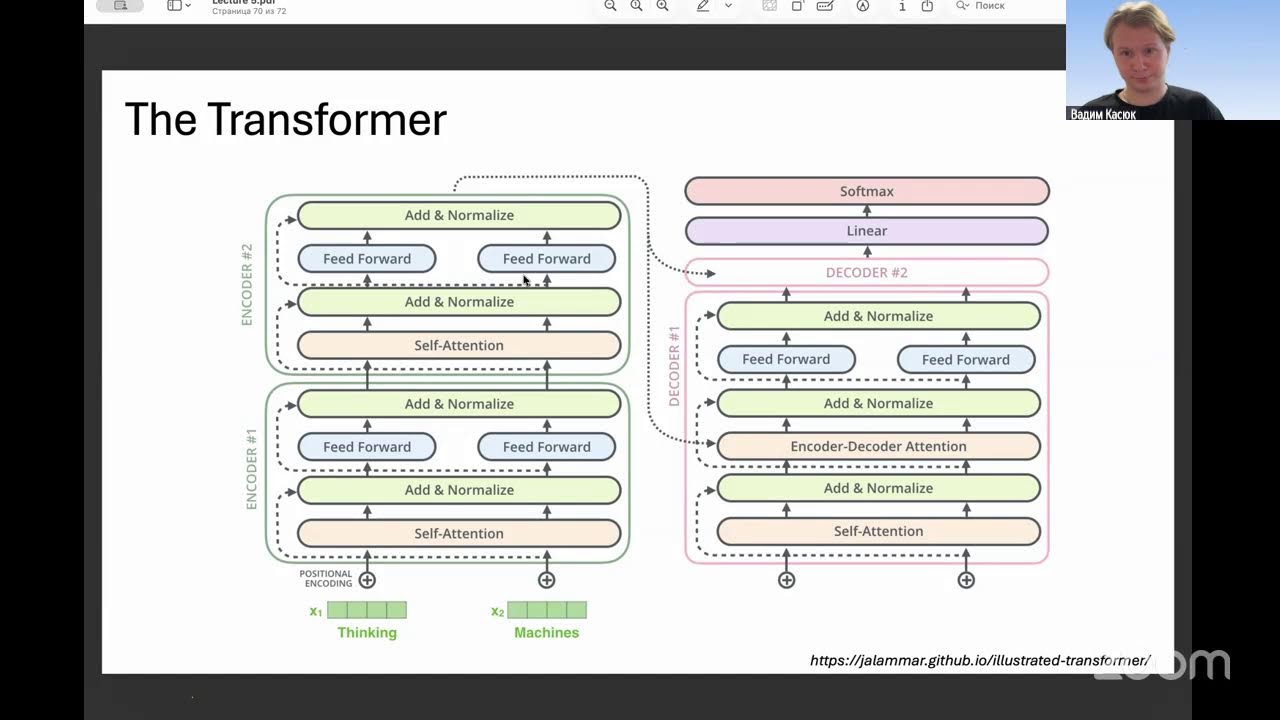
- Transformer architecture and self-attention; conclusion of the lecture.
Cited Sources
- Video source — The lecture itself, which presents concepts such as RNN, LSTM, attention, and Transformers.
Contribution & Novelties
The lecture provides a comprehensive review of sequence-based NLP models, integrating quiz-based revision with new material on attention and Transformers. The practical example of using cosine similarity for candidate generation in product matching offers a real-world application. The interactive format helps solidify understanding.
Pour aller plus loin :
- Recurrent neural network — Foundation of sequence modeling.
- Long short-term memory — Addresses vanishing gradient problem.
- Attention mechanism — Core idea behind modern transformers.
- Transformer (deep learning architecture) — Revolutionary architecture using self-attention.
- Word embedding — Dense vector representations of words.
89 words
Radar Profile
The radar profile shows high scores in quantity and quality of information, with moderate technical level and strong reliability. This reflects a dense, well-structured lecture that covers both foundational and advanced topics, though it is not a frontier research presentation.