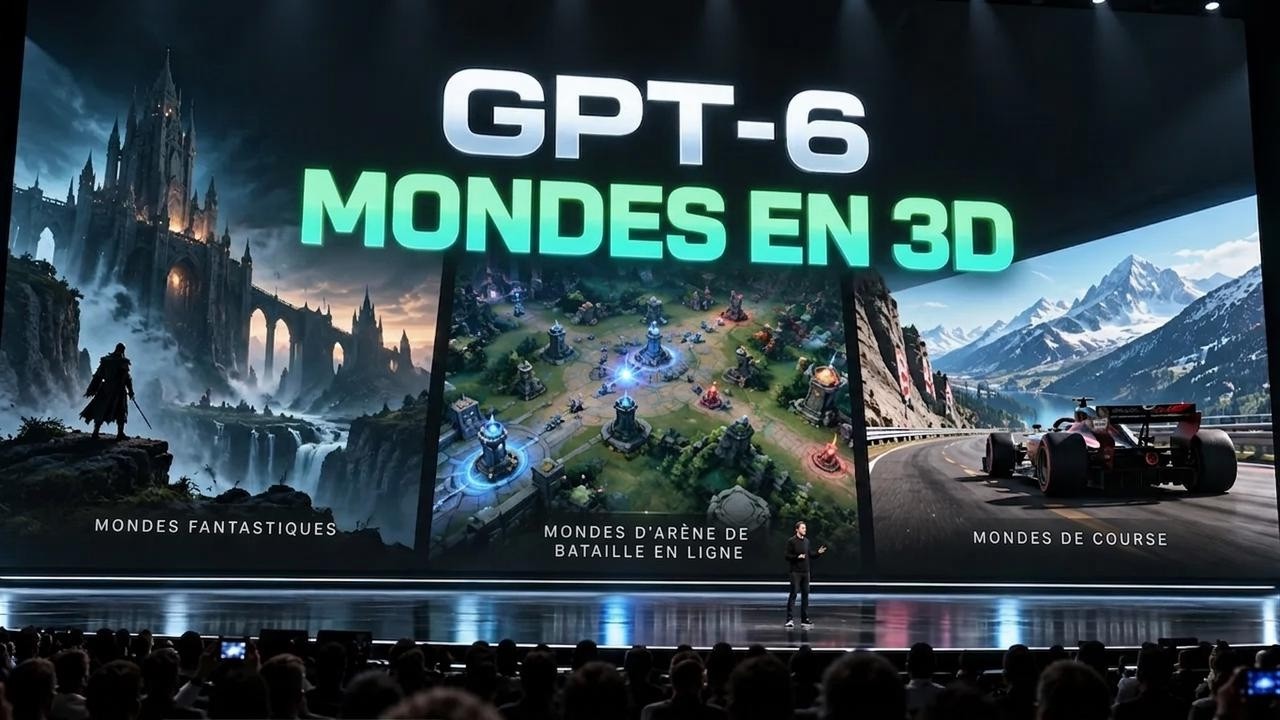
Ce nouveau système GPT 6 crée des mondes 3D bluffants
This new GPT 6 system creates stunning 3D worlds
Keywords
Summary
180 words
Critical Evaluation
Value of the Information & Strength of the Argument
The video’s primary value lies in its detailed, step-by-step illustration of how an AI system can handle the entire game development pipeline, from concept to deployment. The argumentation is built around convincing examples: the AI self-corrects proportions, optimizes vegetation, and identifies and fixes bugs post-launch, which substantiates the claim of advanced capabilities. The presenter supports each point with concrete technical details, such as the use of GLTF files, texture atlases, and automated test suites. However, the argumentation relies entirely on the presenter’s narrative and the provided examples; there are no external benchmarks, comparative analyses, or independent verifications, which weakens the overall persuasiveness. The spectacular nature of the demos may also overshadow the lack of critical scrutiny typically expected in scientific evaluations.
Scientific Rigor, Source Quality, Title Accuracy
Scientific rigor is low: the video cites no research papers, official documentation, or third-party assessments, and the only external links are promotional (a Mintos ad and a Spotify podcast). The sources cited are not authoritative and do not support the technical claims. The title is accurate in that it captures the core subject—an AI generating 3D worlds—but it uses sensationalist language (‘bluffants’) that emphasizes impressiveness over factual precision. The video’s internal logic is coherent, and the technical explanations are plausible, but without verifiable sources it remains an anecdotal showcase rather than a reliable scientific contribution.
231 words
Title / Content Match
The title accurately reflects the content: the video showcases an AI system creating several 3D game environments that appear visually impressive.
Quality & Reliability
5/10
The video offers a detailed and visually rich demonstration of an AI system generating three complete 3D games, but the claims are unverified, rely heavily on promotional language, and lack any external scientific validation or peer-reviewed sources. The presentation is compelling but not reliable as a rigorous technical assessment.
Key Moments
Markers derived by PSI from the transcript: the creator did not define chapters.
- Presentation of the three generated games: a MOBA, a dark fantasy RPG, and a racing game.
- Introduction to the AI system called Astra and its automated production process.
- Explanation of the creative workflow: concept art, Blender scripting, asset export, and iterative visual checks.
- Development details of the MOBA 'Emberfall', including champion design, system architecture, and optimization.
- Showcase of the dark fantasy RPG 'Eye of the Fallen God', focusing on atmosphere, scale, and combat.
- Creation of the racing game 'Celestial Alps GP', featuring vehicle physics, track geometry, and camera modes.
- Discussion of system limitations, deployment process, and the distinction from commercial game development.
- Conclusion and call to action for viewer feedback.
Cited Sources
- AI Revolution podcast on Spotify — The video announces a podcast version of the channel, though this is not a direct scientific source.
Contribution & Novelties
The video’s original contribution is its comprehensive demonstration of an AI system handling the full pipeline of 3D game generation, from concept art to deployment, with self-correction and optimization. It showcases a level of integration and autonomy not commonly seen in public demos. However, the novelty is more illustrative than groundbreaking in terms of underlying technology, as it relies on existing tools like Blender and Three.js. The video offers a compelling vision of future AI-assisted production, but it does not introduce new algorithms or methods.
Pour aller plus loin :
- Blender — An open-source 3D creation suite used by the AI for asset generation; relevant to understanding the toolchain.
- Three.js — A JavaScript library for 3D graphics in the browser, central to the web-based games; provides technical background.
- Rapier Physics Engine — A physics engine used for realistic simulation in the generated games; official site offers documentation.
- GLTF Format — The file format used for 3D asset exchange; explains the interoperability between Blender and Three.js.
165 words
Radar Profile
The radar profile shows high scores in technical depth and information quantity, reflecting the video's dense, detailed presentation. However, reliability is markedly low due to the absence of external validation, resulting in an unbalanced profile where technical impressiveness outweighs scientific credibility.