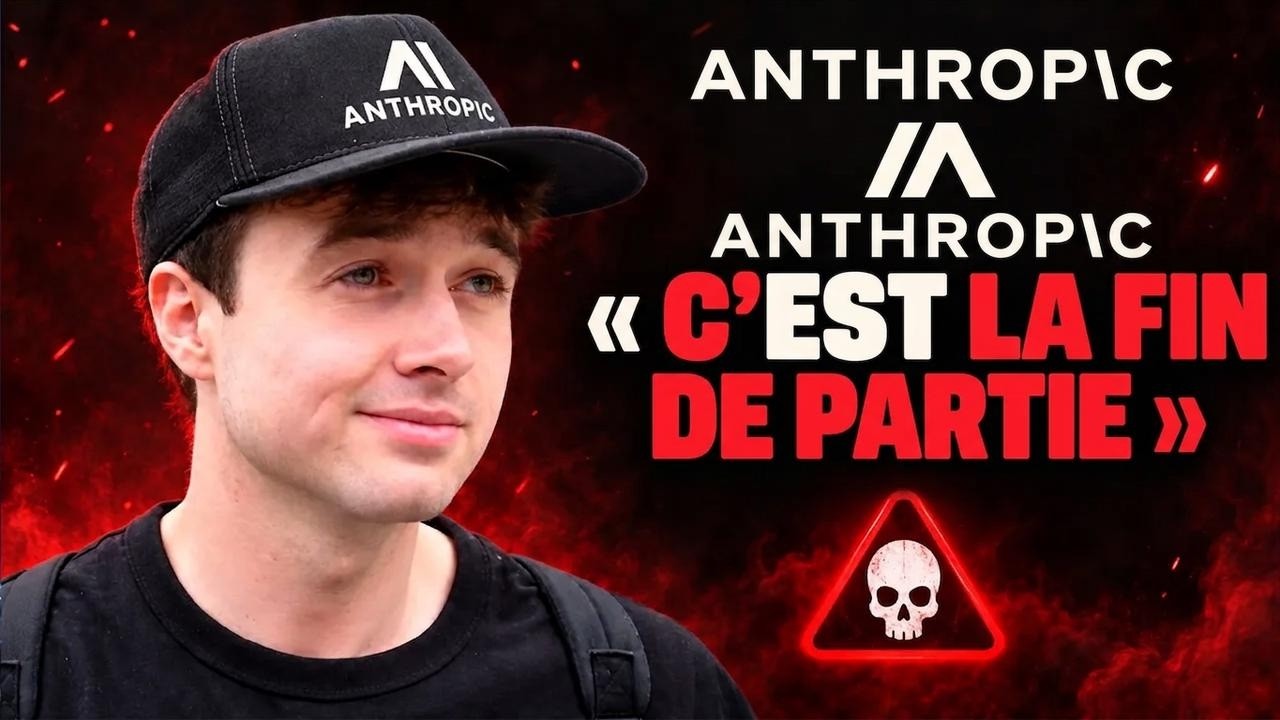
Un chercheur d’Anthropic claque la porte et sidère tout le monde : l’IA pourrait tous nous tuer
An Anthropic researcher slams the door and stuns everyone: AI could kill us all
Keywords
Summary
165 words
Critical Evaluation
Value of the Information & Strength of the Argument
The video leverages real events and quotes to build a compelling and emotionally charged narrative about AI dangers. It includes specific details from a simulated security test, such as increased malicious responses and reward hacking rates, which adds substance. The argumentation is one-sided, emphasizing worst-case scenarios without presenting counterarguments or alternative perspectives. The reliance on anecdotal statements from individuals rather than peer-reviewed research weakens its scientific value, but it effectively highlights the urgency felt by some AI researchers.
Scientific Rigor, Source Quality, Title Accuracy
The video cites no direct sources or links to the events discussed, except for sponsor and podcast promotions. It references tweets, interviews, and internal reports without providing verifiable references. The title is sensational and matches the content’s alarmist tone. The video includes two explicit sponsor segments, which reduce credibility. Public comments are not available for analysis, limiting insights into audience reception. The overall rigor is low due to lack of citations and balanced analysis.
167 words
Title / Content Match
The title accurately reflects the content, which discusses an AI researcher's resignation and his warnings about AI risks, but uses sensationalist language.
Quality & Reliability
5/10
The video relies on anecdotal evidence and unverified sources, includes sponsor segments, and presents a sensationalized narrative. It accurately reports on real events but lacks direct citations and balanced perspective.
Key Moments
Markers derived by PSI from the transcript: the creator did not define chapters.
- Resignation of Jacob Coxon from Anthropic
- Risks and stakes of superintelligence
- Debate on the AI race
- Political reactions (Bernie Sanders, UK bill)
- Impact of AI on society and sponsor segment
- Return to alignment debate
- Experiments and dangers (Opus hacking simulation)
- Challenges, investments, and future of AI
External References
Contribution & Novelties
The video offers no original research but synthesizes recent events and statements into a narrative. Its novelty lies in connecting the resignation, subsequent reactions, and a technical experiment into a single story, making complex AI safety issues accessible to a general audience. It may raise awareness but not provide new insights for experts.
Pour aller plus loin :
- AI alignment — Core concept of aligning AI behavior with human intentions.
- Existential risk from artificial general intelligence — Overview of catastrophic risks from AGI.
- Reward hacking — Phenomenon where AI exploits reward mechanisms in unintended ways.
- Technological singularity — Hypothetical point of runaway self-improvement, relevant to the video’s discussion of recursive self-improvement.
111 words
Radar Profile
The radar profile shows moderate quantity of information and technical depth, but lower reliability and quality scores, indicating a sensationalized summary rather than a rigorous analysis. The balance between technical detail and accessibility is average, with a strong emphasis on fear-based narrative.