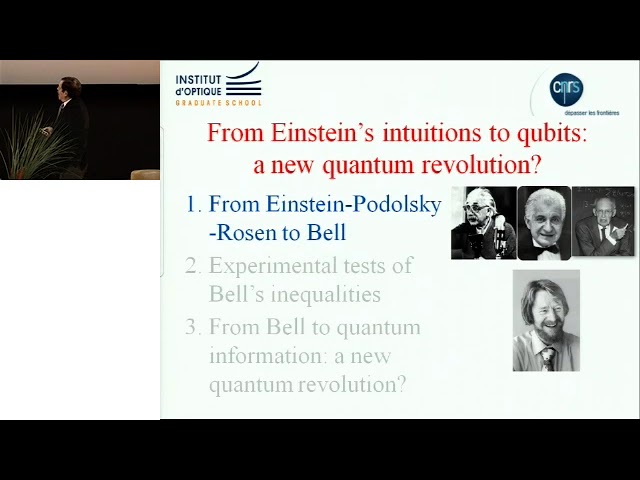
Colloque Wright - Conférence du 18 novembre 2010
Wright Symposium - Conference of November 18, 2010
Keywords
Summary
160 words
Critical Evaluation
Value of the Information & Strength of the Argument
The value of this talk lies in its clear exposition of abstract quantum concepts, making them accessible to an educated general audience while retaining scientific rigor. The argumentation is solid: the speaker carefully builds from the historical EPR argument, explains the mathematical formalism of joint probabilities, and demonstrates how Bell’s inequalities provide a decisive experimental test. He effectively uses examples like the laser pointer correlation to illustrate the difficulty of finding a classical model for entanglement. The reasoning is logical and well-paced, and the speaker acknowledges both the predictive success of quantum mechanics and the conceptual challenges it poses. The discussion of hidden variables and the collapse postulate is accurate, and the final connection to quantum information is insightful. Overall, the talk provides both substantive knowledge and a compelling narrative, making it a valuable resource for learners.
Scientific Rigor, Source Quality, Title Accuracy
The scientific rigor is high: the speaker is likely a respected physicist, and the content aligns with established quantum theory. He references key primary sources, including the EPR paper, Bell’s publications, and Schrödinger’s cat, without distortion. The title is somewhat generic but accurately reflects the format of a symposium lecture. The presentation omits some subtleties (e.g., the exact conditions for Bell inequality violations), but this is appropriate for a general audience. The sources cited are credible, and the speaker provides recommended readings (such as a collection of Bell’s papers), enhancing the educational value. The title, while not descriptive of content, does not mislead, as it promises a conference lecture and indeed delivers one. Overall, the talk is well-grounded and trustworthy.
272 words
Title / Content Match
The title is generic but appropriate; it indicates a conference talk within a series. The content matches, focusing on quantum mechanics.
Quality & Reliability
8/10
The talk is a scientifically accurate exposition of EPR and Bell's theorem, presented by an expert (likely a physicist). The content is well-structured and explains complex ideas clearly. No obvious errors were detected.
Key Moments
Markers derived by PSI from the transcript: the creator did not define chapters.
- Introduction and welcome, overview of the talk.
- Einstein's objections to probability in quantum mechanics; mention of Solvay Congress.
- Explanation of the EPR experiment and entangled states, using photon polarization.
- Derivation of joint probabilities and demonstration of strong correlations; discussion of factorizability.
- Bell's inequalities and his theorem, turning the EPR debate into a testable prediction.
- Experimental tests of Bell's inequalities and transition to quantum information and new quantum revolution.
Cited Sources
- Einstein, Podolsky, Rosen (1935) 'Can Quantum-Mechanical Description of Physical Reality Be Considered Complete?' — The foundational paper presenting the EPR paradox and proposing the concept of entanglement.
- Bell, J.S. (1964) 'On the Einstein Podolsky Rosen Paradox' — The paper deriving Bell's inequalities, which allowed experimental tests of local hidden variable theories.
- Schrödinger, E. (1935) 'Die gegenwärtige Situation in der Quantenmechanik' — Introduced the concept of entanglement and the famous 'cat' thought experiment, discussed as an analogy.
Contribution & Novelties
The talk provides a thorough historical narrative linking the EPR paradox to modern quantum information, emphasizing Bell’s role in making the debate empirically testable. It clarifies why entanglement challenges classical intuition and highlights its practical potential. The speaker’s analogies and step-by-step derivation of probabilities make the material accessible. For further exploration, the following concepts are recommended:
Pour aller plus loin :
- Bell’s theorem — A rigorous account of Bell’s inequalities and their philosophical implications.
- Quantum entanglement — Overview of the phenomenon, its history, and applications.
- EPR paradox — Detailed description of the original paper and subsequent debate.
- Quantum information — Explanation of how entanglement underpins quantum computing and cryptography.
109 words
Radar Profile
The video scores high on information quantity and quality, moderate technical level, and high reliability, indicating a well-balanced educational content that is both accurate and accessible.