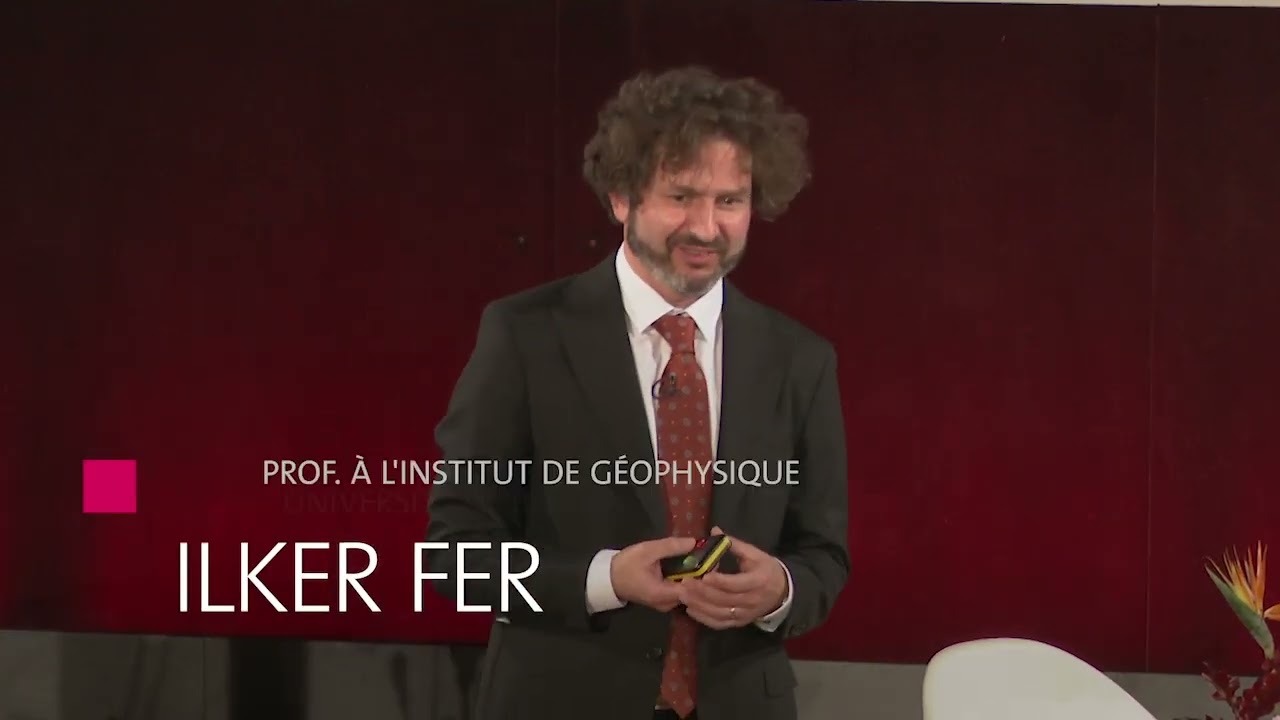
Professeur Ilker Fer : La turbulence des océans révélée par de nouvelles techniques d’observation
Professor Ilker Fer: Ocean turbulence revealed by new observation techniques
Keywords
Summary
198 words
Critical Evaluation
Value of the Information & Strength of the Argument
The lecture provides a valuable and well-structured overview of ocean turbulence research, integrating fundamental physical principles with concrete observational examples. The argumentation is solid, as it progresses logically from the global-scale importance of oceans in climate regulation to the specific small-scale processes that drive mixing. Fer effectively demonstrates how new technologies have overcome past observational limitations, leading to groundbreaking discoveries such as the persistent Lofoten vortex and its intense turbulence levels. The reasoning is supported by quantitative data and visualizations, and the speaker clearly explains the implications for climate modeling. The presentation is persuasive in establishing that turbulence is not a negligible detail but a critical component of the Earth system.
Scientific Rigor, Source Quality, Title Accuracy
The scientific rigor is high: Fer is an expert in polar oceanography, and his claims are grounded in extensive field measurements and peer-reviewed publications. The observational techniques described are state-of-the-art, and the interpretation of data follows standard oceanographic practice. While no specific sources are listed in the video description, the talk refers to well-known programs (Argo, gliders) and established concepts, indicating reliance on reputable research. The title accurately captures the content, focusing on the revelation of turbulence through new measurement methods. The presentation is logically organized, and the technical level is appropriate for a general scientific audience, with clear explanations of complex processes.
229 words
Title / Content Match
The title accurately reflects the lecture's focus on new observational techniques for studying ocean turbulence, which is indeed the central theme.
Quality & Reliability
9/10
The speaker is a recognized expert in physical oceanography, and the presentation is based on peer-reviewed research and direct observational data. The content is precise, well-structured, and supported by extensive measurements. No explicit sources were cited in the description, but the talk references well-established programs and methods.
Key Moments
Markers derived by PSI from the transcript: the creator did not define chapters.
- Introduction to the ocean's role in climate, heat absorption, and sea level rise.
- Explanation of thermohaline circulation and its importance for global climate.
- Discussion of the limitations of traditional observations and the need for new technologies.
- Introduction of modern observational tools: Argo floats, gliders, and satellite altimetry.
- Overview of turbulent mixing processes and their energy sources (wind, tides, internal waves).
- Case study: the Lofoten Basin vortex, its structure, and intense deep turbulence.
- Direct measurements of microstructure and velocity in the vortex, showing dissipation rates.
- Conclusions on the importance of turbulence for climate modeling and future research directions.
Contribution & Novelties
The lecture presents a synthesis of recent advances in observing ocean turbulence, notably the integration of autonomous platforms (Argo floats, gliders) with microstructure profilers to capture fine-scale mixing. The original contribution lies in highlighting the Lofoten Basin vortex as a hotspot of turbulence and in demonstrating how multi-platform observations can reveal persistent, energetic eddies that are critical for vertical heat transport. This work pushes forward the understanding of mesoscale and submesoscale dynamics and their parameterization in climate models.
Pour aller plus loin :
- Ocean turbulence (Wikipedia) — Provides background on turbulence in the ocean and its significance.
- Argo program — Details the global array of profiling floats used for real-time ocean observations.
- Thermohaline circulation (Wikipedia) — Explains the global density-driven circulation that influences climate.
- [Microstructure profiler (relevant concept) — No direct URL, but commonly used in oceanographic research] — Instrumentation for measuring small-scale turbulent dissipation.
145 words
Radar Profile
The radar profile shows a strong emphasis on information quantity and quality, with high reliability and moderate technical depth. This reflects a scientifically dense but accessible lecture, balancing detailed data with clear explanations for a general audience.