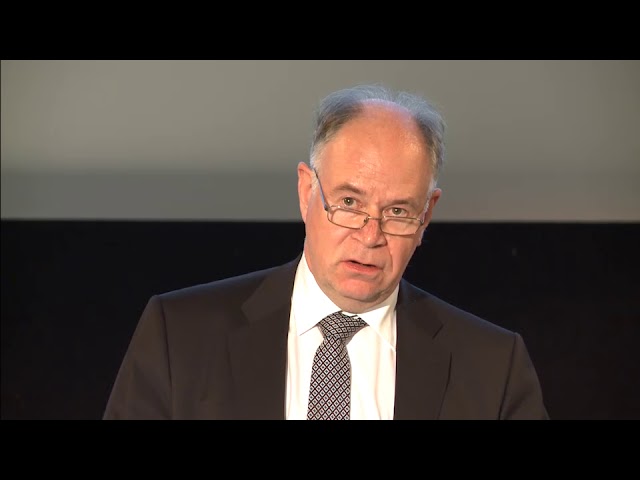
Colloque Wright
Wright Symposium
Keywords
Summary
132 words
Critical Evaluation
Value of the Information & Strength of the Argument
The talk delivers substantial scientific value by presenting fundamental insights into ion channel function, grounded in the speaker’s Nobel Prize-winning research. MacKinnon’s argumentation is clear and logically structured: he first establishes the existence of electrical phenomena in biology, then explains the underlying mechanisms with simple analogies, and finally describes the experimental methods used to elucidate the molecular structures. The historical narrative reinforces the credibility of the scientific progress and demonstrates how curiosity-driven research leads to revolutionary discoveries. The argumentation is persuasive and accessible, effectively bridging physics and biology without oversimplifying the core concepts.
Scientific Rigor, Source Quality, Title Accuracy
The scientific rigor is exemplary, given the speaker’s authority and the well-established nature of the content. MacKinnon references original contributions from key scientists (Galvani, Volta, Faraday, Maxwell) and explains the evidence supporting each step of the reasoning. The only limitation is the lack of openly cited sources within the video (no URLs in the description), but the content itself aligns with peer-reviewed literature and the speaker’s own publications. The title ‘Colloque Wright’ is vague, but it functions as a series label rather than a description of the content; it does not mislead but provides little guidance about the actual topic.
208 words
Title / Content Match
The title 'Colloque Wright' is generic and does not hint at the specific topic (ion channels and the electrical system of life), but it likely refers to a colloquium series, so it is not misleading.
Quality & Reliability
8/10
The content is presented by Nobel laureate Roderick MacKinnon, a leading expert on ion channels, ensuring high scientific reliability. The talk explains the molecular basis of electrical signals in cells using established research and historical context.
Key Moments
Markers derived by PSI from the transcript: the creator did not define chapters.
- Introduction of the colloquium and speaker Roderick MacKinnon.
- Start of the lecture on the electrical system of life.
- Historical background: Galvani's experiments and Volta's battery.
- Explanation of cell membrane structure, ion pumps, and ion channels.
- Discussion of selective ion channels and gating mechanisms.
- Introduction to x-ray crystallography and molecular architecture of channels.
Cited Sources
- Luigi Galvani — Mentioned in the historical introduction about animal electricity.
- Alessandro Volta — Discussed in relation to the invention of the battery and the controversy over animal electricity.
- Michael Faraday — Mentioned for his work on electromagnetic induction.
- James Clerk Maxwell — Referenced for his unified theory of electricity and magnetism.
- Roderick MacKinnon — The speaker himself, a Nobel laureate in Chemistry for work on ion channels.
Contribution & Novelties
This lecture provides a high-level synthesis of ion channel physiology, presenting the electrical system of life in a cohesive narrative. It offers valuable context on how fundamental physical principles apply to biology and highlights the importance of structural biology in understanding molecular mechanisms.
Pour aller plus loin :
- Ion channel selectivity — Explains how channels discriminate between ions.
- Potassium channel — Detailed structure and function of the channels discussed.
- Membrane potential — The electrical gradient across cell membranes.
- X-ray crystallography — The technique used by MacKinnon to solve protein structures.
- Roderick MacKinnon’s Nobel Prize — Official information about the award for ion channel studies.
104 words
Radar Profile
The radar profile shows high scores across all dimensions, particularly in quality and reliability, reflecting the authoritative and well-structured nature of the talk. The technical level is moderate-high, making it accessible to a general audience while retaining depth.