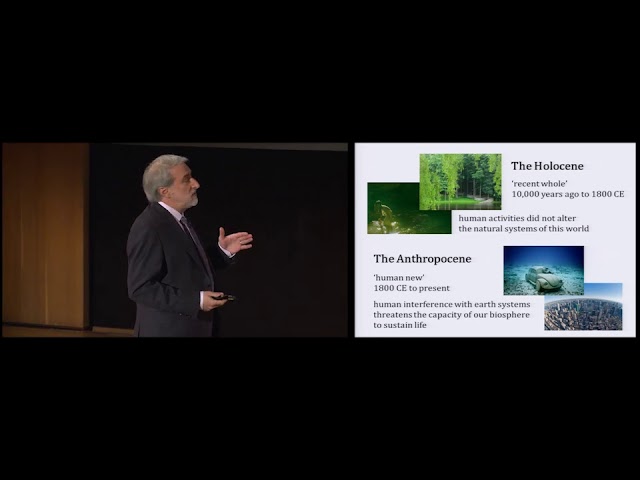
Colloque Wright 2014 - Conférence du 13 novembre 2014
Wright Symposium 2014 - Conference of November 13, 2014
Keywords
Summary
184 words
Critical Evaluation
Value of the Information & Strength of the Argument
The talk provides substantial value by framing global energy challenges in a holistic manner, linking energy use, wealth, and environmental impact through a simple identity equation. Nocera’s argument for solar energy is compelling, supported by quantitative estimates and practical reasoning. He effectively communicates the urgency of addressing energy poverty, using the ‘Sustainessene’ concept to integrate social justice with sustainability. His cost-per-weight analysis offers an original perspective on the economics of scalable technologies. However, some arguments are simplified; for instance, the claim that ‘you can never be cheaper than $10 per pound’ is presented without detailed empirical evidence, and the energy storage via artificial leaf is described optimistically without fully addressing practical challenges.
Scientific Rigor, Source Quality, Title Accuracy
Nocera is a credible source, with over 350 papers and a widely cited 2006 article ‘Powering the Planet: Chemical Challenges in Solar Energy Utilization.’ He does not cite specific external sources during the talk, instead relying on his own calculations and insights. The title is clear and directly relates to the content, though it could be more specific about the artificial leaf approach. The conference is part of a series, and the presentation includes a brief introduction by Alan Williams, adding context. Overall, the rigor is acceptable for a public conference, but the lack of citations for data and claims limits its scientific precision.
231 words
Title / Content Match
The title accurately reflects the content: the conference focuses on providing solar energy to disadvantaged populations, and Nocera presents his artificial leaf and broader societal implications.
Quality & Reliability
8/10
The talk is delivered by a distinguished professor and researcher in energy and chemistry, with well-established credentials and a widely cited paper. However, the arguments are presented in a simplified, persuasive manner with some approximations, and no external sources are provided to support the specific numbers and claims.
Key Moments
Markers derived by PSI from the transcript: the creator did not define chapters.
- Welcome and introduction of the conference
- Alan Williams introduces Daniel Nocera and his background
- Nocera introduces the concept of the Sustainessene and the energy equation
- Discussion of future energy demand (30 TW) and comparisons of nuclear, biomass, wind
- Advocacy for solar energy and the artificial leaf concept
- Frugal innovation and cost-per-weight curve for affordable technologies
- Conclusion and call to empower the poor with clean energy
Cited Sources
- Powering the Planet: Chemical Challenges in Solar Energy Utilization — Referenced by Nocera as his 2006 paper with 1600 citations, foundational to his solar energy research.
Contribution & Novelties
Nocera’s talk presents an original integrated perspective linking energy, poverty, and sustainability through the ‘Sustainessene’ concept. His artificial leaf technology aims to provide cheap, decentralized solar energy storage, addressing both environmental and social challenges. The cost-per-weight analysis offers a pragmatic lens for technology development. The talk’s key novelty lies in framing energy research as a tool for poverty alleviation.
Pour aller plus loin :
- Artificial photosynthesis — Relevant as the basis of Nocera’s artificial leaf.
- Energy poverty — Directly addresses the population segment Nocera targets.
- Frugal innovation — Nocera’s strategy for creating affordable technologies for the poor.
97 words
Radar Profile
The radar profile indicates a balanced presentation with high scores in quality and reliability, though slightly lower in quantity and technical depth. The talk is accessible yet informative, with a strong focus on applied solutions.