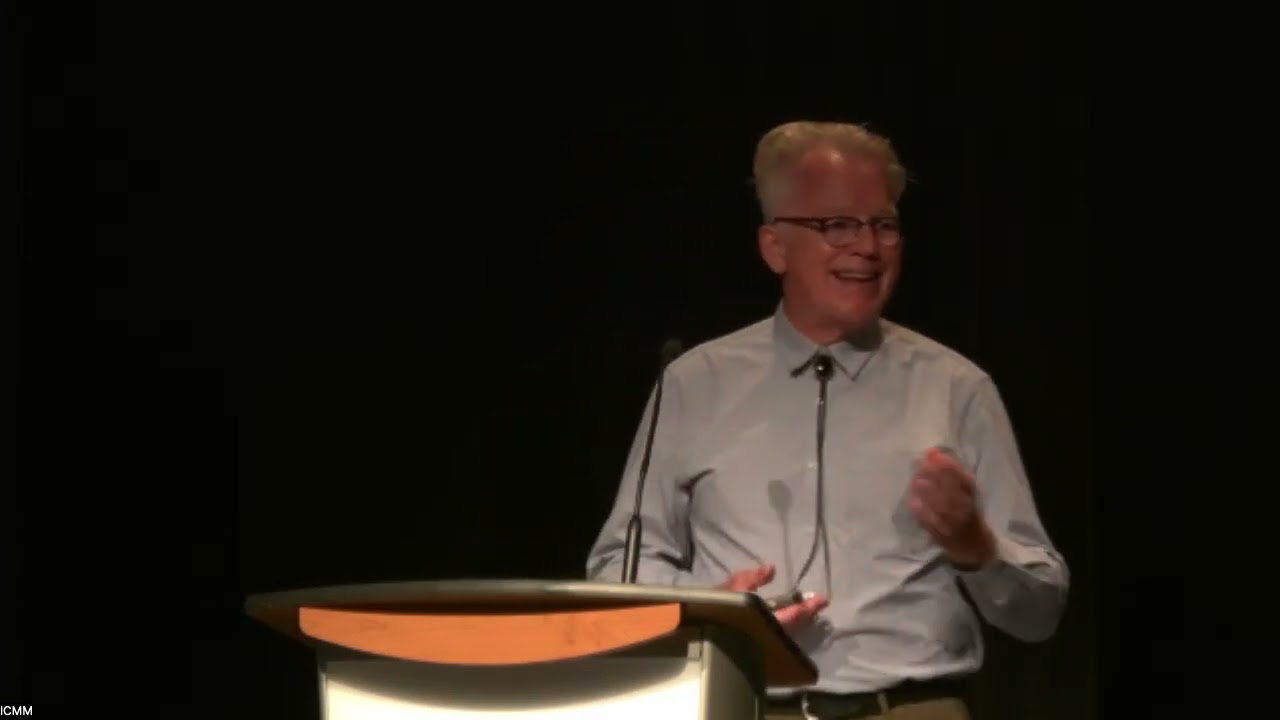
Keynote 3: My Ship of Private Choices, On Our Common Ocean Of Needs - Paddy Rogers, RMG
Keywords
Summary
212 words
Critical Evaluation
Value of the Information & Strength of the Argument
The value of this talk lies in its unique interdisciplinary perspective, combining a professional background in shipping with museum leadership to reflect on ethical and cultural issues. Rogers presents a coherent argument that human progress depends on collective action, not individual survival, and supports this with references to Darwin (misinterpreted as ‘survival of the fittest’), Kropotkin’s mutual aid, and the symbolic power of the Earthrise photograph. His discussion of shipping economics is informative, illustrating how arbitrage and structural imbalances shape global trade, and he effectively argues that the failure to price carbon constitutes a market distortion with grave environmental consequences. The argumentation is persuasive but not strictly academic; it relies on anecdotal examples and sweeping statements (e.g., the claim that all societies with high wealth disparity are unhappy) without empirical evidence. The rhetorical style is engaging, but the lack of systematic data and clear citations limits the scientific rigor of the presentation.
Scientific Rigor, Source Quality, Title Accuracy
Rigor and source quality are moderate. Rogers explicitly states that his views are personal, not those of his institution, which is appropriate for a keynote. He makes several named references (e.g., Kropotkin, Timothy Mo’s novel ‘An Insular Possession’, and the Earthrise photograph), but these are not formally cited, and he does not provide academic references or data sources. The talk is more of a discursive reflection than a scientific review. The title of the video is somewhat abstract but adequately reflects the content’s exploration of personal choices versus shared needs. The description of the event provides context (ICMM Congress 2022, theme about maritime museums and daily challenges), which aligns with the talk’s themes. Overall, while the content is intellectually stimulating, the reliance on personal opinion rather than verifiable sources reduces its scholarly rigor. There are no comments to analyze.
306 words
Title / Content Match
The title accurately captures the central theme of navigating between individual choices and collective needs, though the talk also covers broader topics such as maritime economics and environmental sustainability.
Quality & Reliability
6/10
The talk is a personal reflection by a museum director with executive shipping experience. It offers thoughtful cultural and economic insights, but it is not a systematic scientific study and relies on anecdotal evidence and broad assertions. Some references to specific works (e.g., Kropotkin, Timothy Mo) are mentioned, but no explicit citations or grounding in specialized literature is provided.
Key Moments
Markers derived by PSI from the transcript: the creator did not define chapters.
- Introduction by moderator, welcoming attendees and introducing speaker Paddy Rogers
- Rogers begins, stating the talk is about managing maritime history and the need for consistent approach
- Discussion of three big concerns: habitability, diversity, and wealth disparity
- Reflection on individualism and isolation, referencing Hamlet and Plato's call for reflection
- Mention of Darwin and Kropotkin; emphasis on cooperation and the 'world wide wood' network of trees
- Earthrise photograph and ocean as heat distributor; the 'goldilocks planet' and human's common fate
- Economic framework of shipping: arbitrage, trade balance, and historical example of the Opium Wars
- The necessity of carbon pricing to internalize environmental costs; inefficiency of avoiding hydrocarbon use without incentives
- Comparison of shipping's carbon efficiency relative to truck, rail, and air; critique of unnecessary transportation
- Concluding thoughts on adapting to change, the role of museums, and a call to navigate toward a common good
Cited Sources
- An Insular Possession — Novel by Timothy Mo cited in context of the Opium Wars and the granting of Hong Kong
- Mutual Aid: A Factor of Evolution — Work by Peter Kropotkin mentioned to argue for cooperation in nature
- Earthrise photograph, Apollo 8 — Referenced as a powerful symbol of human unity and planetary awareness
Contribution & Novelties
This talk offers a distinctive blend of practical shipping experience and museum leadership, arguing that maritime museums should act as agents of societal change by fostering empathy, cooperation, and a sense of shared destiny. Rogers’s call to ‘price carbon’ into market economics as a necessary step for environmental justice is a concrete proposition, though not novel. The reinforcement of the ocean as a unifying narrative thread is pedagogically valuable. Overall, the novelty is moderate; it synthesizes known ideas into a call for action.
Pour aller plus loin :
- Mutual Aid: A Factor of Evolution - Wikipedia — Provides background on Kropotkin’s argument about cooperation in nature, which Rogers cites.
- Earthrise - Wikipedia — Context on the Apollo 8 photograph that Rogers uses as a symbol of planetary unity.
- Carbon tax - Wikipedia — Explores the carbon pricing mechanism Rogers advocates as essential for environmental sustainability.
- Global commons - Wikipedia — Relevant to Rogers’s discussion of the ocean as a shared resource and the environmental commons.
165 words
Radar Profile
The radar profile shows moderate scores across all dimensions, with slightly lower technical level. This reflects a thoughtful but non-quantitative and non-technical presentation. The content is ethically and culturally rich but lacks empirical grounding, making it more of an inspirational keynote than a rigorous scientific contribution.