Quels algorithmes pour la physique des particules
Which algorithms for particle physics
Keywords
Summary
139 words
Critical Evaluation
Value of the Information & Strength of the Argument
The talk provides a valuable overview of how algorithms underpin modern particle physics, from raw detector signals to high-level physics conclusions. Billoir argues convincingly that algorithms are not mere tools but enablers of discovery, as demonstrated by the Higgs boson detection. He explains the logic of hypothesis testing and the importance of multiple independent signatures, strengthening the credibility of the results. The argumentation is logical and well-supported with concrete examples, such as the two-photon and four-lepton channels. However, the lecture is at an introductory level and does not delve into algorithmic details or recent advances like deep learning, which are mentioned only superficially.
Scientific Rigor, Source Quality, Title Accuracy
The speaker is an experienced physicist, and the content aligns with established scientific knowledge as of 2019. The description includes official institutional links (BnF, SFP, IN2P3, theses.fr) which lend credibility. The title accurately matches the content: the talk indeed discusses algorithms in particle physics. The transparency about approximations and uncertainties demonstrates scientific rigor. However, the talk does not provide explicit citations to specific papers during the presentation, relying instead on general references. The audience comments are not available, so public reception cannot be assessed.
202 words
Title / Content Match
The title faithfully reflects the content: the talk covers various algorithms used in particle physics, from event reconstruction to theoretical calculations.
Quality & Reliability
8/10
The talk is given by a professional physicist with a clear, structured exposition, and is based on established results (e.g., Higgs discovery) and standard theoretical frameworks. The content is reliable within the context of a public lecture, but may not capture later developments.
Key Moments
Markers derived by PSI from the transcript: the creator did not define chapters.
- Introduction to the talk and the broad scope of particle physics.
- Discovery of the Higgs boson via the two-photon channel and its statistical significance.
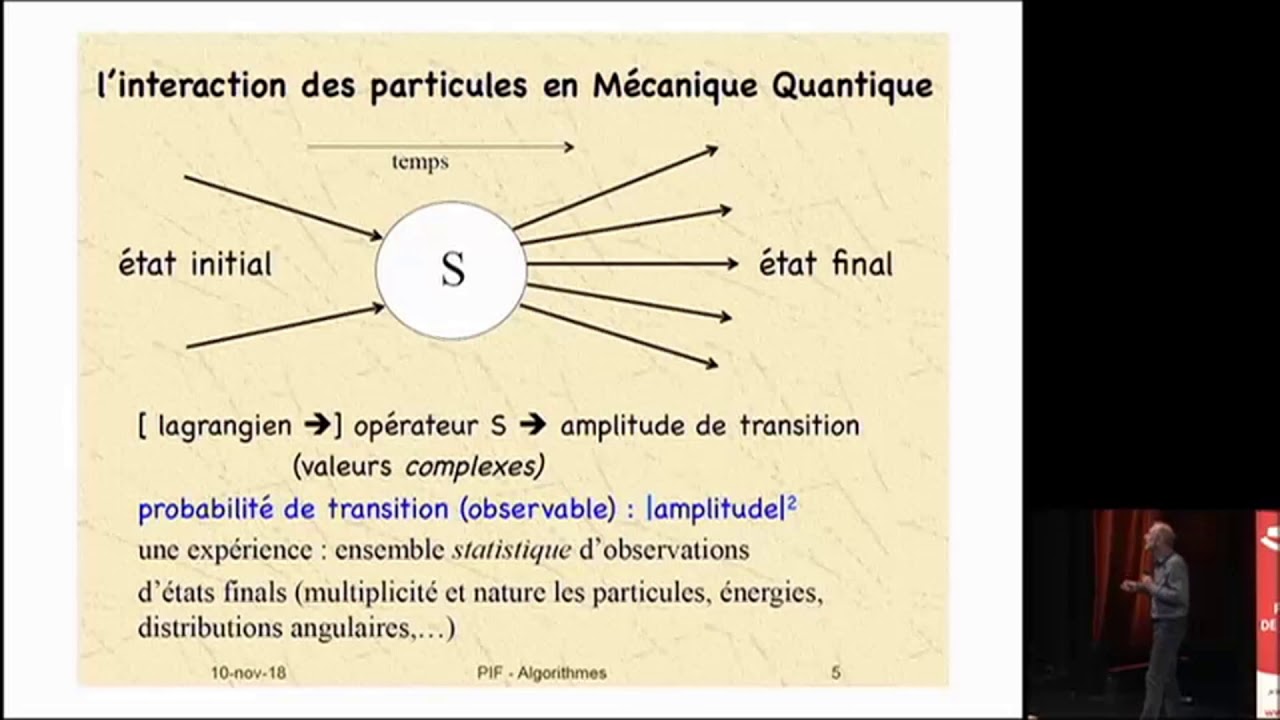
- Theoretical description: quantum mechanics, Standard Model and perturbative expansion.
- Algorithms for event reconstruction in detectors like ATLAS.
- Complementary signatures and confirmation of the Higgs boson.
- Concluding remarks on the role of algorithms and future challenges.
Cited Sources
- Bibliothèque nationale de France — Co-organizer of the PIF conference.
- Société Française de Physique — Co-organizer of the PIF conference.
- Pierre Billoir's institutional profile — Speaker's affiliation and contact.
- Thesis record for Pierre Billoir — Archived thesis information.
Contribution & Novelties
The lecture synthesizes established knowledge on algorithms in particle physics, emphasizing their role in discovery and validation. It offers an accessible explanation of how algorithms convert raw data into physics results, bridging theory and experiment. The talk also highlights the limitations of current methods and the need for future developments.
Pour aller plus loin :
- Higgs boson — Overview of the particle’s discovery and properties.
- Large Hadron Collider — The facility where the experiments are conducted.
- Monte Carlo method — Key technique for simulations in particle physics.
- Event reconstruction — Process of interpreting detector signals.
95 words
Radar Profile
The radar profile shows high fiabilité and qualité information, moderate quantité and niveau technique, indicating a reliable and insightful talk that is more focused on clarity than depth.