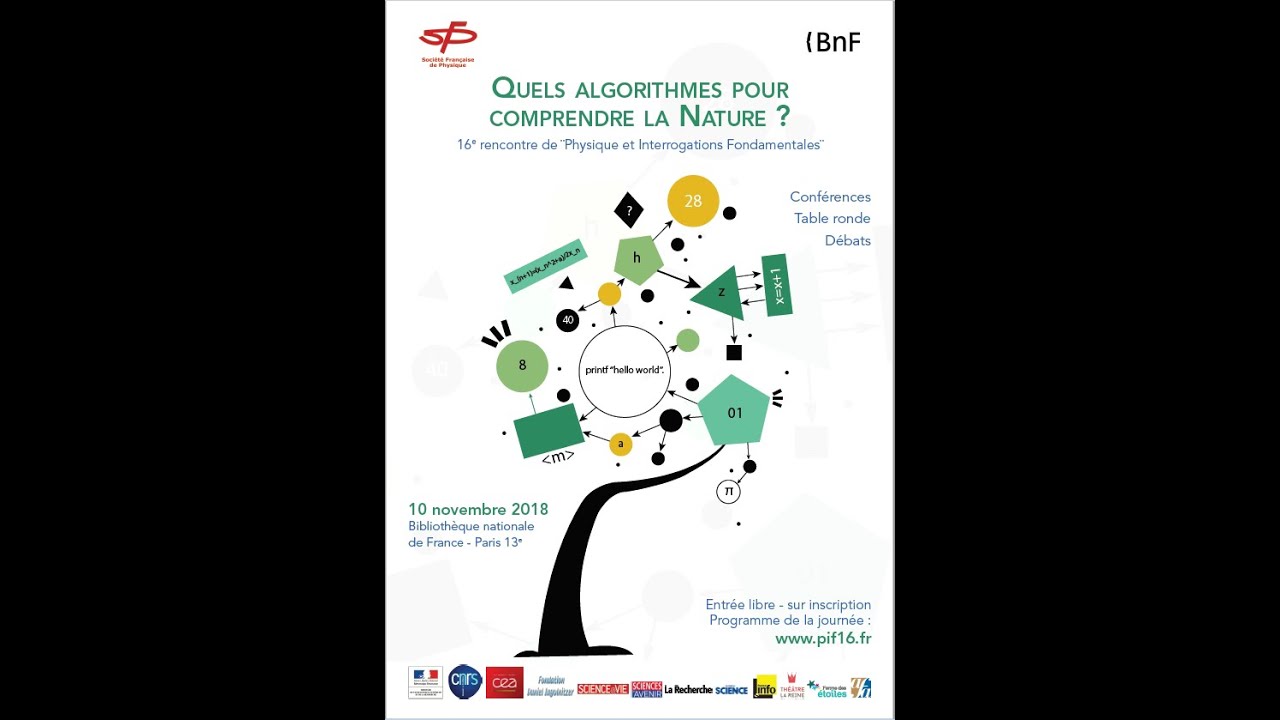
Physique et interrogations fondamentales (PIF): Algorithmes pour comprendre ou pour normer le monde
Physics and Fundamental Questions (PIF): Algorithms to understand or to standardize the world
Keywords
Summary
239 words
Critical Evaluation
Value of the Information & Strength of the Argument
The talk offers a high-value critical perspective on the role of algorithms in science, grounded in the speaker’s deep knowledge of mathematical logic and computation. Longo systematically builds a case against naive reductionism, providing concrete examples from biology (epigenetic splicing, random molecular interactions) and computer science (the discrete vs. continuous distinction). His argumentation is solid and well-structured, progressing from historical foundations to contemporary issues like deep learning and big data. He is careful to acknowledge the utility of algorithms while highlighting their limits, avoiding both techno-futurism and Luddism. The reasoning is rigorous and philosophically informed, although some points are presented more as assertions than as evidence-driven claims, which is typical of an oral conference format.
Scientific Rigor, Source Quality, Title Accuracy
The speaker demonstrates strong scientific rigor by referring to established mathematical results (Turing, Church, Gödel) and to his own collaborations with biologists. He cites the work of Jacques Monod, Alain Berthoz, and others in passing, but does not provide detailed references during the talk. The official description of the video provides links to Giuseppe Longo’s academic pages and to the hosting institutions (BnF, SFP), which enhance credibility. The title is perfectly aligned with the content: the lecture indeed explores whether algorithms help us understand the world or impose norms on it. The speaker makes explicit this tension throughout. The presentation is well-suited for a scientifically literate audience, but the arguments are developed with clarity.
244 words
Title / Content Match
The title accurately reflects the core question addressed: whether algorithms are tools for understanding or tools for normalizing the world. The speaker critically examines both roles throughout the talk.
Quality & Reliability
7/10
The talk is given by a renowned mathematician and philosopher of science, with nuanced arguments and references to established scientific results (Turing, Church, Gödel, etc.). However, it is a point of view, not a peer-reviewed publication, and some claims about biology are presented without systematic citations.
Key Moments
Markers derived by PSI from the transcript: the creator did not define chapters.
- Introduction: algorithms as a new fundamental invariant, origins in mathematical logic in the 1930s.
- Critique of transferring physical invariants to other fields, example of economics and Poincaré's letter.
- DNA is not a program: context-dependent interactions, alternative splicing, stochasticity as functional.
- Comparison between discrete and continuous frameworks for understanding the world; measurement and counting.
- Deep learning as an intelligence tool, but not a model of human perception; limits of image recognition.
- Big data without science: Ramsey theory shows that arbitrary regularities appear; danger of isolating information processing from imagination and emotion.
Cited Sources
- Giuseppe Longo - Wikipedia — Biographical and academic context of the speaker.
- Bibliothèque nationale de France — Hosting institution for the lecture series.
- Giuseppe Longo's page at ENS — Academic homepage with publications and research interests.
- Giuseppe Longo - IEA Nantes — Fellowship and research profile.
- Société Française de Physique — Organizer of the 16th PIF meeting.
- First video of the conference series — Link to the first conference of this edition.
Concurring Sources
- The Emperor's New Mind by Roger Penrose — Penrose argues for non-algorithmic aspects of human understanding, aligning with Longo's criticism of strong AI.
Dissenting Sources
- The Society of Mind by Marvin Minsky — Minsky's computational theory of mind suggests that intelligence can be fully explained by algorithmic processes, in contrast to Longo's emphasis on irreducible stochastic and experiential components.
Contribution & Novelties
The lecture provides an original epistemological synthesis, connecting foundational work in computability theory with contemporary debates on AI and biology. Longo’s key contribution is to emphasize the discontinuity between algorithmic processes and living phenomena, arguing that the stochastic and context-dependent nature of life is not a defect but a source of robustness and diversity. He offers a nuanced perspective on deep learning, neither dismissive nor utopian, and warns against the ideological use of algorithms to normalize thought. This is particularly relevant in the context of big data and the growing trust in ‘data-driven’ science.
Pour aller plus loin :
- Church–Turing thesis — Foundational to understanding the limits of algorithmic computability, central to the talk’s historical introduction.
- Alternative splicing — Biological example illustrating context-dependent gene expression, used by the speaker against the DNA-program metaphor.
- Ramsey theory — Mathematical background for the claim that large datasets inevitably contain arbitrary regularities, limiting the predictive power of big data without theoretical guidance.
158 words
Radar Profile
The radar profile shows a balanced distribution across the four dimensions, with information quality and technicality slightly higher than quantity and reliability, reflecting a dense conceptual lecture rather than an exhaustive survey or hard empirical study.