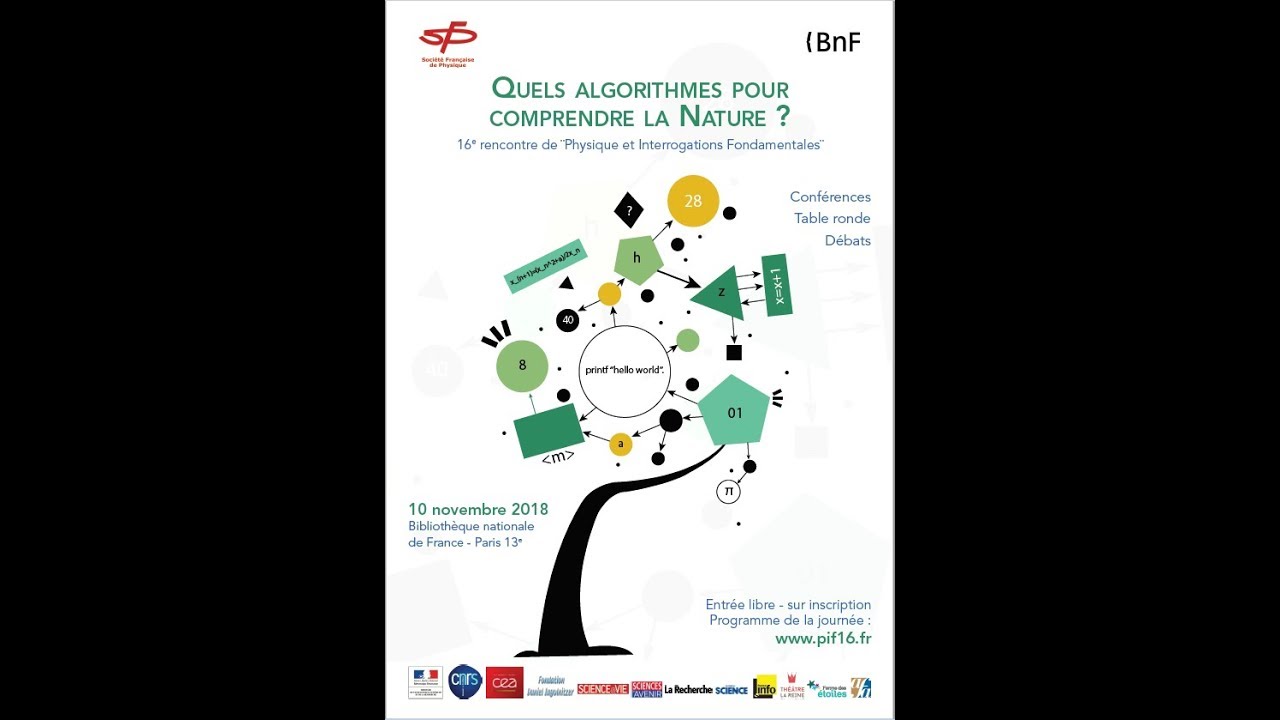
Physique et interrogations fondamentales (PIF): Algorithmes et humains : la rencontre
Physics and Fundamental Questions (PIF): Algorithms and humans: the encounter
Keywords
Summary
96 words
Critical Evaluation
Value of the Information & Strength of the Argument
The talk provides valuable insights by connecting diverse fields through algorithmic thinking. The argumentation is solid, with each example supported by references to specific research and mathematical models. Claire Mathieu clearly demonstrates how nature’s solutions to optimization problems parallel computer science concepts, offering a compelling perspective on the universality of algorithms. The reasoning is logical and well-structured, making complex ideas accessible.
Scientific Rigor, Source Quality, Title Accuracy
The scientific rigor is high, as the speaker is a recognized expert and the examples are drawn from real studies. The sources cited in the description include institutional pages and Wikipedia, which are generally reliable for such contexts. The title adequately reflects the content, although it is broader than the specific examples given. The video is a recording of a live conference, so some minor audio issues may exist, but the substance is credible.
150 words
Title / Content Match
The title accurately reflects the content, which discusses the interaction between algorithms and human understanding, with examples from nature and technology.
Quality & Reliability
7/10
The talk is delivered by a respected mathematician and includes references to scientific studies. The content is accurate but presented in a simplified manner for a general audience.
Key Moments
Markers derived by PSI from the transcript: the creator did not define chapters.
- Introduction by Michel Netzer, director of Sciences and Techniques at the BnF
- Michel Spiro presents the French Physical Society and its missions
- Claire Mathieu begins her lecture on algorithms and nature
- Example of slime mold solving the shortest path problem
- DNA computing and Leonard Adleman's Hamiltonian path experiment
- Bird flocking and Craig Reynolds' boids model
- Detecting emergent communities on Twitter using sampling algorithms
- Graph reconstruction techniques and conclusion
Cited Sources
- Claire Mathieu - Collège de France — Profile of the main speaker, mathematician at Collège de France
- Claire Mathieu's page at DI ENS — Academic home page with research details
- Claire Mathieu - Wikipédia — Biographical reference for the speaker
- Michel Spiro - Société Française de Physique — Official site of the French Physical Society, co-organizer of the event
- Bibliothèque nationale de France — Venue and co-organizer of the PIF conference
- Michel Netzer - data.bnf.fr — Profile of the BnF director of Sciences and Techniques department
External References
Contribution & Novelties
The talk offers a fresh perspective on algorithmic thinking by illustrating that nature itself performs complex computations, from slime mold optimizing paths to DNA encoding solutions. It bridges the gap between theoretical computer science and natural phenomena, emphasizing that algorithms are not merely human inventions but also emergent properties of natural systems. The discussion of Twitter community detection and graph reconstruction provides concrete applications, showing how algorithmic concepts can be harnessed for real-world data analysis.
Pour aller plus loin :
- Physarum polycephalum (slime mold) — Relevant to the slime mold example; describes the organism and its computational abilities.
- DNA computing — Explains the principles behind Adleman’s experiment and molecular computation.
- Boids (Reynolds’ model) — Details the bird flocking simulation and its applications in computer graphics and artificial life.
128 words
Radar Profile
The radar profile shows high scores in information quantity and quality, with moderate technical depth. Reliability is high due to the speaker's expertise. The balance suggests an informative and trustworthy presentation.