PLEINS FEUX SUR LA MATIÈRE NOIRE - Nathalie PALANQUE-DELABROUILLE
SPOTLIGHT ON DARK MATTER - Nathalie PALANQUE-DELABROUILLE
Keywords
Summary
131 words
Critical Evaluation
Value of the Information & Strength of the Argument
The talk provides a comprehensive and well-structured overview of dark matter evidence and detection strategies. The arguments are logically developed, starting from historical observations and building to current experimental challenges. The speaker explicitly acknowledges ambiguities in interpretation (e.g., gamma-ray excess) and the lack of direct detection, demonstrating balanced scientific thinking. She also briefly introduces alternative theories (modified gravity), giving a fair assessment of the field.
Scientific Rigor, Source Quality, Title Accuracy
The speaker is a recognized expert, and the content aligns with established scientific consensus. No specific references are cited in the talk itself, but the conference is sourced from Canal-U, a reputable academic platform. The title accurately reflects the content, which is a survey of dark matter research. The presentation maintains scientific rigor, clearly distinguishing observations from hypotheses, and avoids overstating results.
142 words
Title / Content Match
The title accurately reflects the content: a focused presentation on dark matter, covering evidence and detection efforts.
Quality & Reliability
9/10
The speaker is a senior researcher in cosmology at CEA and spokesperson for the DESI experiment, with the recent Joliot-Curie prize. The presentation is rigorous, covers historical evidence and current research, and clearly distinguishes observed facts from interpretations.
Key Moments
Markers derived by PSI from the transcript: the creator did not define chapters.
- Introduction and presentation of the speaker's background.
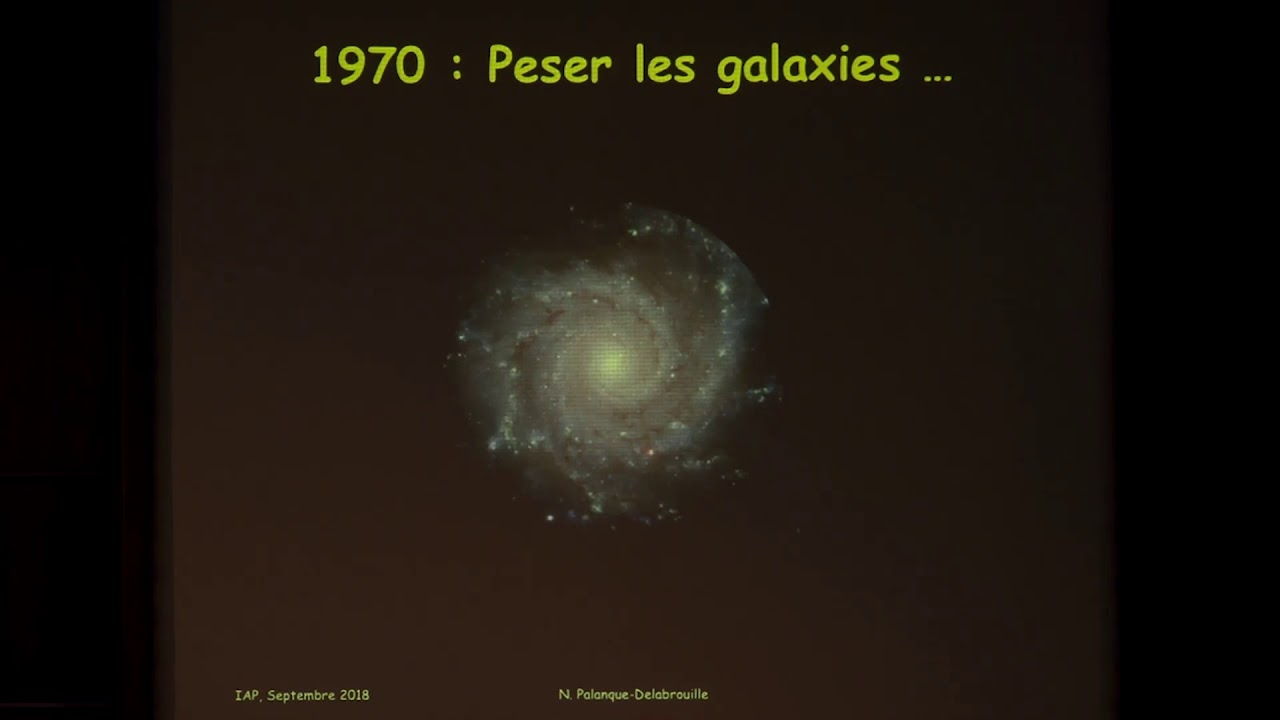
- Historical evidence: Zwicky's work on the Coma cluster and missing mass.
- Vera Rubin's rotation curves and the need for dark matter halos.
- Gravitational lensing and X-ray observations of galaxy clusters.
- Introduction to WIMPs and searches at the LHC.
- Direct detection experiments and the Fermi satellite observations of gamma-ray excess.
- Discussion of alternative interpretations (pulsars) and conclusion.
Cited Sources
- Canal-U — The conference video was originally published on Canal-U, a French academic platform.
Contribution & Novelties
This video offers a clear and accurate synthesis of the current state of dark matter research, accessible to a general audience while maintaining scientific depth. It highlights the multiple independent lines of evidence and the ongoing ambiguity in interpreting gamma-ray signals.
Pour aller plus loin :
- Dark matter - Wikipedia — Provides a broad overview of dark matter evidence and theoretical candidates.
- WIMP - Wikipedia — Details the WIMP hypothesis and experimental searches.
- Fermi Gamma-ray Space Telescope - Wikipedia — Describes the Fermi satellite and its role in indirect dark matter searches.
- Gravitational lensing - Wikipedia — Explains the lensing effect used to map dark matter.
106 words
Radar Profile
The profile shows high scores in information quantity, quality, technical level, and reliability, indicating a well-rounded and authoritative presentation.