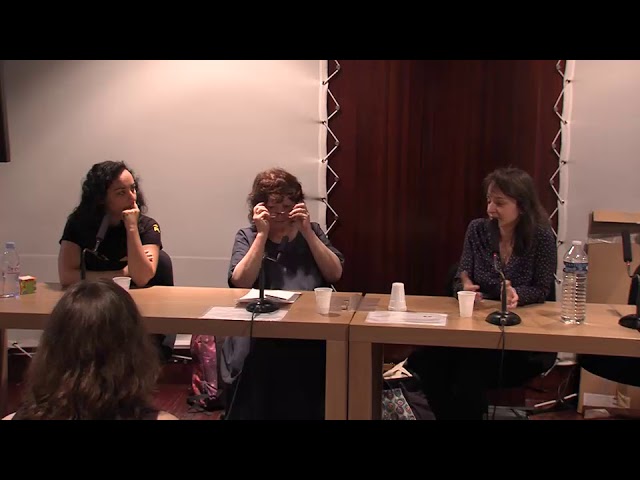
La vulgarisation scientifique 2.0 autour de l'exposition Sciences pour tous, 1850 - 1900
Scientific popularization 2.0 around the exhibition Sciences for all, 1850 - 1900
Keywords
Summary
188 words
Critical Evaluation
Value of the Information & Strength of the Argument
The value of this discussion lies in its authentic, first-person accounts of the challenges and joys of science communication. Both speakers provide concrete examples of how they built their careers, from Montaigne’s use of blogs to test content to Porcel’s insistence on contacting scientists directly. The argumentation is largely anecdotal, but it is persuasive because it is grounded in lived experience. Montaigne notably argues that simplification does not necessarily betray science, provided it is done responsibly, and both women emphasize that scientists are often eager to share their work with a broader audience. The strength of the arguments rests on their practical success stories rather than on rigorous data, but this is a panel discussion, not a research presentation. The logic is coherent: the internet acts as an equalizer, enabling passionate amateurs to become credible interlocutors between science and the public.
Scientific Rigor, Source Quality, Title Accuracy
The discussion does not cite scientific studies, but the speakers reference their own works (e.g., Montaigne’s books and animated series, Porcel’s podcast and books) as well as the CNES and other institutions. The only external source provided in the description is the BnF website, which is relevant to the exhibition’s context. The title accurately describes the topic: both speakers explicitly address the ‘2.0’ dimension via blogs, YouTube, and social media, and the exhibition ‘Sciences pour tous, 1850-1900’ serves as a historical backdrop. The content is consistent with the title, although the historical aspect is only lightly touched upon. No comments are provided, so public reception cannot be assessed.
264 words
Title / Content Match
The title accurately reflects the content, which focuses on science popularization in the digital age, linked to the exhibition.
Quality & Reliability
6/10
The discussion provides authentic insights from practitioners but relies on personal anecdotes and opinions rather than systematic evidence. The factual accuracy is not challenged, but the content is inherently subjective.
Key Moments
Markers derived by PSI from the transcript: the creator did not define chapters.
- Introduction by Christine Goémé, presenting Marion Montaigne and Florence Porcel and the exhibition context.
- Marion Montaigne explains her early passion for biology and how she turned to drawing after feeling discouraged in school.
- Florence Porcel describes her background in performing arts and her self-taught learning of science through books and the internet.
- Discussion on the role of the internet in bypassing editors and testing content, with Montaigne's example of her blog.
- Montaigne explains how she collaborates with scientists, including a visit to the Curie Institute and meeting with Thomas Pesquet.
- Porcel discusses her Twitter fiction about the universe and how CNES contacted her, leading to her partnership with the space agency.
- Both speakers share advice on approaching scientists and emphasize that researchers are often eager to communicate their work.
- Current projects: Montaigne's comic about Thomas Pesquet and Porcel's upcoming book on the solar system adapted from her podcast.
Cited Sources
- Bibliothèque nationale de France — Mentionnée dans la description comme source de la conférence et contexte de l'exposition 'Sciences pour tous, 1850-1900'.
Contribution & Novelties
This video provides an insider perspective on the evolution of science popularization in the digital age, highlighting the importance of personal initiative and the internet as a springboard. The speakers offer original insights into the motivations and methods of contemporary science communicators, especially the role of humor and visual media. While not groundbreaking in scientific terms, it enriches the debate on science outreach with concrete success stories. Pour aller plus loin :
- Science communication on Wikipedia — Pertinent for general context on the field.
- Popular science — Discusses the medium and its evolution.
- YouTube as an educational platform — Relevant to the digital distribution strategies mentioned by the speakers.
109 words
Radar Profile
The radar profile shows moderate scores in quantity and reliability, reflecting the anecdotal nature of the discussion. Quality of information is slightly higher due to the genuine expertise of the speakers. Technical level is low, as expected in a public outreach conversation. The overall shape indicates a balanced but content-rich panel rather than a technical or data-driven presentation.