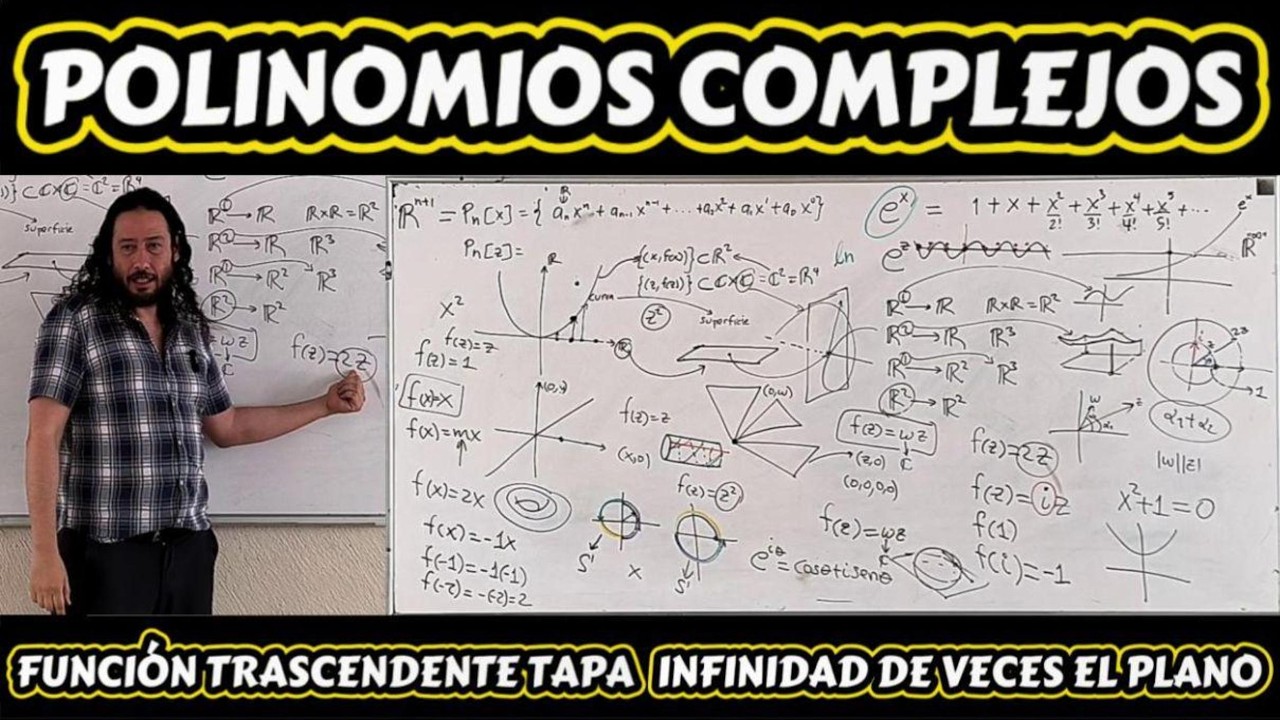
Polinomios Complejos Función trascendente tapa infinidad de veces el plano (Efraín vega landa)
VID 20260904 101649 971
Keywords
Summary
172 words
Critical Evaluation
Value of the Information & Strength of the Argument
The information provided is highly valuable for students of complex analysis, offering a clear geometric intuition that is often missing from standard textbooks. The argumentation is logically sound, building step-by-step from simple linear transformations to the general concept of complex functions. The instructor carefully explains each concept, using visual and physical analogies (e.g., stretching a rubber sheet, rotating a plane) to ground abstract ideas. The reasoning is rigorous and does not rely on hand-waving, making it an effective pedagogical tool.
Scientific Rigor, Source Quality, Title Accuracy
The scientific rigor is high; the lecture is mathematically correct and well-presented. However, no external sources are cited; the content is self-contained, relying on general mathematical knowledge. The title is somewhat misleading within the transcript provided, as the video likely continues to explicitly demonstrate the ‘covering’ property, but the transcript ends before that exposition. The adequacy between title and content is only partial based on the available transcript.
163 words
Title / Content Match
The title suggests a direct exploration of transcendental functions covering the plane infinitely many times, but the provided transcript focuses on building foundational understanding of complex functions and does not fully demonstrate this property. The title is slightly ahead of the content covered.
Quality & Reliability
8/10
The lecture is mathematically sound, well-structured, and presented by an expert educator. The explanations are rigorous and clear, making it a reliable resource for learning complex analysis.
Key Moments
Markers derived by PSI from the transcript: the creator did not define chapters.
- Review of polynomial spaces and counting parameters for degree n.
- Introduction of complex variable z and the hidden complexity in changing from real x.
- Explanation that the graph of a complex function requires four dimensions.
- Demonstration of linear complex functions and their effect on the plane (expansion/contraction).
- Multiplication by i as a rotation of 90 degrees, illustrated with the mapping of 1 to i.
- Solving z²+1=0 in the complex plane, showing that i and -i are solutions.
Contribution & Novelties
The lecture offers a fresh pedagogical perspective by emphasizing the geometric effect of complex functions on the plane rather than their 4D graphs. This approach clarifies the concept of transcendental functions ‘covering’ the plane infinitely many times, which is a central idea in complex analysis. The presentation encourages intuitive understanding through visual analogies, making advanced mathematics more accessible.
Pour aller plus loin :
- Complex analysis — Foundation for understanding analytic functions and their properties.
- Riemann surface — A geometric concept that formalizes how multi-valued functions, like the logarithm, behave on multiple ‘sheets’ covering the plane.
- Picard theorem — A key result about the behavior of entire functions, stating they can omit at most one value, which relates to the covering property discussed.
122 words
Radar Profile
The radar profile shows high scores in quantity and quality of information (8 each), moderate technical level (7), and high reliability (8), indicating a comprehensive and trustworthy lecture that is suitable for advanced undergraduate students.