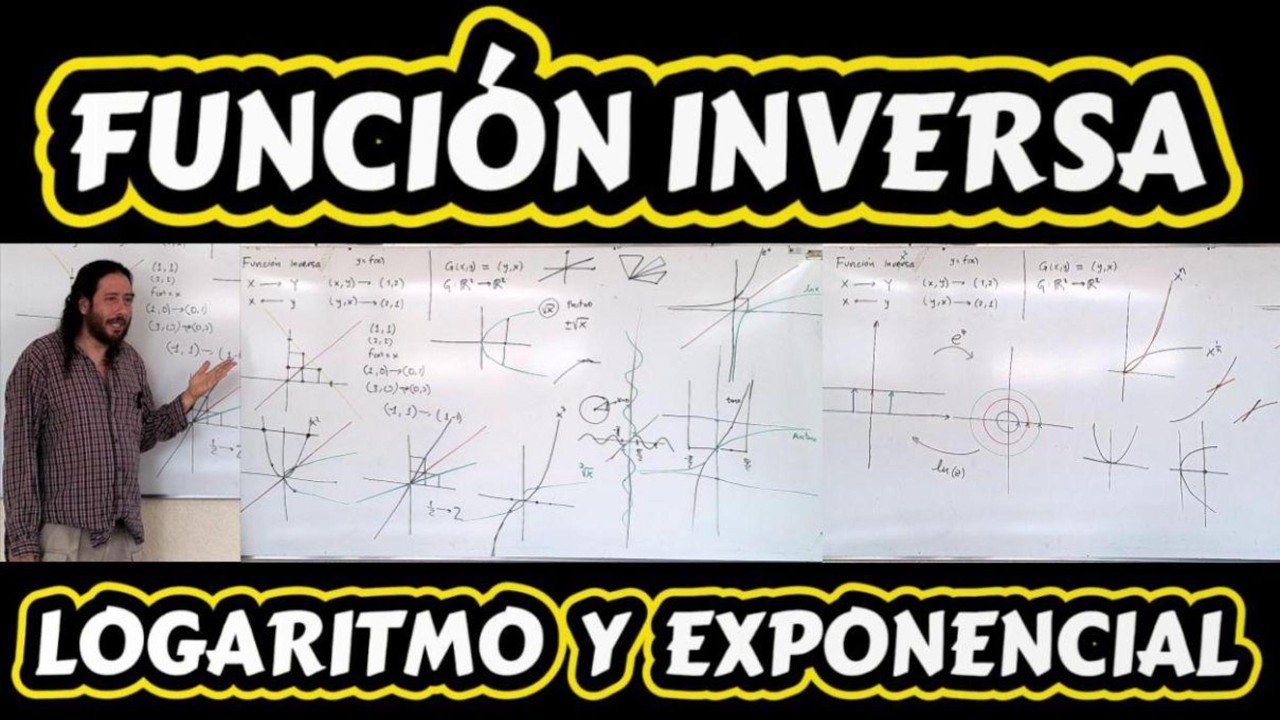
Función Inversa Logaritmo y Exponencial (Efraín Vega Landa)
Inverse Function: Logarithm and Exponential (Efraín Vega Landa)
Keywords
Summary
178 words
Critical Evaluation
Value of the Information & Strength of the Argument
The value of this lecture lies in its pedagogical clarity: it builds inverse functions from intuitive geometric transformations, then systematically derives the conditions for existence. The argumentation is solid, as it carefully tests each example against the definition of a function, distinguishing cases where an inverse exists globally versus after domain restriction. The use of reflections, the role of the identity line, and the interplay between tangent lines and asymptotes (e.g., vertical tangents becoming horizontal) deepen understanding. The instructor connects abstract ideas to visual intuition, making the material accessible yet rigorous.
Scientific Rigor, Source Quality, Title Accuracy
The scientific rigor is high: the lecture adheres to formal definitions of injective, surjective, and bijective functions, and validates each step with geometric reasoning. No external sources are cited, but the mathematical content is self-contained and accurate. The title matches the content well, as the lecture explicitly aims to introduce logarithms and exponentials through inverse functions, though the logarithm itself is only partially reached before the video ends. The lack of citations is typical for a classroom-style lecture, not affecting the reliability of the exposition.
191 words
Title / Content Match
Title accurately reflects content, focusing on inverse functions with explicit treatment of logarithms and exponentials.
Quality & Reliability
8/10
Rigorous mathematical presentation, clear geometric intuition, and a well-structured path from inverse function definition to logarithm as inverse of exponential.
Key Moments
Markers derived by PSI from the transcript: the creator did not define chapters.
- Introduction to inverse functions and the idea of swapping coordinates.
- Reflection across y=x demonstrated with point examples, leading to the identity function.
- Analysis of x² as non-invertible, introduction of injectivity and square root function.
- Discussion of x³ and odd powers being bijective, with their inverses.
- Sine and tangent functions, domain restriction for invertibility, arcosine and arctangent.
Contribution & Novelties
The lecture offers a cohesive geometric framework for understanding inverse functions, using reflection across y=x as a unifying theme. It systematically covers polynomial, trigonometric, and exponential-logarithmic pairs, providing a strong foundation. The ‘Pour aller plus loin’ section suggests further exploration.
Pour aller plus loin :
- Inverse function (Wikipedia) — Classic reference for definitions and properties.
- Logarithm (Wikipedia) — Detailed exposition of logarithms and their properties.
- Exponential function (Wikipedia) — Foundational for understanding the inverse relationship.
75 words
Radar Profile
The radar profile shows strong technical depth and reliability, with balanced quantities of information. The high technical score reflects the advanced mathematical content, while the quality and reliability scores are consistent with a well-explained academic lecture.