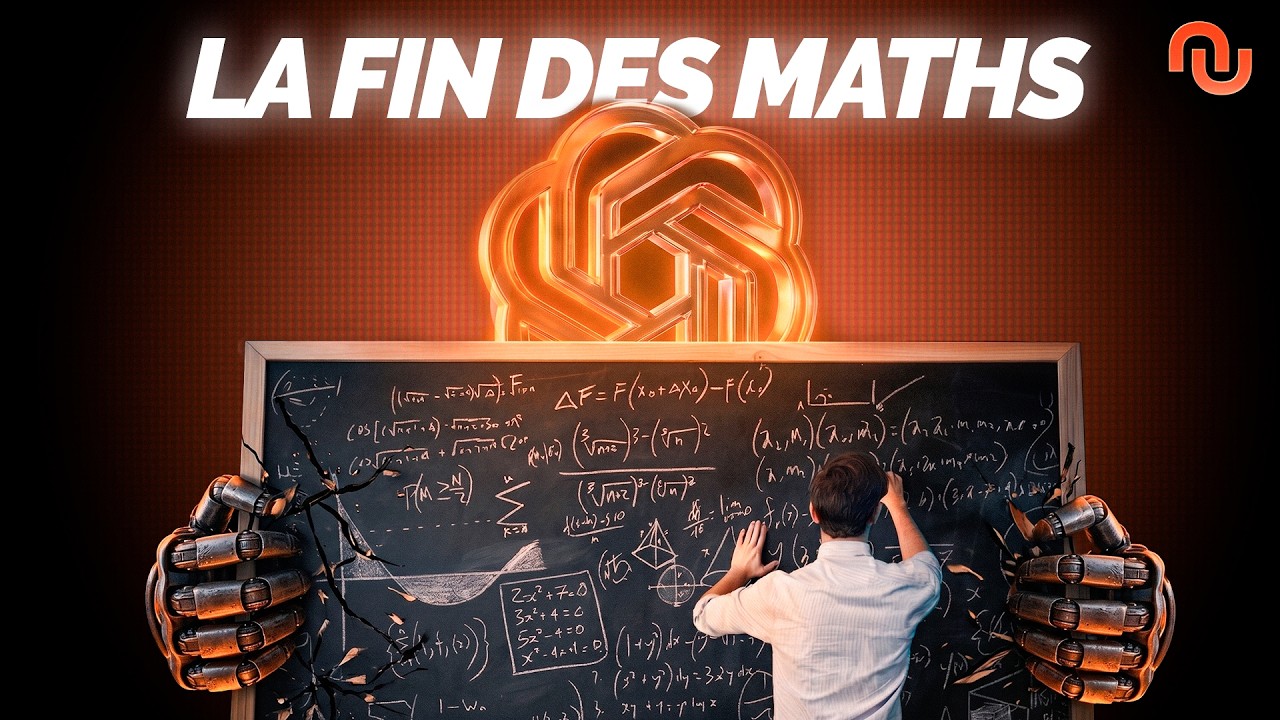
L’IA vient-elle de tuer les mathématiques ?
Did AI just kill mathematics?
Title history
- L’IA vient-elle de tuer les mathématiques ? — observed on 20261031-2304 UTC (YouTube)
Keywords
Summary
138 words
Critical Evaluation
Value of the Information & Strength of the Argument
The video offers valuable insights into the ongoing disruption in mathematics, combining recent news with expert commentary. The argumentation is well-structured: it starts with concrete examples (OpenAI’s 722 results), explains key concepts (proofs, conjectures), and then delves into the societal and professional implications. Hugo Duminil-Copin provides credible perspectives, acknowledging AI’s power while emphasizing the irreplaceable value of human comprehension and the risk of ‘cannibalization’ if AI trains on AI-generated content. The discussion of recognition and funding is particularly relevant, highlighting the mismatch between current evaluation systems and the new reality. However, the video could have been more critical of OpenAI’s motivations, though it does mention marketing aspects. Overall, the reasoning is solid and balanced, even if it leans slightly toward a humanistic defense of the profession.
Scientific Rigor, Source Quality, Title Accuracy
The video relies on interviews with a recognized expert and references recent public announcements from OpenAI, which are factual. It mentions Terence Tao’s ideas and the New York Times report, but without direct citations or URLs. The title is catchy and accurate, reflecting the central theme. The description provides links to Numerama’s general site and social media, but no direct primary sources. While the video clearly distinguishes between facts and opinions, some claims (like the specific number of 10,000 agents) come from OpenAI’s own announcements, which could be biased. The adéquation between title and content is good, though it never definitively answers the question, leaving it open-ended as intended.
250 words
Title / Content Match
The title is engaging and accurately reflects the central question about AI's impact on mathematics.
Quality & Reliability
7/10
The video provides a balanced but slightly optimistic view, featuring a prominent Fields medalist (Hugo Duminil-Copin) and references recent OpenAI announcements. It lacks direct peer review but clearly distinguishes verified facts from opinions.
Chapters
- Plongée dans la vie d'un mathématicien en 2026
- Un mathématicien, c'est quoi ?
- L'IA s'attaque aux maths
- Le vrai but des entreprises d'IA : science ou marketing ?
- Le métier de mathématicien doit évoluer
- Décoder des mathématiques des IA
- Sanctuariser les mathématiques pour les humains ?
- "Faire le deuil" des mathématiques qu'on connaît
- La place des futurs mathématiciens remise en cause ?
- La question du financement de la recherche
- Des règles pour encadrer tout ça
- Des désaccords sur la reconnaissance : le cas OpenAI / Buckmaster
- "Prendre le bateau" ou apprendre à faire ce métier avec l'IA
- Combiner humain et IA pour avancer en recherche
- Est-ce la fin des maths ?
- Bientôt l'IA ira dans d'autres domaines (chimie, physique ...)
Cited Sources
- Numerama website — General source and platform for the video
- Numerama+ — Premium content of the channel
- Numerama Twitch — Live streaming channel
- Numerama YouTube playlists — For more videos by the channel
- Numerama YouTube channel — Main channel link
Contribution & Novelties
The video provides an original synthesis of recent AI developments in mathematics, offering a human perspective through an expert interview. It goes beyond mere reporting by discussing the emotional and career implications for mathematicians, and proposing potential adaptations such as ‘sanctuaries’ for AI-free research. The interview with Hugo Duminil-Copin adds unique insights not commonly found in tech news.
Pour aller plus loin :
- Millennium Prize Problems — Background on the seven problems, including Navier-Stokes and Riemann hypothesis.
- Lean proof assistant — The formal verification tool mentioned in the video as a way to check AI proofs.
- Hugo Duminil-Copin — Information about the interviewed Fields medalist.
- Terence Tao — The mathematician who proposed ‘sanctuaries’ for human-only math.
- OpenAI — Official site for the company’s announcements (though specific papers not linked in video).
131 words
Radar Profile
The radar profile shows a well-rounded video with high quantity of information and reliability, but slightly lower technical depth and moderate novelty, reflecting its focus on societal impact rather than technical detail.
💬 Balanced: Sur les 30 commentaires analysés, le public est partagé entre optimisme sur l'impact de l'IA et inquiétude pour le rôle des mathématiciens, avec quelques critiques sur le manque de diversité des opinions et un débat sur la valeur de la compréhension humaine.