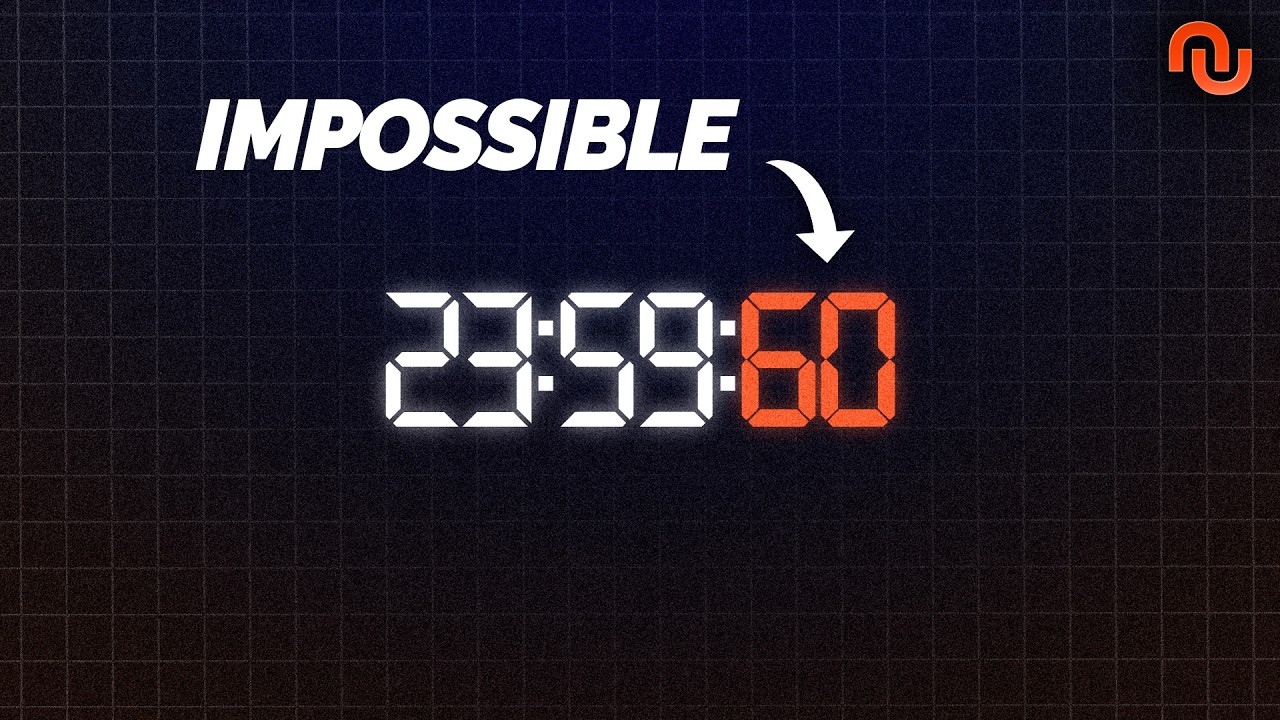
La seconde qui a fait planter Internet
The second that crashed the Internet
Title history
- La seconde qui a fait planter Internet — observed on 20261101-0113 UTC (YouTube)
Keywords
Summary
161 words
Critical Evaluation
Value of the Information & Strength of the Argument
The video provides valuable insights into the often-overlooked complexities of time measurement, blending history, physics, and computer science. Its argumentation is solid, building logically from ancient timekeeping to modern technological challenges. The explanation of leap seconds and the reasoning behind their potential abolition is clear and supported by expert commentary. The use of the 2012 bug as a concrete example effectively illustrates the real-world impact of time irregularities. The video also raises interesting philosophical questions about our relationship with natural time versus technological time, making it thought-provoking beyond mere factual presentation.
Scientific Rigor, Source Quality, Title Accuracy
The video demonstrates strong rigor by consulting a recognized authority, Denis Savoie, and referencing official bodies such as the Bureau des Longitudes and the General Conference on Weights and Measures. While no specific scientific papers are cited, the information aligns with established knowledge about leap seconds and time standards. The title accurately represents the content, focusing on the leap second crash and its broader implications. The video clearly discloses its sponsored segment, which is integrated into the narrative but doesn’t undermine the factual content. Overall, the source quality is good, though it relies primarily on expert opinion and historical facts rather than peer-reviewed literature.
210 words
Title / Content Match
The title accurately reflects the content: the video explains the 2012 leap second bug and the broader context of timekeeping.
Quality & Reliability
8/10
The video is well-researched, features a recognized expert (Denis Savoie, Observatoire de Paris), and covers historical and technical facts accurately. It simplifies complex aspects for a general audience but maintains factual correctness.
Chapters
Cited Sources
- Numerama official website — Channel's main site for articles and further resources.
- Bot or Not game — Mentioned in the sponsored segment as an experiment about AI bots.
- Numerama+ subscription — Channel's premium content offering.
- Numerama Twitch channel — Live streaming platform of the channel.
- Numerama playlists — YouTube playlists organizing channel content.
- Numerama YouTube channel — Main YouTube presence of the channel.
Contribution & Novelties
The video provides an original synthesis of historical timekeeping and modern computing issues, making the leap second controversy accessible to a broad audience. Its novelty lies in linking ancient practices to contemporary digital infrastructure failures, and explaining the 2035 decision to abandon leap seconds. It offers a clear narrative of how nature and technology have become increasingly detached.
Pour aller plus loin :
- Leap second — Background on the definition and history of leap seconds.
- Atomic clock — Explanation of the technology underlying atomic time.
- Coordinated Universal Time (UTC) — Details on the standard time system and its relation to leap seconds.
- Earth’s rotation — Information on why Earth’s rotation is irregular, affecting timekeeping.
114 words
Radar Profile
The radar profile shows a balanced performance with high scores in information quality and reliability, decent quantity and technical level. The video is strong on accurate content and expert backing, while being slightly more modest in depth and technical detail, reflecting its accessible approach.