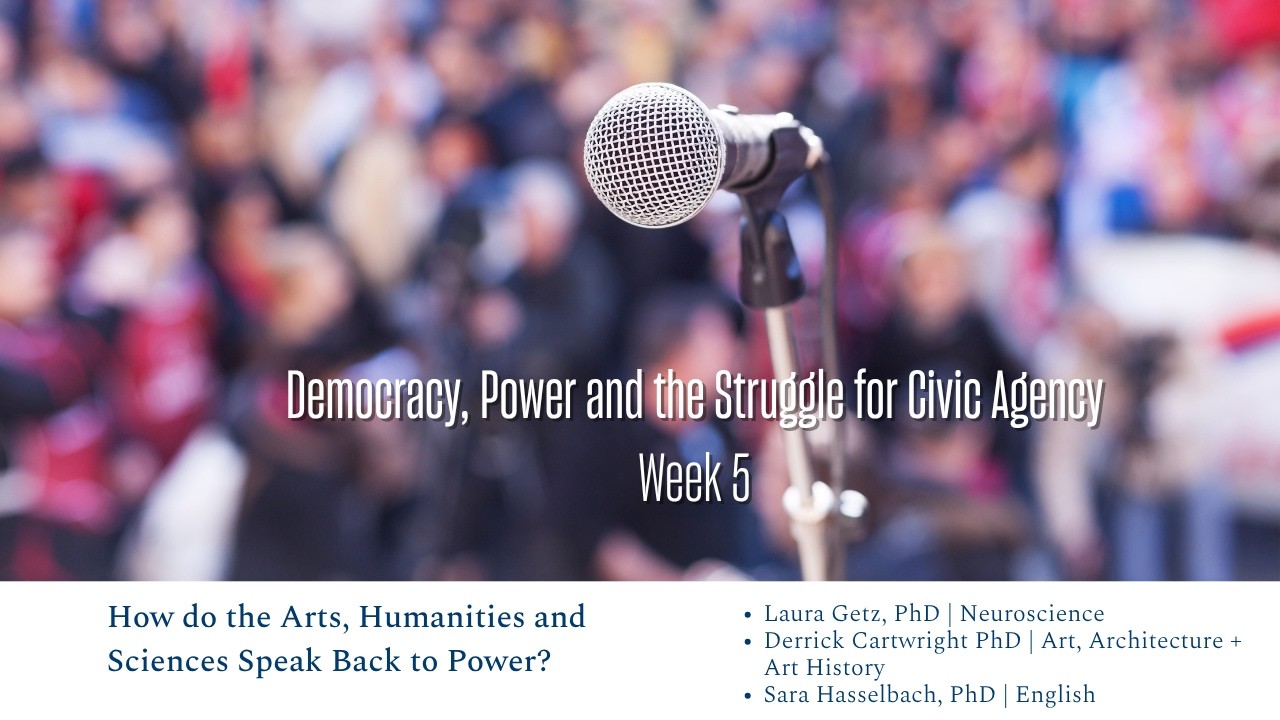
Democracy, Power the Struggle for Civic Agency | Week 5 - How Arts, Humanities, and Sciences Speak
Keywords
Summary
155 words
Critical Evaluation
Value of the Information & Strength of the Argument
The information provided is valuable as it bridges cognitive neuroscience with democratic practice, highlighting how subjective human cognition affects information processing and civic engagement. The argumentation is solid: Dr. Getz builds a case through multiple demonstrations and references to peer-reviewed research, logically progressing from perception to memory to decision-making. She effectively ties these scientific insights to broader societal implications, such as misinformation and the need for critical thinking. The use of interactive elements engages the audience and reinforces the points. The only weakness is the truncated nature of the transcript, limiting the evaluation of the subsequent speakers.
Scientific Rigor, Source Quality, Title Accuracy
The scientific rigor is high for the neuroscience portion: Dr. Getz cites classic studies (Loftus & Palmer, own-race bias) and aligns with established literature on cognitive biases. She correctly represents the findings and acknowledges nuances, such as the dual nature of heuristics. The sources are credible and appropriate for the topic. The title accurately encapsulates the seminar’s purpose, and the content matches the promise of discussing how arts, humanities, and sciences ‘speak back’ to power, though the first speaker focuses on the science side. The production quality is high, with clear references to resources for further learning.
209 words
Title / Content Match
The title accurately reflects the seminar's theme of exploring how arts, humanities, and sciences engage with civic agency and democratic power. The content aligns closely with this framing.
Quality & Reliability
8/10
The content is presented by a cognitive neuroscientist with clear references to established studies (Loftus & Palmer, own-race bias) and a Crash Course video. The presentation is well-structured and scientifically grounded, though limited to the first speaker in the transcript.
Key Moments
Markers derived by PSI from the transcript: the creator did not define chapters.
- Welcome and introduction to the seminar series
- Introduction of the seminar theme and speakers
- Dr. Getz begins her presentation on cognitive neuroscience
- Demonstration of ambiguous figure (13/B) illustrating top-down processing
- Auditory illusion: 'bill' repeated with visual influence
- Discussion of own-race bias in facial recognition
- Apple logo memory experiment revealing reconstructive memory
- Memory distortion demonstrations and Loftus & Palmer study
- Discussion of heuristics and cognitive biases (availability, confirmation)
- Conclusion and introduction to next speaker Derrick Cartwright
Cited Sources
- Loftus and Palmer (1974) study on leading questions and memory — Cited by Dr. Getz to illustrate suggestibility in memory recall
- Crash Course video on cognitive biases (Hank Green) — Referenced for discussion of heuristics and biases, with a quote about understanding bias
Contribution & Novelties
The seminar’s contribution lies in its interdisciplinary approach, connecting cognitive science with democratic theory and civic engagement. Dr. Getz’s talk effectively translates complex neuroscientific findings into practical implications for citizens, emphasizing that understanding our cognitive limitations is the first step toward a more informed democracy. The interactive demonstrations make the concepts tangible.
Pour aller plus loin :
- Cognitive bias — Overview of systematic patterns of deviation from norm or rationality in judgment.
- Own-race bias — Detailed explanation of the tendency to recognize faces of one’s own race more accurately.
- Loftus and Palmer study — Summary of the famous car accident experiment and its implications for eyewitness testimony.
107 words
Radar Profile
The radar profile shows high scores in quality and reliability, moderate to high in quantity and technical level, reflecting a well-presented expert lecture with solid scientific grounding. The lower view count and comment count suggest a niche academic audience.