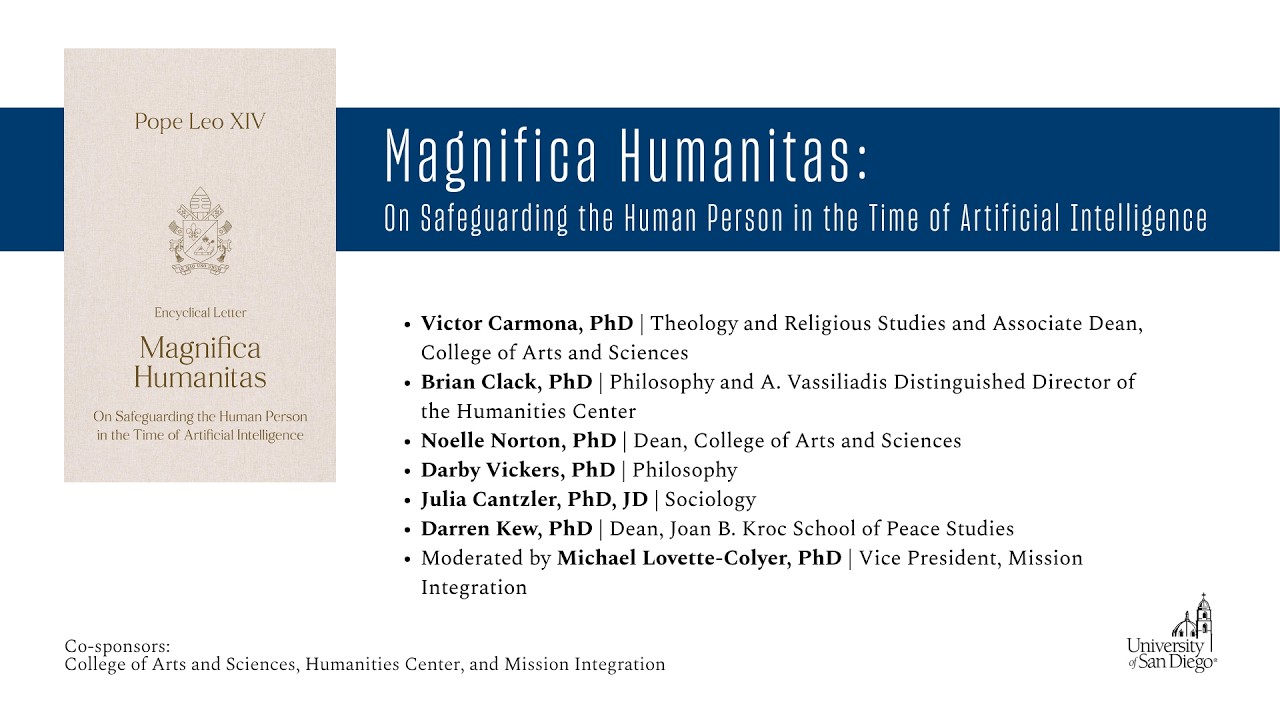
Magnifica Humanitas Forum: On Safeguarding the Human Person in the Time of Artificial Intelligence
Keywords
Summary
177 words
Critical Evaluation
Value of the Information & Strength of the Argument
The value of the information lies in its multidisciplinarity: theology, philosophy, political science, and education perspectives converge to offer a rich and nuanced analysis of the papal encyclical. The argumentation is solid, grounded in the encyclical’s text and theological tradition, while also integrating contemporary concerns about governance, education, and technological ethics. Each speaker builds a coherent case for prioritizing human dignity over efficiency, using biblical narratives (Babel vs. Jerusalem, Nehemiah) to illustrate the stakes. The panel successfully bridges the encyclical’s moral theology with secular political theory, making a compelling argument for democratic oversight and ethical AI development.
Scientific Rigor, Source Quality, Title Accuracy
The rigor is high, as all speakers directly engage with the primary source (the encyclical) and cite specific passages. The panelists’ academic credentials add credibility. The sources cited are the encyclical itself and, implicitly, broader Catholic social teaching; no external sources are needed for this type of commentary. The title is an accurate descriptor of the content; the forum is precisely on safeguarding human dignity in AI, and the discussion remains focused on that theme. No significant discrepancies between title and content were observed, and the discussion adheres faithfully to the encyclical’s framework.
205 words
Title / Content Match
The title accurately describes the content, as the video is a panel discussion on safeguarding human dignity in the context of artificial intelligence, based on the encyclical Magnifica Humanitas.
Quality & Reliability
8/10
The panel consists of established academics in theology, philosophy, political science, and sociology, providing a multidisciplinary and credible interpretation of the papal encyclical, anchored in Catholic social teaching and political theory.
Key Moments
Markers derived by PSI from the transcript: the creator did not define chapters.
- Welcome and introduction by Michael Lovette-Collier framing the event.
- Victor Carmona begins his talk on the choice between Babel and rebuilding Jerusalem.
- Brian Clack discusses education, contrasting fast information with patient wisdom.
- Noel Norton addresses governance, human rights, and the threats of AI to democracy.
- Darby Vickers shares personal experience with AI and underscores the choice to enhance human cognition.
- Q&A session begins with audience questions.
Cited Sources
- Pope Leo XIV, Encyclical Letter Magnifica Humanitas — The primary source discussed throughout the panel; speakers quote passages on education, governance, and human dignity.
Contribution & Novelties
The panel offers a unique interdisciplinary reading of a recent papal encyclical, highlighting its practical implications for AI governance, education, and ethics. It synthesizes theological, political, and personal perspectives, providing a model for how religious and secular reasoning can inform public debate on technology. The discussion encourages a shift from simply asking ‘how can we use AI?’ to ‘when should we not use it?’.
Pour aller plus loin :
- Catholic social teaching — Provides the broader doctrinal context that underpins the encyclical.
- Artificial intelligence ethics — Covers current ethical debates and frameworks relevant to the panel’s discussion.
- Human dignity — Explores the philosophical and theological concept central to the encyclical and the panelists’ arguments.
114 words
Radar Profile
The profile shows high scores in quantity and quality of information, with a moderate technical level, reflecting an accessible yet substantive academic discussion. Reliability is strong due to expert speakers and a clear primary source. The radar would be elongated along the quantity and reliability axes, indicating a well-founded and informative presentation with moderate technical depth.