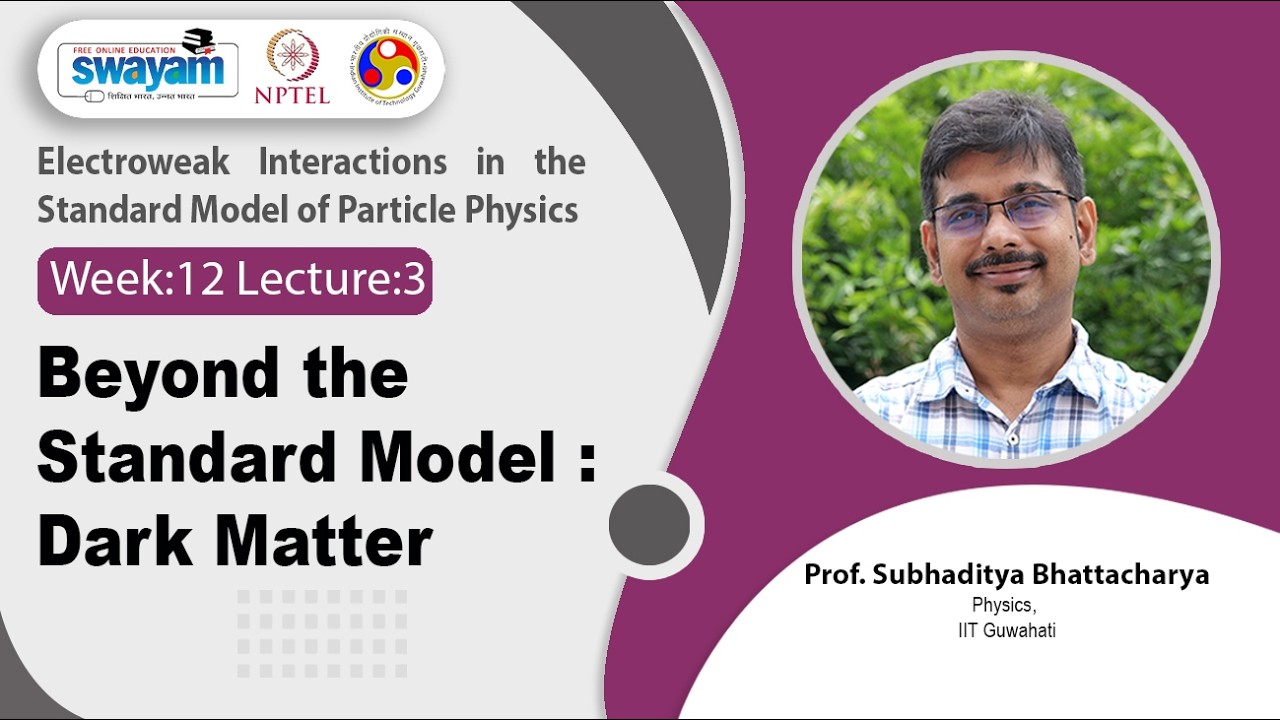
Lec 59: Beyond the Standard Model : Dark Matter
Keywords
Summary
199 words
Critical Evaluation
Value of the Information & Strength of the Argument
The video provides a rigorous and pedagogical treatment of dark matter physics. It establishes a solid argumentation by sequentially linking observations to theoretical model building, then to predictions. The inclusion of a concrete scalar dark matter model and the derivation of its relic density via the Boltzmann equation demonstrate a clear logical structure. The value lies in its accessibility for graduate students, connecting astrophysical data with particle physics formalism. The explanation of the WIMP miracle and the resonance phenomenon is particularly illuminating. The lecture does not shy away from the current lack of experimental detection, presenting it as a motivation for further research.
Scientific Rigor, Source Quality, Title Accuracy
The scientific rigor is high, as the content is based on established facts (rotation curves, CMB data) and standard theoretical frameworks (Z2 symmetry, Boltzmann equation). The lecturer is a professor at a reputable institution, and the course material is part of NPTEL’s formal curriculum. The sources referenced are implicit (Vera Rubin, Lambda-CDM model) and are discussed without explicit citations, but the information is consistent with known literature. The title perfectly matches the content, delivering exactly what it promises. The description provides links to the course and playlist, which are useful for context. Overall, the lecture demonstrates rigorous scientific methodology and source reliability appropriate for an academic setting.
225 words
Title / Content Match
The title exactly matches the content, which discusses dark matter as a topic beyond the Standard Model.
Quality & Reliability
9/10
The lecture is delivered by a professor of physics at IIT Guwahati, based on established particle physics and cosmology, and clearly explains both evidence and model construction.
Key Moments
Markers derived by PSI from the transcript: the creator did not define chapters.
- Introduction to the course and the topic of dark matter beyond the Standard Model.
- Galaxy rotation curve evidence and Vera Rubin's observations showing flat velocities.
- Cosmic microwave background anisotropies and the energy budget of the universe.
- Construction of a simple scalar dark matter model with Z2 symmetry and Higgs coupling.
- Derivation of freeze-out via Boltzmann equation and the WIMP cross-section requirement.
- Resonance behavior in parameter space and concluding remarks on current searches.
Cited Sources
- NPTEL Course: Electroweak Interactions in the Standard Model of Particle Physics — Course homepage for this lecture series.
- Playlist of NPTEL IIT Guwahati Standard Model Lectures — Full playlist containing this lecture.
Contribution & Novelties
This lecture provides a clear, step-by-step illustration of how a minimal scalar dark matter model is constructed and how it connects to cosmological observations. It effectively demonstrates the freeze-out mechanism and the WIMP paradigm, making advanced concepts accessible. The originality lies in its synthesis of astrophysical evidence and particle physics model building within a single pedagogical framework.
Pour aller plus loin :
- WIMP — Candidat privilégié pour la matière noire, lié à la densité relique.
- Dark matter — Vue d’ensemble des preuves et des modèles théoriques.
- Cosmic microwave background — Source clé des contraintes observationnelles sur la matière noire.
- Boltzmann equation — Équation fondamentale pour décrire le freeze-out des particules.
110 words
Radar Profile
Le profil radar montre un équilibre entre haute qualité et haute technicité, avec une fiabilité élevée. La quantité d'information est légèrement inférieure, mais le contenu reste dense et bien structuré. La performance globale est très satisfaisante pour un cours de niveau avancé.