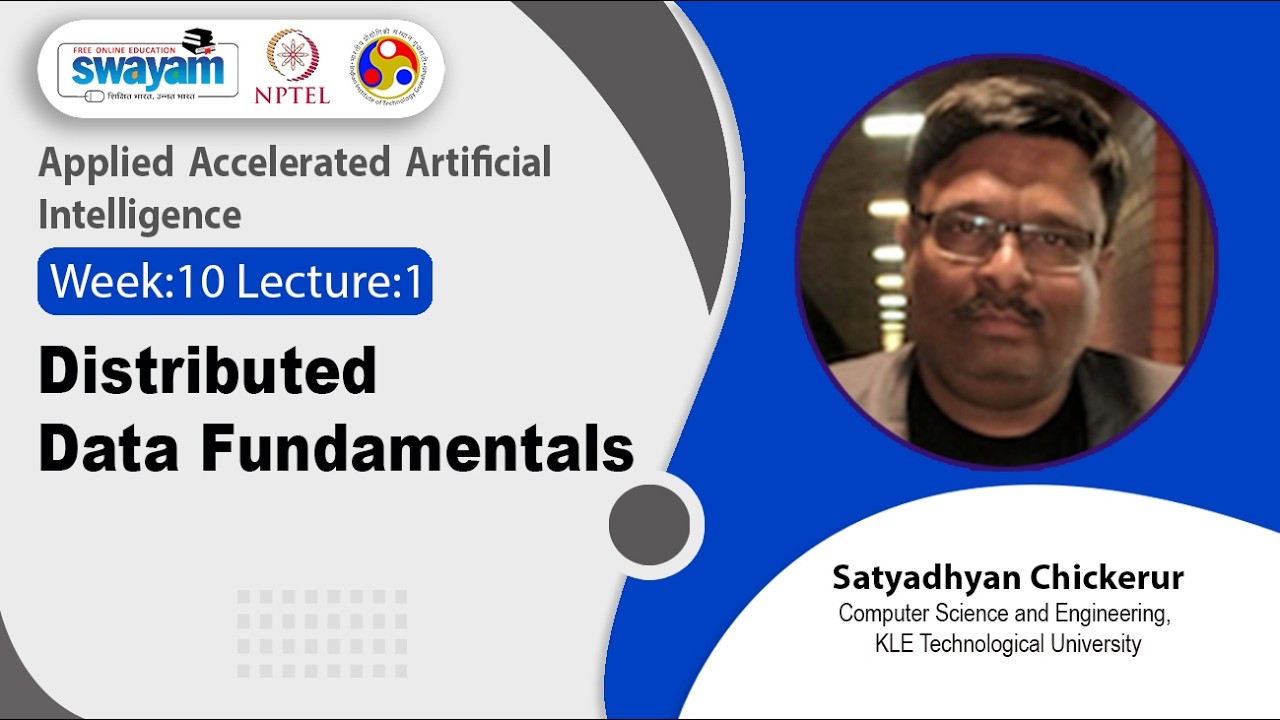
Lec 44: Distributed Data Fundamentals
Keywords
Summary
229 words
Critical Evaluation
Value of the Information & Strength of the Argument
The lecture provides a solid, well-structured synthesis of distributed data fundamentals, connecting prior course topics to practical data processing tools like Spark and Dask. The argumentation is clear and logical, walking through definitions, examples, and strategies. It effectively explains why partitioning and lazy evaluation are critical, and it demystifies shuffle and fault tolerance with concrete scenarios. The value lies in its integrative nature, offering a mental model for approaching distributed data problems. However, it remains at a conceptual level, avoiding deep technical details, which is suitable for a consolidation lecture but not for practitioners seeking implementation specifics. The reasoning is sound and avoids unsupported claims, though it does not introduce novel ideas beyond standard practice.
Scientific Rigor, Source Quality, Title Accuracy
The lecture is rigorous in its pedagogical approach, based on accepted concepts in distributed computing. It does not cite external sources beyond the course materials, but it correctly references tools like Spark, Dask, and concepts like lineage. The title ‘Distributed Data Fundamentals’ is accurate, as the content covers essential building blocks. The delivery is consistent with academic standards of the institution, though the lack of citations to external literature is notable. There is no observed bias or misinformation. The title fully matches the scope and content of the lecture.
219 words
Title / Content Match
The title accurately reflects the content, which discusses fundamental concepts of distributed data processing.
Quality & Reliability
7/10
The lecture is delivered by faculty from IIT Guwahati as part of an NPTEL course, ensuring academic rigor. It covers established concepts in distributed data processing without citing external sources, but the content aligns with standard practice.
Key Moments
Markers derived by PSI from the transcript: the creator did not define chapters.
- Introduction to the lecture and overview of previous topics.
- Definition of key terms: partition, worker, DAG, lazy evaluation, shuffle, lineage.
- Partitioning strategies explained: row range, hash key, range key, with telephone directory example.
- Comparison of lazy evaluation (Spark/Dask) vs. eager execution (pandas).
- Shuffle cost and techniques to minimize it (broadcast, pre-filtering).
- Fault tolerance via lineage: worker failure recovery example.
- Choosing partition strategy based on use case (hash for group-by, range for date, etc.).
- Common mistakes and concluding remarks.
Cited Sources
- Applied Accelerated Artificial Intelligence - NPTEL course — Official course page for this lecture series.
- Course playlist — Playlist containing this lecture and related sessions.
Concurring Sources
- Applied Accelerated Artificial Intelligence - NPTEL course — Course page confirming the academic context of the lecture.
- Course playlist — Playlist of lectures in the same course series.
Contribution & Novelties
This lecture’s originality lies in its role as a conceptual consolidator, linking practical tools (Kubernetes, containers) to distributed data processing frameworks (Spark, Dask). It offers a clear decision framework for partitioning strategies based on query patterns, and stresses the importance of lazy evaluation and lineage-based fault tolerance. It does not introduce new algorithms but serves as a roadmap for applying learned skills in real-world ETL pipelines.
Pour aller plus loin :
- Apache Spark — The leading distributed data processing engine, directly relevant to the lecture’s discussion of lazy evaluation and shuffles.
- Dask — A Python-based parallel computing library that provides distributed data structures similar to Spark, useful for comparison.
- Spark RDD Lineage — Official documentation explaining lineage-based fault tolerance, a key concept covered in the lecture.
126 words
Radar Profile
The profile shows balanced scores, with particularly high scores in information quantity and quality, reflecting a dense but clear presentation. Technical level and overall reliability are moderate, as expected for a conceptual lecture without deep implementation details.