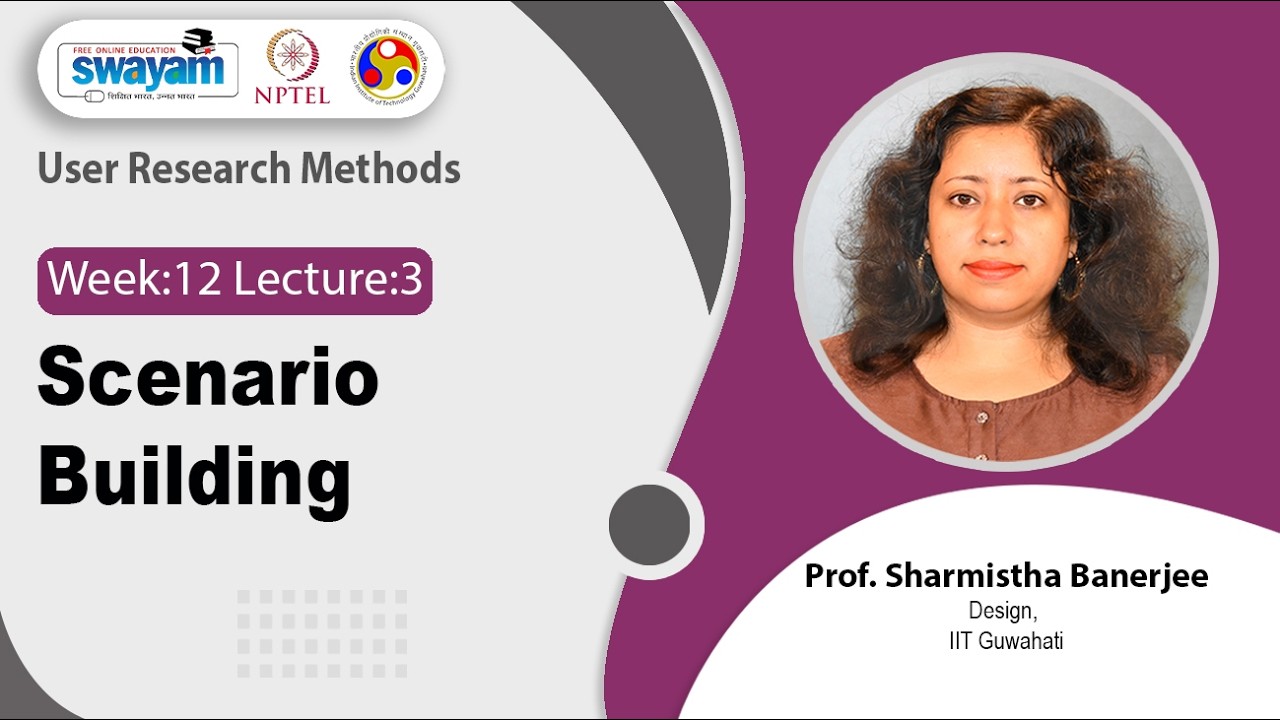
Lec 60: Scenario Building
Keywords
Summary
175 words
Critical Evaluation
Value of the Information & Strength of the Argument
The value of this lecture lies in its clear, structured framework for scenario building, directly applicable to user-centered design practice. It provides a systematic anatomy (motivator, intent, action, benefit) and distinguishes four scenario types with specific purposes, enabling designers to cover different aspects of user experience. The argumentation is solid, consistently linking techniques back to empirical user research data, and using concrete examples (e.g., Adam’s watch, Carmen’s setup) to illustrate principles. The lecture convincingly argues that data-driven scenarios are testable and actionable, while offering practical writing guidelines that enhance realism and utility. It also addresses the importance of emotional and social context, which is often overlooked, thereby strengthening the design rationale.
Scientific Rigor, Source Quality, Title Accuracy
The scientific rigor is high for an educational presentation: the lecturer is an academic from IIT Guwahati, and the content aligns with established scenario-based design literature, notably referencing Carroll’s work on scenario-based design. The NPTEL platform is a government-backed educational initiative, adding credibility. The sources explicitly mentioned include the course page and playlist, both from NPTEL, and a book reference (Making Use: Scenario-Based Design of Human-Computer Interactions) without a URL. The title ‘Scenario Building’ precisely matches the content, which deals exclusively with constructing scenarios in user research. No comments were provided, so no public feedback analysis is possible.
224 words
Title / Content Match
The title accurately reflects the lecture's focus on building scenarios in user research, covering definition, types, anatomy, and writing practices.
Quality & Reliability
8/10
Content produced by a reputable institution (IIT Guwahati) and delivered by an academic expert. The lecture is structured, evidence-based, and grounded in established scenario-based design methods. It emphasizes data-driven construction of scenarios and provides concrete examples and practical guidelines. No evident bias or unverified claims, though it remains a teaching resource rather than peer-reviewed literature.
Key Moments
Markers derived by PSI from the transcript: the creator did not define chapters.
- Introduction to scenarios in user research and their importance
- Explanation of the anatomy of a scenario: motivator, intent, action, benefit
- Presentation of four scenario types: current state, goal-driven, edge case, failure
- Writing practices: specificity, emotional resonance, context, realistic dialogue
- Key takeaways and walkthroughs, references, and transition to journey mapping
Cited Sources
- NPTEL Course: User Research Methods — The lecture is part of this NPTEL course offered by IIT Guwahati.
- Playlist: User Research Methods — Full playlist containing this lecture and related content.
- Making Use: Scenario-Based Design of Human-Computer Interactions — Reference mentioned in the lecture for further reading on scenario-based design.
Contribution & Novelties
This lecture provides a practical, structured methodology for transforming user research data into actionable design scenarios. Its value lies in the explicit four-component structure and the taxonomy of scenario types, which clarifies how to use scenarios strategically in design. The emphasis on grounding each scenario in real observations, including emotional and social context, is a notable strength. For further exploration, one can delve into scenario-based design theory, persona development, and user research methods.
Pour aller plus loin :
- Scenario-based design — Foundational concept underlying the lecture’s approach, useful for understanding its theoretical basis.
- Persona (user experience) — Personas are the protagonists of scenarios; learning about their creation and use complements this lecture.
- User research — Broader context of the research methods that feed into scenario building, including interviews and observations.
130 words
Radar Profile
The radar profile shows relatively high quality and reliability (8/10) with moderate quantity and technical depth (7 and 6). This indicates a well-produced educational resource that is rich in practical guidance but not extremely dense or highly technical. The overall balance suggests a solid lecture for practitioners seeking applied knowledge.