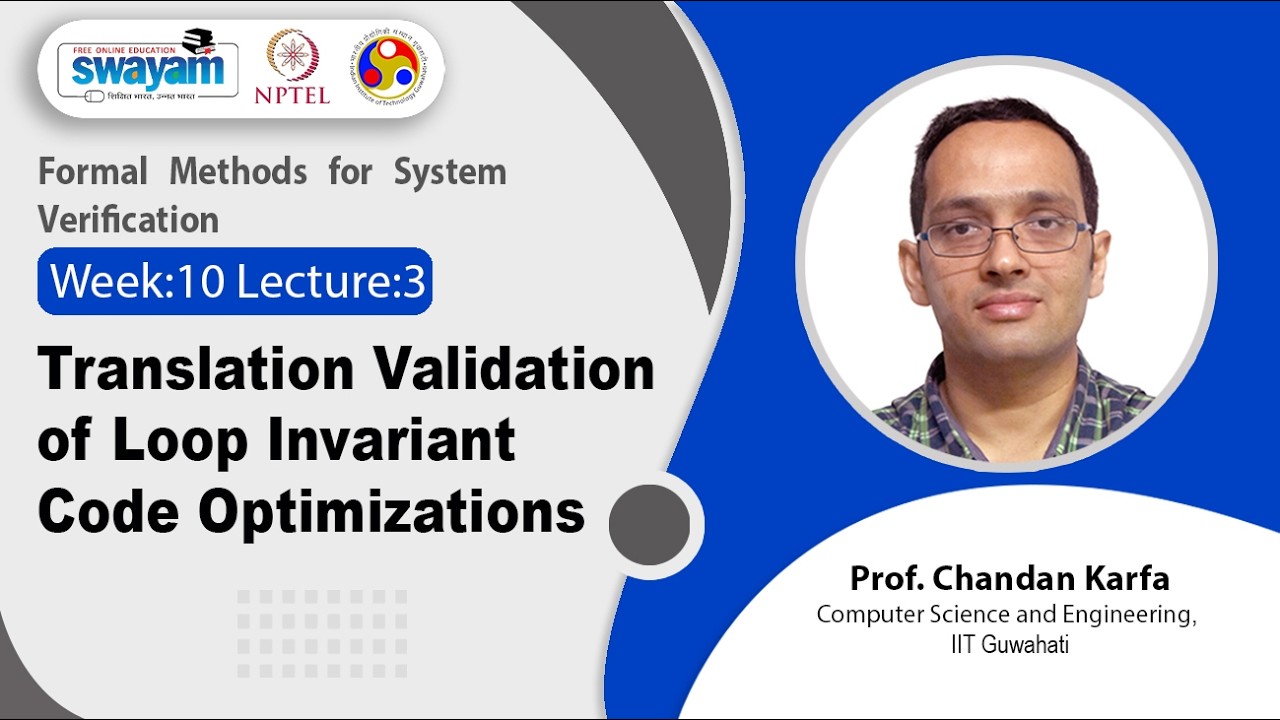
Lec 45: Translation Validation of Loop Invariant Code Optimizations
Keywords
Summary
143 words
Critical Evaluation
Value of the Information & Strength of the Argument
The value of the information is high because it presents a rigorous theoretical method for an important problem in compiler correctness. The argumentation is systematic: it first identifies a limitation of the existing method, then proposes an extension, and demonstrates it on a concrete example. The instructor explicitly explains the intuition behind value propagation and illustrates the mechanics with symbolic execution. The reasoning is clear and well-structured, building incrementally from previous lectures. While the lecture does not include formal proofs, it provides a convincing logical explanation and references to published work, which strengthens the argument.
Scientific Rigor, Source Quality, Title Accuracy
The scientific rigor is strong: the instructor is a recognized researcher in the field, and the method is rooted in established formal verification techniques. He cites his own previous papers and points to follow-up work, though he does not give explicit URLs or titles. The title is perfectly adequate, as the entire lecture is dedicated to translation validation of loop invariant code optimizations. No comments are provided for analysis, so public reception cannot be assessed.
185 words
Title / Content Match
The title precisely reflects the content, which focuses on applying translation validation to verify loop invariant code optimizations.
Quality & Reliability
9/10
The lecture is given by an IIT professor, presenting a well-established formal method with clear examples and rigorous reasoning. The content is consistent with academic literature on formal verification.
Key Moments
Markers derived by PSI from the transcript: the creator did not define chapters.
- Recap of previous lecture: need for translation validation and FSMD-based equivalence checking.
- Explanation of cut-point method and path cover, with by-simulation approach.
- Example of handling code motion within branches using the existing method.
- Identification of limitation: method cannot handle code motion across loops.
- Introduction to value propagation concept to overcome the limitation.
- Detailed explanation of value propagation with symbolic values and matching variables.
- Example of loop invariant code motion and how value propagation verifies it.
Cited Sources
- Formal Methods for System Verification - Course page — Official course page for the lecture series.
- NPTEL IIT Guwahati - Formal Methods Playlist — Playlist containing this lecture and related sessions.
Contribution & Novelties
The lecture presents an extension of existing FSMD-based equivalence checking to handle loop invariant code motion. The key contribution is the value propagation method, which allows mismatched variable values to be passed to subsequent paths, enabling verification across loops. This goes beyond the previous cut-point method that was limited to code motions within a loop. The lecture also situates the method within the broader literature, referencing the instructor’s earlier work and subsequent extensions.
Pour aller plus loin :
- Formal verification — Foundational concept for ensuring system correctness.
- Loop invariant code motion — The compiler optimization class addressed in the lecture.
- Bisimulation — A related equivalence notion used in the by-simulation approach.
- Compiler optimization — Context for transformation validation.
118 words
Radar Profile
The profile is balanced with high scores across all dimensions, reflecting a technically demanding yet well-explained academic lecture. The quantity of information is substantial for a 34-minute talk, and the quality and reliability are top-notch due to the expert presenter and rigorous methodology.