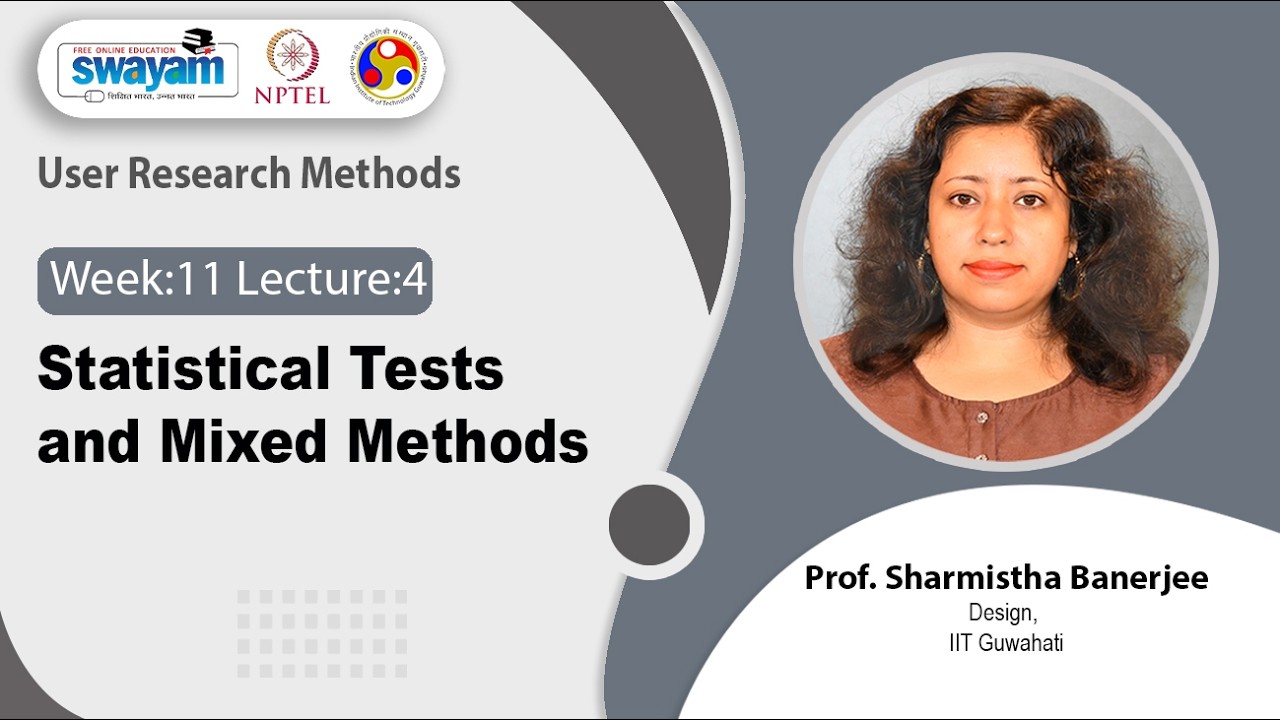
Lec 55: Statistical Tests and Mixed Methods
Keywords
Summary
185 words
Critical Evaluation
Value of the Information & Strength of the Argument
The lecture provides high value by offering a practical, step-by-step decision path for selecting statistical tests, a topic often confusing for researchers. It effectively argues for integrating effect sizes and confidence intervals to move beyond dichotomous thinking about p-values, and makes a compelling case for mixed methods, showing how qualitative and quantitative strands complement each other. The argumentation is solid, grounded in established statistical conventions and well-known frameworks like Lincoln and Guba’s criteria. The emphasis on designing studies with adequate power and on honest reporting (e.g., not hiding failed tests) strengthens the overall credibility.
Scientific Rigor, Source Quality, Title Accuracy
The lecture demonstrates high scientific rigor by accurately presenting statistical concepts, including the central limit theorem, assumptions of parametric tests, and the rationale for non-parametric alternatives. It correctly warns against common pitfalls like multiple t-tests without correction and emphasizes the primacy of study design in ensuring valid results. The sources, though not explicitly cited in the talk, are implied through the course materials; the lecture aligns with standard textbooks and statistical practices. The title matches the content precisely, as both statistical tests and mixed methods are thoroughly covered. No external sources are referenced directly, but the content is consistent with academic standards.
211 words
Title / Content Match
The title accurately reflects the content, as the lecture covers both statistical test selection and the integration of mixed methods, with emphasis on effect sizes and power.
Quality & Reliability
9/10
The lecture is delivered by a professor at IIT Guwahati, an accredited and reputable institution. It provides accurate, well-structured content on statistical test selection, effect sizes, power analysis, and mixed methods, adhering to established scientific standards. The presentation is clear and methodical, with practical examples and appropriate caveats.
Key Moments
Markers derived by PSI from the transcript: the creator did not define chapters.
- Introduction and learning outcomes: selecting appropriate tests, reporting effect sizes, and integrating mixed methods.
- Review of previous lectures on data preparation and descriptive statistics.
- Decision path for choosing statistical tests: comparison vs. association, paired vs. independent, number of groups, and scale of outcome.
- Explanation of paired vs. independent designs and their impact on statistical power.
- Assumptions of parametric tests: normality, equal variance, and independence; default to Welch's t-test and respect design independence.
- Non-parametric fallbacks: Mann-Whitney U, Wilcoxon sign-rank, Kruskal-Wallis, Fisher's exact; when to use them.
- Effect sizes and p-value limitations; importance of confidence intervals.
- Power analysis and sample size planning; rule of thumb 64 participants per group.
- Introduction to mixed methods research designs: convergent, explanatory sequential, exploratory sequential, and embedded.
- Qualitative rigor: saturation and Lincoln and Guba's four trustworthiness criteria.
- Key takeaways and conclusion.
Cited Sources
- Course Preview: User Research Methods — Official course page providing details about the User Research Methods course.
- Playlist: User Research Methods — YouTube playlist containing all lectures of the course, including the current one.
Contribution & Novelties
This lecture provides a comprehensive, decision-oriented overview of statistical testing and mixed methods, synthesizing often fragmented knowledge into a coherent process. Its original value lies in the explicit pairing of statistical effect size and power analysis with qualitative trustworthiness criteria, offering a unified framework for user research. The lecturer’s emphasis on designing studies with adequate power and on treating divergence from mixed methods as a productive finding is particularly instructive.
Pour aller plus loin :
- Statistical hypothesis testing — Foundational concepts for the tests discussed.
- Effect size — Measures of magnitude beyond p-values.
- Power (statistics) — Understanding statistical power and its role in sample size planning.
- Mixed-methods research — Overview of designs and integration strategies.
115 words
Radar Profile
The radar profile is balanced, with high scores in reliability and quality, reflecting the academic rigor and clear presentation. The technical level is moderate, indicating that the content is accessible to a broad audience while still covering advanced concepts. The overall profile suggests a trustworthy and informative lecture.